Elementary Rate Laws - Unimolecular, Bimolecular and Termolecular Reactions - Chemical Kinetics
TL;DR
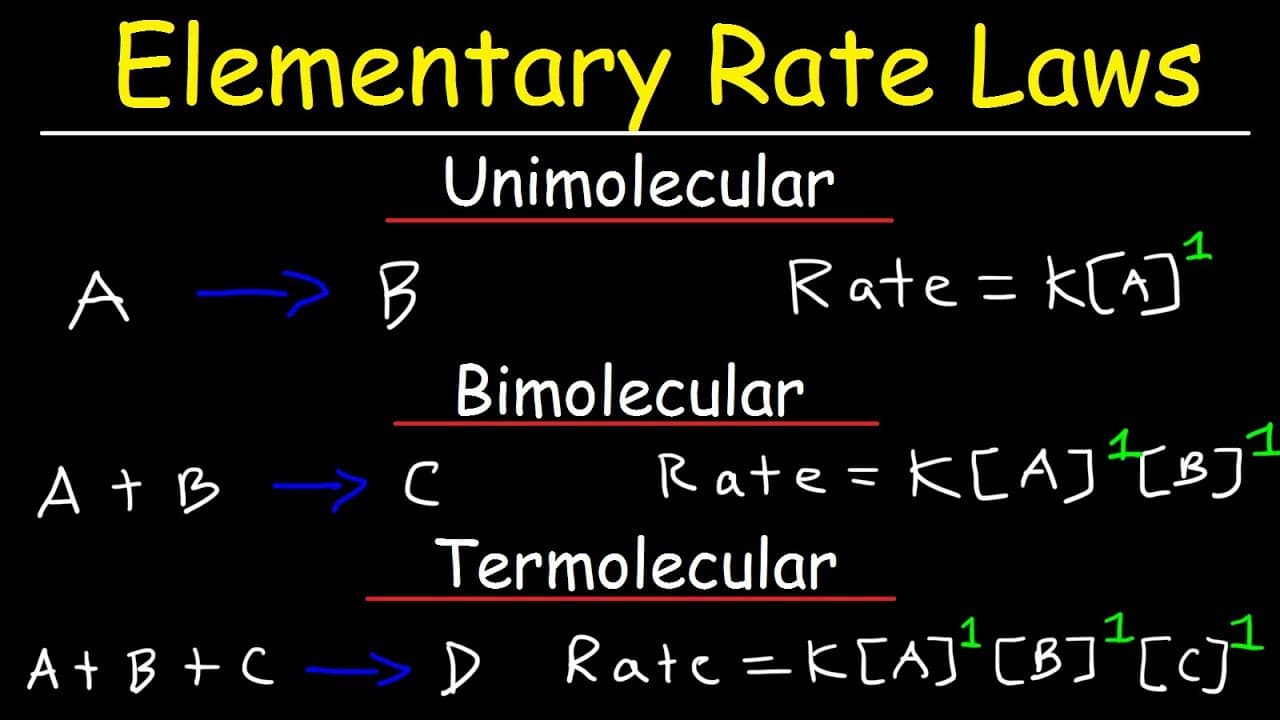
Elementary reactions are those in which the coefficients of the reactants determine their order in the rate law expression.
Transcript
now what exactly is an elementary reaction an elementary reaction is one in which the coefficients of the reactants represent the order of each reactant in a rate log expression so let me give you example so let's say that we have let me write that a turn into b the rate law expression is going to be k times a raised to the first power because the ... Read More
Key Insights
- 😑 Elementary reactions have rate law expressions determined by reactant coefficients.
- ❓ Unimolecular reactions only require one molecule for the reaction to occur.
- ❓ Bimolecular reactions require two molecules to collide for the reaction to occur.
- ❓ Termolecular reactions require three or more molecules to collide for the reaction to occur.
- 🪈 The overall order of a reaction is determined by the sum of the reactant orders.
- 😑 The coefficient of a reactant represents its order in the rate law expression.
- ❓ Termolecular reactions are less common compared to unimolecular and bimolecular reactions.
Install to Summarize YouTube Videos and Get Transcripts
Explore YouTube Video Summarizer or Get YouTube Transcript Extractor
Questions & Answers
Q: What is an elementary reaction?
An elementary reaction is one where the coefficients of the reactants represent their order in the rate law expression. It can be unimolecular, bimolecular, or termolecular, depending on the number of molecules required for the reaction to occur.
Q: How does the coefficient of a reactant affect the rate law expression?
The coefficient of a reactant determines the order of that reactant in the rate law expression. If the coefficient is 1, the reactant's order is 1. If the coefficient is 2, the reactant's order is 2.
Q: What is the difference between unimolecular and bimolecular reactions?
Unimolecular reactions only require one molecule for the reaction to occur, while bimolecular reactions require two molecules to collide. The rate law expression reflects this difference.
Q: How can the molecularity of a reaction be determined?
The molecularity of a reaction can be determined by examining the coefficients of the reactants. If it takes one molecule to react, the reaction is unimolecular. If it takes two or more molecules to react, it is bimolecular or termolecular.
Summary & Key Takeaways
-
An elementary reaction's rate law expression is determined by the coefficients of the reactants.
-
Unimolecular reactions only require one molecule for the reaction to occur.
-
Bimolecular reactions require two molecules to collide for the reaction to occur.
-
Termolecular reactions require three or more molecules to collide for the reaction to occur.
Read in Other Languages (beta)
Share This Summary 📚
Summarize YouTube Videos and Get Video Transcripts with 1-Click
Try YouTube Summary with ChatGPT & Claude or YouTube Transcript Generator
Explore More Summaries from The Organic Chemistry Tutor 📚

Summarize YouTube Videos and Get Video Transcripts with 1-Click
Try YouTube Summary with ChatGPT & Claude or YouTube Transcript Generator