How Do Japan's Maglev Trains Operate?
TL;DR
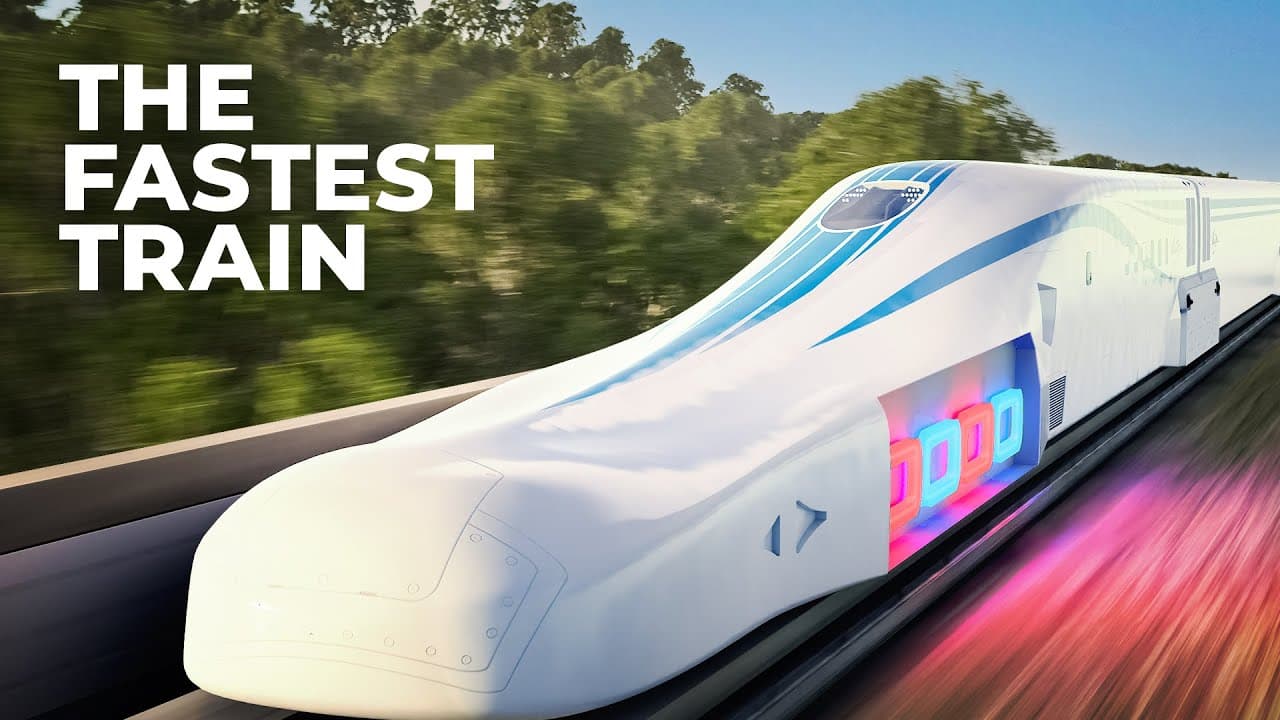
Japan's Maglev trains use superconducting magnets to levitate and propel at speeds of 500 km/h without physical contact with tracks, offering lower maintenance and weather-independent operation. Despite their speed, high costs and infrastructure needs limit widespread adoption, with Japan's line being the first long-distance implementation.
Transcript
Buried here, deep in a Japanese mountain pass, is one of the world's rarest technologies. A 43-kilometer-long magnetic levitation train track. Which will eventually become part of the world's first inter-city Maglev train, connecting Tokyo and Osaka. With the power of superconducting magnets, these trains hover a mere 10 centimeters above their ... Read More
Key Insights
- Maglev trains hover 10 centimeters above tracks using superconducting magnets, allowing speeds up to 500 km/h.
- Japan's Maglev system uses a stable levitation method suitable for earthquake-prone regions, unlike the Shanghai system.
- Superconducting coils on the train must be cooled below critical temperatures using advanced refrigeration techniques.
- Maglev trains do not touch the ground, using linear motors for propulsion, which eliminates wheel friction.
- The magnetic field is carefully managed to prevent interference with passengers and nearby materials.
- High-speed Maglev lines are costly, with Japan's line costing significantly more per kilometer than traditional high-speed rail.
- Japan's Maglev train aims to reduce travel time between Tokyo and Osaka, but extensive tunneling raises costs.
- Despite higher energy usage in tunnels, Maglev trains are more efficient than air travel.
Install to Summarize YouTube Videos and Get Transcripts
Explore YouTube Video Summarizer or Get YouTube Transcript Extractor
Questions & Answers
Q: How do Maglev trains levitate?
Maglev trains levitate using superconducting magnets that create a magnetic field, allowing the train to hover above the track without physical contact. This is achieved through the interaction of magnets on the train with coils on the track, generating a repulsive force that lifts the train. The Japanese system uses a stable method suitable for earthquake-prone areas, maintaining a 10 cm gap between train and track.
Q: What propulsion system do Maglev trains use?
Maglev trains use a linear motor propulsion system, where alternating magnetic fields attract and repel the train, propelling it along the track. This system eliminates the need for wheels and reduces friction, allowing for higher speeds. The propulsion system is also capable of regenerative braking, using the motor in reverse to slow the train.
Q: Why are Maglev trains not widely deployed?
Maglev trains are not widely deployed primarily due to their high construction and operational costs. Building Maglev lines requires specialized tracks with electromagnetic coils and materials resistant to strong magnetic fields, making them significantly more expensive than traditional high-speed rail. Additionally, the economic viability is challenged by the need for new infrastructure and competition with other transport modes.
Q: How do Maglev trains manage magnetic fields near passengers?
Maglev trains manage magnetic fields near passengers by using electric steel shielding to redirect the magnetic field away from the cabin. This shielding, combined with careful design of the magnets, creates a low magnetic field bubble within passenger areas. The field strength is reduced to levels similar to Earth's magnetic field, minimizing interference and ensuring passenger safety.
Q: What are the energy requirements for Maglev trains?
Maglev trains have high energy requirements, particularly when traveling through tunnels. The need to overcome air resistance in confined spaces increases energy consumption by about 30% compared to open-air travel. Despite this, Maglev trains are more energy-efficient than air travel. The superconducting coils require cooling to maintain their function, adding to the energy demands.
Q: How does Japan's Maglev train compare to traditional high-speed rail?
Japan's Maglev train offers faster travel times than traditional high-speed rail, with speeds up to 500 km/h. However, the construction costs per kilometer are substantially higher, making it more expensive to build and operate. The Maglev line aims to reduce travel time between Tokyo and Osaka but requires extensive tunneling, further increasing costs. Despite these challenges, the Maglev system promises lower maintenance and greater efficiency.
Q: What is the future of Maglev technology?
The future of Maglev technology is promising but uncertain due to high costs and infrastructure challenges. Japan's long-distance line will be a significant milestone, yet widespread adoption depends on economic feasibility and technological advancements, such as room-temperature superconductors. Maglev trains offer potential for efficient, high-speed travel, particularly between large cities, but require substantial investment and planning.
Q: Why is Japan investing in Maglev technology?
Japan is investing in Maglev technology to maintain its leadership in train innovation and reduce travel times between major cities. The Maglev system offers a faster alternative to existing high-speed rail, enhancing connectivity and economic productivity. Japan's commitment to this technology reflects its long-term vision for efficient, sustainable transportation, despite the significant financial and engineering challenges involved.
Summary & Key Takeaways
-
Japan's Maglev trains employ superconducting magnets for levitation, achieving speeds of 500 km/h with minimal friction and low maintenance. The system's stability and speed make it suitable for long-distance travel, but high costs and infrastructure requirements limit its deployment.
-
Maglev trains use dynamic magnetic fields for levitation and propulsion, with superconducting coils cooled by advanced refrigeration systems. The Japanese system is designed for stability in seismic regions, with magnetic fields managed to avoid passenger interference.
-
Despite the advantages of speed and efficiency, Maglev technology faces economic challenges due to high construction costs. Japan's line, costing significantly more than traditional rail, aims to connect major cities but requires extensive tunneling, increasing operational expenses.
Read in Other Languages (beta)
Share This Summary 📚
Summarize YouTube Videos and Get Video Transcripts with 1-Click
Try YouTube Summary with ChatGPT & Claude or YouTube Transcript Generator
Explore More Summaries from Real Engineering 📚




Summarize YouTube Videos and Get Video Transcripts with 1-Click
Try YouTube Summary with ChatGPT & Claude or YouTube Transcript Generator