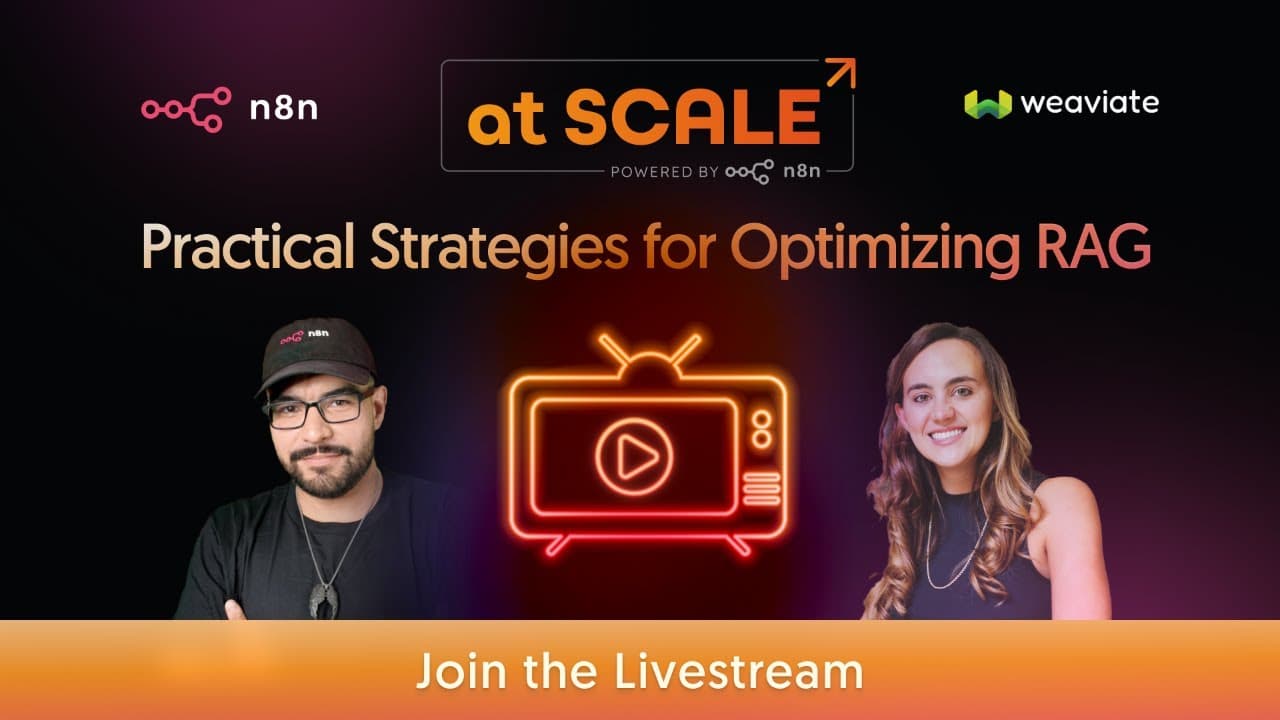
How to Optimize RAG Workflows in n8n at Scale
TL;DR
Use RAG when a knowledge base is too large for a model prompt or when answers need grounding in private, internal context. Optimize the workflow by evaluating context limits, dividing documents into useful chunks, embedding queries and documents with the same model, improving retrieval with metadata and vector search, and carefully selecting models and prompts.
Transcript
[Applause] Heat. Heat. Heat. Heat. Heat. Heat. Heat. Heat. Heat. Heat. Heat. Heat. Hey, [Applause] heat. Hey. Heat. Heat. Heat. Heat. Heat. Heat. Heat. Heat. Yeah. Heat. Heat. Heat. Heat. [Applause] Heat. Heat. Heat. N. And good morning everyone. Hello. Welcome. So good morning from Tucson, Arizona. Read More
Key Insights
- RAG is a framework that connects a large language model to an external knowledge base, allowing generated answers to be grounded in retrieved context and potentially accompanied by citations to the source material.
- RAG is most appropriate when documents form a comprehensive knowledge base that cannot reasonably fit inside the model prompt, particularly when the information is internal, privileged, or needed to reduce unsupported answers.
- A model’s stated context-window size does not guarantee reliable retrieval from every part of a long prompt. The presented guidance expresses skepticism about context windows above 8,000 tokens because needle-in-a-haystack tests can expose retrieval weaknesses.
- RAG indexing works by dividing source documents into chunks, sending those chunks through an embedding model, and storing the resulting numerical vectors in a vector database for later similarity searches.
- RAG inference works by embedding the user’s query with the same embedding model used for the documents, comparing that query vector against stored vectors, and retrieving the closest matching objects.
- Vector search is a similarity search across a multidimensional latent space. It identifies stored embeddings with the shortest distance from the query embedding, such as the five closest objects in the example discussed.
- The final RAG response is produced from an augmented prompt containing the original query and retrieved context. The language model uses that context to formulate an answer and can cite the particular text chunk retrieved from the database.
- RAG does not eliminate hallucinations because the system can retrieve irrelevant or incorrect context. Retrieval quality therefore remains a major limitation and should be improved through chunking, metadata, model selection, vector search, and prompt engineering.
Install to Summarize YouTube Videos and Get Transcripts
Explore YouTube Video Summarizer or Get YouTube Transcript Extractor
Questions & Answers
Q: What is retrieval-augmented generation and how does it work?
Retrieval-augmented generation, or RAG, is a framework that gives a large language model access to an external knowledge base. Documents are divided into chunks, converted into numerical embeddings, and stored in a vector database. A user query is embedded with the same model, matched against similar stored vectors, and combined with retrieved context so the language model can generate a grounded response.
Q: When should you use RAG instead of placing documents in a prompt?
RAG should be used when a comprehensive collection of internal, privileged, or specialized documents is too large to fit effectively within a language model’s prompt. A small collection, such as 10 or possibly 20 medium or shorter documents, may fit within the context window. Larger collections, including 100 peer-reviewed articles of 10 to 20 pages each, are better candidates for RAG.
Q: Why can a large language model's context window be insufficient?
A stated context-window capacity does not necessarily mean the model can reliably find every important fact placed inside a long prompt. The session describes needle-in-a-haystack testing, where a small fact is inserted into a large prompt and the model is asked to retrieve it. Because models may perform poorly on this task, context windows larger than about 8,000 tokens are treated with skepticism by the guest.
Q: What happens during the RAG indexing stage?
During indexing, the source documents are prepared for later retrieval. Their text is divided into chunks, and each chunk is sent to an embedding model. The model converts the raw text into an embedding, which is a sequence of numbers representing semantic meaning. Those embeddings, also called vectors, are then stored in a vector database or vector store.
Q: What happens during the RAG inference stage?
During inference, the user submits a query and the system sends it to the same embedding model used during indexing. The resulting query embedding is compared with embeddings stored in the vector database. The closest matching objects are retrieved, added to the original query as context, and passed to the language model, which produces the final grounded response.
Q: Why must queries and documents use the same embedding model?
The workflow presented uses the same embedding model for both stored documents and incoming queries. Document chunks are embedded during indexing, while the user’s query is embedded during inference. This places both representations into the same latent space so vector search can compare their distance, identify semantic similarity, and retrieve the stored objects closest to the query.
Q: How does vector similarity search support a RAG workflow?
Vector similarity search compares the numerical embedding of a query with the embeddings stored in a vector database. These embeddings exist in a large multidimensional latent space. The system calculates which stored objects have the least distance from the query and returns the closest matches, such as the five nearest objects in the example, for inclusion in the augmented prompt.
Q: Can RAG completely prevent language model hallucinations?
RAG cannot completely prevent hallucinations, even when generated answers cite sources. Its main weakness occurs when the retrieval process selects the wrong context. The language model may then produce an answer grounded in irrelevant or unsuitable material. Improving retrieval through effective chunking, metadata, appropriate embedding and generative models, vector search, and prompt engineering is therefore essential to response quality.
Summary & Key Takeaways
-
Retrieval-augmented generation gives a large language model access to an external knowledge base, helping it answer with relevant context rather than relying only on its existing capabilities. It is especially useful for comprehensive internal or privileged datasets, although grounded answers can still be wrong when retrieval supplies the wrong context.
-
RAG has two main stages: indexing and inference. Indexing divides documents into chunks, converts them into numerical embeddings, and stores those vectors in a vector database. During inference, the query is embedded with the same model, compared against stored vectors, and combined with retrieved text to create an augmented prompt.
-
An optimized n8n RAG workflow requires decisions about chunking, metadata, embedding models, generative models, prompts, and vector search. Weaviate can provide the vector store, while Ollama can run models locally when privileged data should not be sent to an external API. Effective retrieval remains central to response quality.
Read in Other Languages (beta)
Share This Summary 📚
Summarize YouTube Videos and Get Video Transcripts with 1-Click
Try YouTube Summary with ChatGPT & Claude or YouTube Transcript Generator
Explore More Summaries from n8n 📚
![How I Hit 1.4M Followers Solo With AI & Automation [#09 Sabrina Ramonov] thumbnail](/_next/image?url=https%3A%2F%2Fi.ytimg.com%2Fvi%2F5zQCCgv1YSk%2Fhqdefault.jpg&w=750&q=75)
![Automating Gong Sales Call Analysis with n8n and AI [n8n At Scale] thumbnail](/_next/image?url=https%3A%2F%2Fi.ytimg.com%2Fvi%2FAIiJ29hEn80%2Fhqdefault.jpg&w=750&q=75)
Summarize YouTube Videos and Get Video Transcripts with 1-Click
Try YouTube Summary with ChatGPT & Claude or YouTube Transcript Generator