Palmer Luckey on Apple Vision Pro and VR's Future
TL;DR
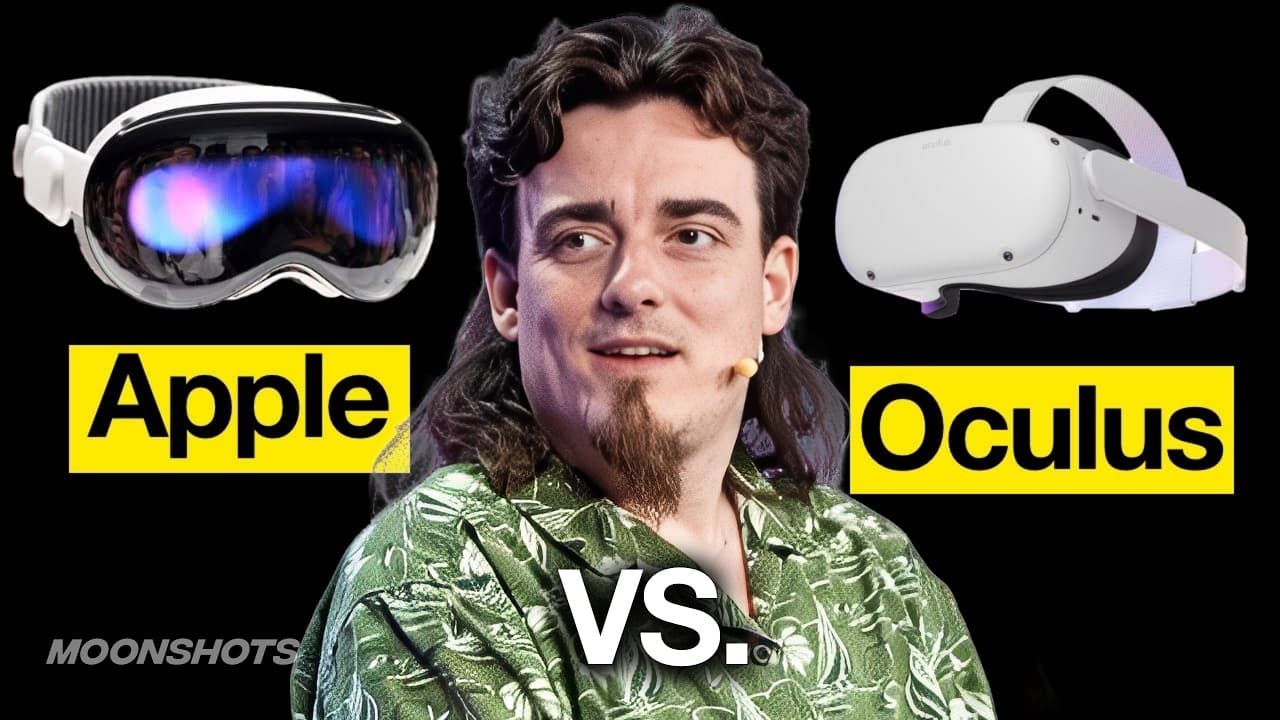
Apple’s Vision Pro could help make headsets desirable and socially accepted before they become affordable to everyone. Palmer Luckey argues that virtual reality is the final computing platform because sufficiently capable VR could emulate, assist, or replace earlier media, while his broader work applies similarly ambitious thinking to defense procurement and destructive wildfires.
Transcript
Palmer lucky invents the Oculus Rift and it brings lasting peace and economic prosperity to the world through the power of the metaverse and everything is great and everyone loves it Palmer lucky Palmer lucky the one the only the founder of Oculus the founder of and Palmer lucky he created Oculus Andre Industries founder Palmer lucky I'm always loo... Read More
Key Insights
- Virtual reality is presented as the final computing platform because a sufficiently capable system could emulate, assist, or replace previous forms of media while enabling experiences that conventional screens and interfaces cannot provide.
- The central Oculus moonshot was accelerating VR development enough to create a viable company, since many people already believed virtual reality would eventually arrive, but turning that distant expectation into a near-term product required years of focused work.
- Apple’s Vision Pro strategy is to make immersive headsets desirable before making them affordable to everyone. Luckey expects visible adoption to change social perceptions, allowing a device category once regarded as uncool to become culturally accepted.
- Luckey’s assessment of Vision Pro is positive but qualified. He considers Apple’s approach significant and expects many people to wear headsets for augmented and virtual reality, while acknowledging that he would have made a different set of product mistakes.
- The origin of Luckey’s VR work was a search for the end state of computing rather than another incremental upgrade. An eight-monitor gaming setup led him to reject adding more displays or resolution as merely temporary progress.
- Luckey began working on virtual reality at about age 15, around 2008 or 2009. He says his early work was poor and required roughly three or four years before he produced something that could plausibly reach other users.
- Anduril’s mission is to reinvent the defense industry on both the private and government sides. Its stated goal is to provide America and its allies with tools capable of deterring conflicts that could threaten what their coalition has built.
- Cost-plus defense contracts can reward higher costs and slower execution because profit is calculated as a fixed percentage above time and materials. Luckey argues that this structure encourages expensive systems, inefficient development, and costly components rather than optimal solutions.
- Related book: Exponential Organizations
- Export your Kindle highlights to Glasp: How to Download Highlights and Notes from Kindle
Install to Summarize YouTube Videos and Get Transcripts
Explore YouTube Video Summarizer or Get YouTube Transcript Extractor
Questions & Answers
Q: How does Palmer Luckey evaluate Apple Vision Pro?
Palmer Luckey views Apple Vision Pro as a potentially important transitional product for augmented and virtual reality, although he says he would have made different mistakes. He believes Apple is prioritizing a headset that people strongly want before trying to make the category affordable to everyone. Visible adoption could also change the cultural perception of wearing headsets from uncool to acceptable.
Q: Why does Palmer Luckey call VR the final computing platform?
Palmer Luckey calls virtual reality the final computing platform because sufficiently capable VR could emulate, assist, or replace every earlier form of media and many imagined future forms. By modulating what users perceive, it could let people experience anything they are capable of experiencing. That flexibility makes disputes about screen size, posture, and conventional interface form factors less important.
Q: What was the original moonshot behind Oculus VR?
The Oculus moonshot was not simply predicting that virtual reality would eventually become important. Luckey says many people already expected that outcome because VR was a recurring science-fiction idea. The difficult objective was to bring VR to life, move it into the mainstream, and develop it quickly enough that a company pursuing the technology could survive on a very small budget.
Q: How did Palmer Luckey decide to work on virtual reality?
Luckey began by considering where gaming and computing were ultimately heading. After building gaming computers, modifying consoles, and using an eight-monitor setup, he concluded that more monitors or higher resolution represented only incremental progress. He identified virtual reality as the end state worth pursuing and began working on it at about age 15, around 2008 or 2009.
Q: How long did it take Palmer Luckey to make viable VR technology?
Luckey says his earliest virtual reality work was poor and initially functioned more as a hobby and thought experiment about gaming’s future. He worked for roughly three or four years before creating something that convinced him he could deliver the experience to other people. That milestone transformed VR from a personal technical interest into a plausible company-building opportunity.
Q: What problem is Anduril trying to solve in defense?
Anduril is trying to reinvent the defense industry across both private companies and government procurement. Its goal is to ensure that America and its allies possess the tools needed now and in the future to deter destructive conflicts. Luckey also wants to restore an industrial capacity that can turn small, innovative defense companies into large and consequential suppliers.
Q: Why does Palmer Luckey criticize cost-plus defense contracts?
Luckey criticizes cost-plus contracting because suppliers receive payment for time and materials plus a fixed percentage of profit. In his account, that arrangement can make expensive programs more attractive and reward slower work, inefficient processes, and costlier components. Because greater cost produces greater absolute profit, companies lack a strong contractual incentive to deliver the least expensive optimal solution.
Q: What is Palmer Luckey’s approach to destructive wildfires?
Luckey’s wildfire goal distinguishes destructive fires from fires that serve useful roles in forest management. He says the objective is not to eliminate every wildfire, since wildlands firefighters use fire as a management tool. Instead, the effort seeks to stop fires that destroy homes and communities, making it easier to preserve and manage productive fire safely.
Summary & Key Takeaways
-
Palmer Luckey describes virtual reality as the final computing platform rather than merely another step in gaming. He believes sufficiently capable VR can emulate, assist, or replace earlier media because it lets software alter a user’s perceived reality and removes conventional constraints involving screens, physical posture, and interface form factors.
-
Apple’s strategy for Vision Pro appears to prioritize desirability before affordability. Luckey suggests that widespread adoption by visible users could make headsets socially acceptable, turning something previously considered uncool into something people want. His assessment is qualified, however, because he says he would have made different mistakes in developing the product.
-
Luckey connects Oculus, Anduril, and the Wildfire XPRIZE through ambitious, long-term problem selection. Oculus sought to accelerate mainstream VR, Anduril seeks to reinvent defense technology and procurement, and the wildfire effort targets destructive fires while preserving useful managed fire. Each project begins with an envisioned end state rather than an incremental improvement.
Read in Other Languages (beta)
Share This Summary 📚
Summarize YouTube Videos and Get Video Transcripts with 1-Click
Try YouTube Summary with ChatGPT & Claude or YouTube Transcript Generator
Explore More Summaries from Peter H. Diamandis 📚
Summarize YouTube Videos and Get Video Transcripts with 1-Click
Try YouTube Summary with ChatGPT & Claude or YouTube Transcript Generator