How to Start a Personal Brand in 90 Days
TL;DR
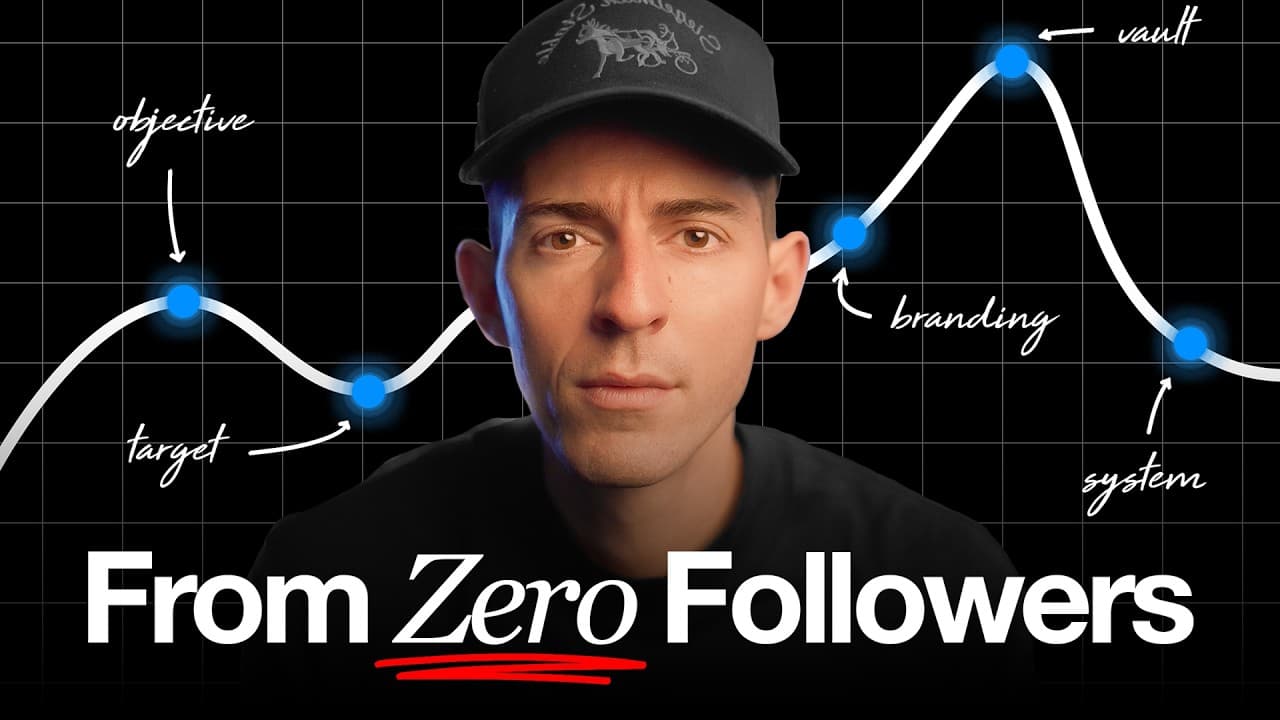
Start by choosing between broad cultural reach and targeted category authority, then define the exact viewer you want to serve. Build clear guardrails around your niche, topics, messaging, proof, and platforms so every piece of content reinforces the same position. Following this workflow for 90 days will not complete a personal brand, but it can establish a focused system whose growth compounds over time.
Transcript
Building a personal brand might be the single greatest cheat code in business today. Everywhere you look, the business owners that are leaning heaviest into content are absolutely exploding. But the problem is most categories are now becoming extremely competitive. So if you're not approaching your personal brand with the right framing and strategy... Read More
Key Insights
- A 90-day period is not enough to finish building a personal brand, but it can establish a repeatable workflow that supports faster, compounding growth. The opening days should focus primarily on positioning and strategy because those decisions guide every later content choice.
- Personal brand objectives generally follow two tracks: mass awareness and reach, or targeted awareness and efficient conversion. The first seeks broad cultural recognition, while the second aims to become highly recognized inside a specific category and generate greater value from a smaller, more concentrated audience.
- Category authority is generally faster to pursue from scratch because the creator serves a narrower group with more relevant content. It may produce more money per follower, although its total footprint and the benefits associated with mainstream recognition are smaller.
- A narrow category position can expand toward mainstream awareness as authority grows, but beginning broadly and later trying to establish category-specific authority is difficult. Choosing the intended direction early therefore affects the content strategy, audience expectations, and opportunities available later.
- An ideal viewer definition works as an avatar filter for content ideas. Every proposed video should be tested by asking whether it provides value to the desired viewer, with irrelevant ideas rejected even when they might attract more views.
- Viewer drift occurs when creators lack clear audience guardrails and gradually favor broader topics or vanity metrics. The resulting content becomes increasingly generic, attracts fewer ideal buyers, and weakens the conversion potency of the audience as its size increases.
- A target authority statement clarifies positioning through the structure, “I help X person with Y thing in Z way.” This short statement identifies the intended audience, the result or problem being addressed, and the creator's chosen mechanism for delivering value.
- Niche targeting works like a bullseye whose center represents the most specific and aligned subject. Starting near the center makes a lane easier to own because topics, examples, pain points, language, offers, and supporting proof can consistently match the same audience.
Install to Summarize YouTube Videos and Get Transcripts
Explore YouTube Video Summarizer or Get YouTube Transcript Extractor
Questions & Answers
Q: How should I start building a personal brand in 90 days?
Begin by spending the first few days on positioning and strategy instead of immediately producing content. Choose your main objective, define the ideal viewer you want to attract, and establish personal brand pillars that limit what you discuss, whom you address, how you communicate, and where you publish. These guardrails create a focused workflow that can support compounding growth beyond the initial 90 days.
Q: What are the two main personal brand strategies?
The two main strategies are mass awareness and reach, and targeted awareness with efficient conversion. Mass awareness seeks broad recognition across culture and can create a larger total financial opportunity, but it also brings the trade-offs of mainstream visibility. Targeted awareness focuses on becoming highly recognized within one category, which can be faster to achieve and may generate more money per follower.
Q: Should a personal brand target a broad or narrow audience first?
A personal brand should generally begin with a narrow category and expand as its authority and proof grow. Narrow targeting reduces the surface area the creator must cover, making it easier to select valuable topics, use familiar audience language, address recurring pain points, and support claims with relevant evidence. Starting broadly and later trying to become category-specific is described as much more difficult.
Q: How do I define the target audience for a personal brand?
Define the exact ideal viewer you want the content to attract, then write a target authority statement using the structure, “I help X person with Y thing in Z way.” This identifies the audience, the value being provided, and the method used. The statement should then become a filter for deciding whether each proposed piece of content directly helps that viewer.
Q: What is viewer drift in personal branding?
Viewer drift is the gradual broadening of content that happens when a creator lacks firm guardrails around the intended audience. The creator begins favoring higher view counts and other vanity metrics, so the messaging becomes more generic over time. Although the audience may grow, it contains fewer ideal buyers, reducing its relevance and conversion potency.
Q: What are personal brand pillars used for?
Personal brand pillars define the guardrails that shape what a creator talks about, whom the content serves, how the ideas are presented, and which platforms are used. Successful positioning depends more on removing unfocused options than continually adding topics. Clear pillars help viewers decide whether to enter the creator's brand world and help algorithms identify the appropriate audience.
Q: How does the niche-targeting bullseye work?
The niche-targeting bullseye places the creator's most specific subject and audience at the center, with progressively broader categories in each outer ring. A creator can begin at the center, where content and audience alignment are strongest, then expand outward as authority and proof increase. The exercise provides a practical boundary for selecting topics and controlling how broadly the brand operates.
Q: Why does content, audience, offer, and proof alignment matter?
Clear alignment ensures that each topic is valuable to the intended viewer, each example reflects situations that viewer experiences, and the language matches thoughts already present in the viewer's mind. It also connects the creator's claims to relevant proof, allowing audience members to recognize themselves in the evidence. Together, these elements make focused personal brand growth easier to sustain.
Summary & Key Takeaways
-
The 90-day workflow begins with positioning rather than immediate content production. Choose whether the primary objective is mass awareness across culture or targeted authority within a category. Both approaches can support large businesses, but they require different strategies, produce different audience footprints, and involve different trade-offs around reach, conversion, and public visibility.
-
Define an ideal viewer and turn that definition into a target authority statement using the structure, “I help X person with Y thing in Z way.” Apply this statement as an avatar filter to every proposed topic. Rejecting ideas that do not serve the intended viewer prevents audience drift, generic messaging, and declining conversion potency.
-
Personal brand pillars create guardrails for what to discuss, whom to address, how to communicate, and which platforms to use. Niche targeting can be mapped as a bullseye, beginning with a narrow area where topics, language, pain points, offers, and proof align. Broader subjects can be introduced as authority and evidence grow.
Read in Other Languages (beta)
Share This Summary 📚
Summarize YouTube Videos and Get Video Transcripts with 1-Click
Try YouTube Summary with ChatGPT & Claude or YouTube Transcript Generator
Explore More Summaries from Kallaway 📚

Summarize YouTube Videos and Get Video Transcripts with 1-Click
Try YouTube Summary with ChatGPT & Claude or YouTube Transcript Generator