How To Find The Resultant of Two Vectors
TL;DR
Learn how to calculate the magnitude and direction of the resultant vector by breaking down force vectors into component form and adding their components together.
Transcript
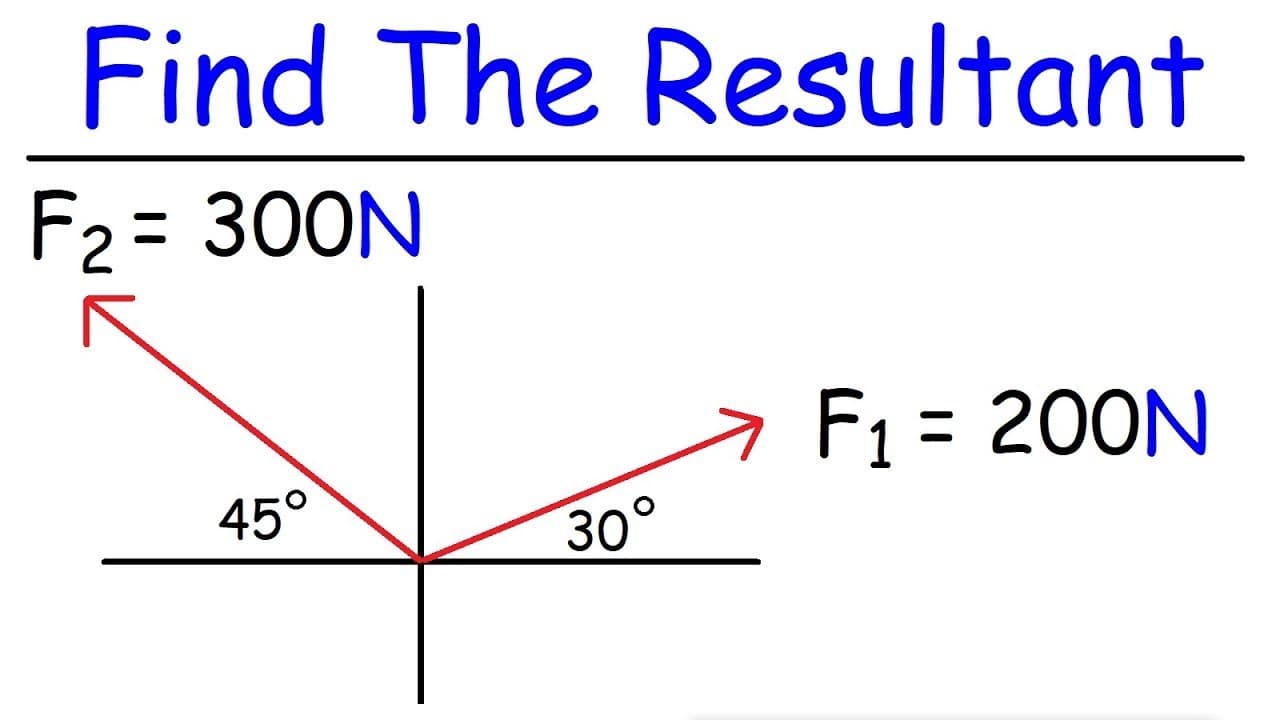
in this video we're going to talk about how to calculate the magnitude and the direction of the resultant vector that is formed when taking the sum of two other force vectors and you can see the two of the force vectors in the diagram shown below but how can we find the results in vector well what we need to do is we need to break down each vector ... Read More
Key Insights
- 💁 Breaking down force vectors into their component form is essential for calculating the resultant vector accurately.
- ✖️ The x component of a force vector is determined by multiplying its magnitude by the cosine of the angle it makes with the positive x-axis.
- ☺️ Negative x components indicate vectors in the negative x direction, which can occur in the second quadrant.
- 😃 Unit vectors (i and j) are used to represent the x and y components of force vectors in component form.
- ❣️ The resultant vector is found by adding the x components together and the y components together.
- ❓ The magnitude of the resultant vector is calculated using the Pythagorean theorem.
- ❣️ The direction of the resultant vector is determined by taking the arctangent of the y component divided by the x component.
Install to Summarize YouTube Videos and Get Transcripts
Explore YouTube Video Summarizer or Get YouTube Transcript Extractor
Questions & Answers
Q: How do you calculate the x and y components of a force vector?
To find the x component of a force vector, multiply its magnitude by the cosine of the angle it makes with the positive x-axis. To find the y component, multiply the magnitude by the sine of the angle.
Q: Why do negative signs appear in the x component of some force vectors?
Negative x components indicate that the force vectors point in the negative x direction, typically found in the second quadrant. It is a valid representation of the vector's direction.
Q: What are unit vectors and how are they used in expressing force vectors?
Unit vectors (i and j) have magnitudes of 1 and represent the positive x and y directions, respectively. They are used to express the x and y components of force vectors in component form.
Q: How is the magnitude and direction of the resultant vector calculated?
The magnitude of the resultant vector is determined using the Pythagorean theorem by finding the square root of the sum of the squared x and y components. The direction is found by taking the arctangent of the y component divided by the x component.
Summary & Key Takeaways
-
The video explains how to calculate the resultant vector by breaking down force vectors into their x and y components and then adding those components together.
-
It provides step-by-step instructions to find the x and y components of each force vector and expresses them in component form.
-
The resultant vector is found by adding the x components together and the y components together, and its magnitude and direction are determined using the Pythagorean theorem and trigonometry.
Read in Other Languages (beta)
Share This Summary 📚
Summarize YouTube Videos and Get Video Transcripts with 1-Click
Try YouTube Summary with ChatGPT & Claude or YouTube Transcript Generator
Explore More Summaries from The Organic Chemistry Tutor 📚



Summarize YouTube Videos and Get Video Transcripts with 1-Click
Try YouTube Summary with ChatGPT & Claude or YouTube Transcript Generator