Calculus 3 - Intro To Vectors
TL;DR
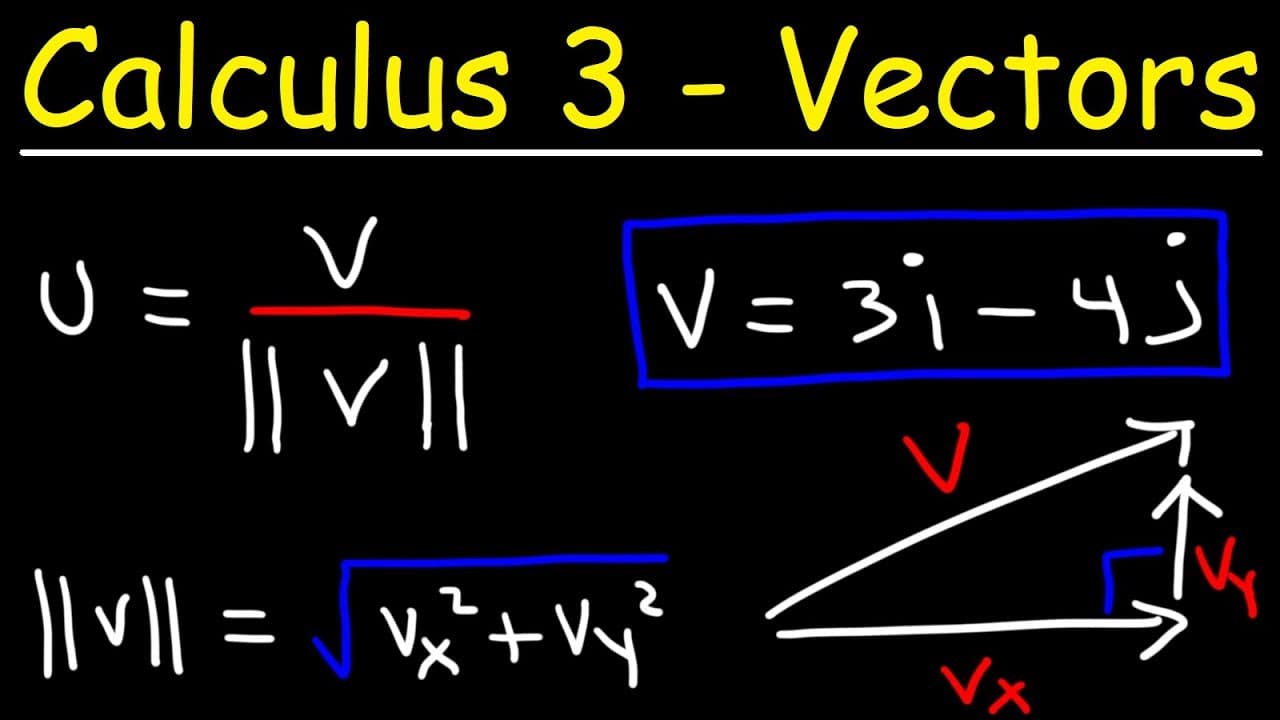
A vector has both magnitude and direction, while a scalar has only magnitude. Saying you drive 40 meters per second is speed (a scalar), but 40 meters per second north is velocity (a vector). Other scalars include temperature, mass, and volume, since you cannot apply a direction to them. This intro shows how to represent vectors as a magnitude and angle or as x and y components, and how to add them graphically.
Transcript
in this video we're going to talk about vectors but what is a vector really and let's distinguish it from something called a scalar quantity so what's the difference between a vector quantity and a scalar quantity well a scalar quantity only has a magnitude a vector quantity has both a magnitude but it also has direction so for instance speed is co... Read More
Key Insights
- ❓ Scalars only have magnitude, while vectors have both magnitude and direction.
- 🐎 Examples of scalar quantities include speed and temperature, while examples of vector quantities include velocity and force.
- 💁 Vectors can be represented using component form or standard unit vectors.
- 🇦🇪 Unit vectors have a magnitude of one and represent direction in a coordinate system.
- 😥 Vectors can be added graphically by connecting the initial point of the second vector to the terminal point of the first vector.
Install to Summarize YouTube Videos and Get Transcripts
Explore YouTube Video Summarizer or Get YouTube Transcript Extractor
Questions & Answers
Q: What is the difference between a vector quantity and a scalar quantity?
A scalar quantity has only a magnitude, while a vector quantity has both a magnitude and a direction. For example, speed is a scalar and velocity is a vector. A quick test is to ask whether you can apply a direction to the quantity; if you can, it is a vector.
Q: Why is velocity a vector but speed a scalar?
Speed gives you only a magnitude, such as 40 meters per second, which tells you how fast you are going. Velocity adds direction, such as 40 meters per second north, combining both magnitude and direction. That added direction is what makes velocity a vector.
Q: Is temperature a vector or a scalar quantity?
Temperature is a scalar quantity because you cannot apply a direction to it. Saying it is 80 degrees east makes no sense, so temperature has only a magnitude. Mass and volume are scalars for the same reason, since 50 kilograms north or 50 milliliters north do not make sense.
Q: How can you tell if a quantity is a scalar or a vector?
Ask yourself whether you can apply a direction to it. If a direction makes sense, like 300 newtons of force directed east, then it is a vector. If a direction does not make sense, like temperature, mass, or volume, then it is a scalar.
Q: What are the two common ways to describe a vector?
One way is to give its magnitude and its angle, such as a vector of length 5 directed at a 40 degree angle, where the magnitude represents the length of the vector. The other way is to use components, giving the x component and y component, such as a vector with components 2 and 3.
Q: How do you tell a vector apart from a point in notation?
A point is written with parentheses, such as (3, 4), and graphs as a single dot in space. A vector is written with angle brackets, such as vector b with components 4 and 5, and graphs as a directed line segment. Using parentheses for a vector is incorrect.
Q: How do you add vectors graphically?
Place the initial point of the second vector at the terminal point of the first vector, connecting them head to tail. The resulting vector is then drawn from the initial point of the first vector to the terminal point of the second vector.
Q: What is a directed line segment and how does it represent a vector?
A vector can be thought of as a directed line segment between two points, with an initial point where the arrow starts and a terminal point where it ends. For points A and B, you draw vector AB with the arrow pointed at B. The length of the segment tells you the magnitude, and where the arrow points tells you the direction.
Summary & Key Takeaways
-
Vectors have both magnitude and direction, while scalars only have magnitude.
-
Scalar quantities include speed and temperature, while vector quantities include velocity and force.
-
Vectors can be represented using component form or standard unit vectors.
-
Unit vectors have a magnitude of one and represent direction in a coordinate system.
Read in Other Languages (beta)
Share This Summary 📚
Summarize YouTube Videos and Get Video Transcripts with 1-Click
Try YouTube Summary with ChatGPT & Claude or YouTube Transcript Generator
Explore More Summaries from The Organic Chemistry Tutor 📚



Summarize YouTube Videos and Get Video Transcripts with 1-Click
Try YouTube Summary with ChatGPT & Claude or YouTube Transcript Generator