Pilot Wave Theory and Quantum Realism | Space Time | PBS Digital Studios
TL;DR
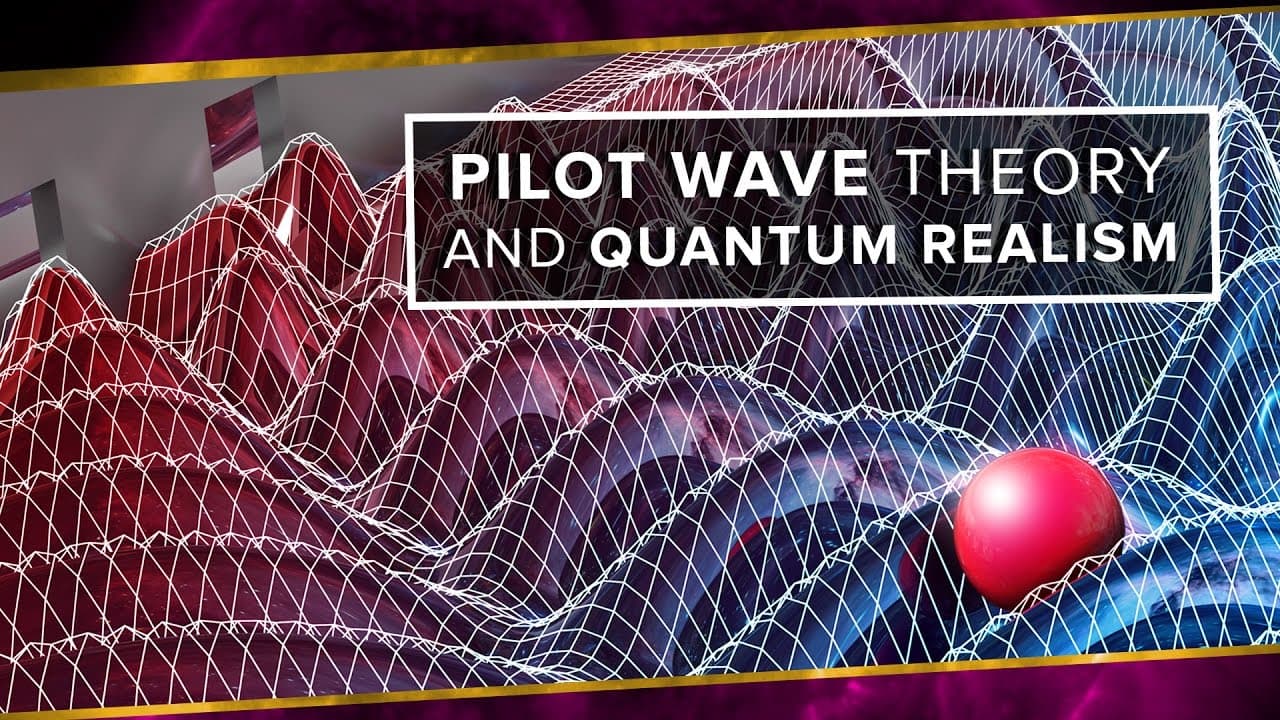
Pilot-wave theory offers a deterministic view of quantum mechanics.
Transcript
[MUSIC PLAYING] There is one interpretation of the meaning of quantum mechanics that somehow manages to skip a lot of the wildly extravagant or near-mystical ideas of the mainstream interpretations. It's the de Broglie-Bohm pilot-wave theory. And despite its alluringly intuitive nature, for some reason it remains a fringe theory. [MUSIC PLAYING] Mi... Read More
Key Insights
- Pilot-wave theory, also known as Bohmian mechanics, offers a deterministic alternative to the mainstream probabilistic interpretations of quantum mechanics, such as the Copenhagen and many-worlds interpretations.
- The theory proposes that particles are guided by a real wave, which determines their trajectories, contrasting with the abstract probability waves of other interpretations.
- Pilot-wave theory is deterministic, suggesting that if the initial conditions of a particle were known, its future path could be precisely predicted, unlike the inherent randomness in other quantum interpretations.
- The theory requires additional mathematical elements, such as a guiding equation, which some critics argue adds unnecessary complexity compared to other interpretations.
- Bohmian mechanics introduces the concept of non-local hidden variables, meaning that the entire wave function knows all particle properties, allowing for instantaneous effects across the wave function.
- Despite its consistency with quantum experiments, pilot-wave theory is not fully accepted due to its non-locality and the challenge of integrating it with relativistic quantum field theory.
- The theory doesn't account for relativity, making it incomplete compared to quantum field theory, which considers all possible particle trajectories equally real.
- Pilot-wave theory's main appeal lies in its physical and deterministic nature, providing a possible framework for understanding quantum mechanics without resorting to mystical explanations.
Install to Summarize YouTube Videos and Get Transcripts
Explore YouTube Video Summarizer or Get YouTube Transcript Extractor
Questions & Answers
Q: What is pilot-wave theory?
Pilot-wave theory, also known as Bohmian mechanics, is an interpretation of quantum mechanics that offers a deterministic framework. It suggests that particles are guided by real waves, which determine their trajectories. Unlike mainstream interpretations, it posits that if the initial conditions of a particle were known, its future path could be precisely predicted. This approach contrasts with the probabilistic nature of interpretations like the Copenhagen and many-worlds theories.
Q: How does pilot-wave theory differ from other interpretations of quantum mechanics?
Pilot-wave theory differs from other interpretations by offering a deterministic view, where particles are guided by real waves. This contrasts with the probabilistic nature of mainstream interpretations, such as the Copenhagen and many-worlds theories, which rely on abstract probability waves. Pilot-wave theory suggests that if the initial conditions of a particle were known, its future path could be precisely predicted, eliminating the inherent randomness present in other interpretations.
Q: What are the criticisms of pilot-wave theory?
Critics argue that pilot-wave theory introduces unnecessary complexity with additional mathematical elements, such as a guiding equation. It also relies on non-local hidden variables, meaning the entire wave function knows all particle properties, allowing for instantaneous effects across the wave function. Furthermore, it is not fully accepted due to its non-locality and the challenge of integrating it with relativistic quantum field theory, making it incomplete compared to other interpretations.
Q: What are hidden variables in pilot-wave theory?
In pilot-wave theory, hidden variables refer to non-local elements that provide additional information about the state of a particle, not described by the wave function. This means the entire wave function knows all particle properties, allowing for instantaneous effects across the wave function. The concept of hidden variables challenges the probabilistic nature of mainstream interpretations and suggests a deterministic framework for quantum mechanics.
Q: Why is pilot-wave theory considered deterministic?
Pilot-wave theory is considered deterministic because it proposes that particles are guided by real waves, which determine their trajectories. If the initial conditions of a particle, such as its position and velocity, were known, its future path could be precisely predicted. This deterministic nature contrasts with the inherent randomness in mainstream interpretations, such as the Copenhagen and many-worlds theories, which rely on abstract probability waves.
Q: How does pilot-wave theory address the concept of non-locality?
Pilot-wave theory addresses non-locality by suggesting that the entire wave function knows all particle properties, allowing for instantaneous effects across the wave function. This means a measurement at one point in the wave function can affect its shape elsewhere, impacting the trajectories and properties of particles carried by that wave. This concept is supported by quantum entanglement experiments, which demonstrate non-locality as a real phenomenon.
Q: What challenges does pilot-wave theory face in integrating with relativistic quantum field theory?
Pilot-wave theory faces challenges in integrating with relativistic quantum field theory because it postulates that particles take a single actual trajectory, the Bohm trajectory. This is not consistent with quantum field theory, which requires that all possible particle trajectories be considered equally real. As a result, there isn't a complete relativistic formulation of Bohmian mechanics, making it incomplete compared to other interpretations that account for relativity.
Q: What is the significance of pilot-wave theory in the context of quantum mechanics?
Pilot-wave theory is significant because it offers a deterministic and physical interpretation of quantum mechanics, providing an alternative to the probabilistic and often mystical explanations of mainstream interpretations. It demonstrates that it's possible to have a consistent framework for understanding quantum mechanics without resorting to abstract probability waves, appealing to those seeking a more intuitive understanding of the microscopic mechanics of spacetime.
Summary & Key Takeaways
-
Pilot-wave theory, also known as Bohmian mechanics, offers a deterministic interpretation of quantum mechanics, suggesting that particles are guided by real waves that determine their trajectories. This contrasts with the probabilistic nature of mainstream interpretations, such as the Copenhagen and many-worlds theories.
-
The theory introduces additional mathematical elements, like a guiding equation, and relies on non-local hidden variables, meaning that the entire wave function knows all particle properties. This allows for instantaneous effects across the wave function, a concept supported by quantum entanglement experiments.
-
Despite its consistency with quantum experiments, pilot-wave theory is not widely accepted due to its non-locality and the challenge of integrating it with relativistic quantum field theory. However, it remains a compelling alternative for those seeking a physical and deterministic framework for quantum mechanics.
Read in Other Languages (beta)
Share This Summary 📚
Summarize YouTube Videos and Get Video Transcripts with 1-Click
Try YouTube Summary with ChatGPT & Claude or YouTube Transcript Generator
Explore More Summaries from PBS Space Time 📚



Summarize YouTube Videos and Get Video Transcripts with 1-Click
Try YouTube Summary with ChatGPT & Claude or YouTube Transcript Generator