How to Find Viral Faceless YouTube Niches
TL;DR
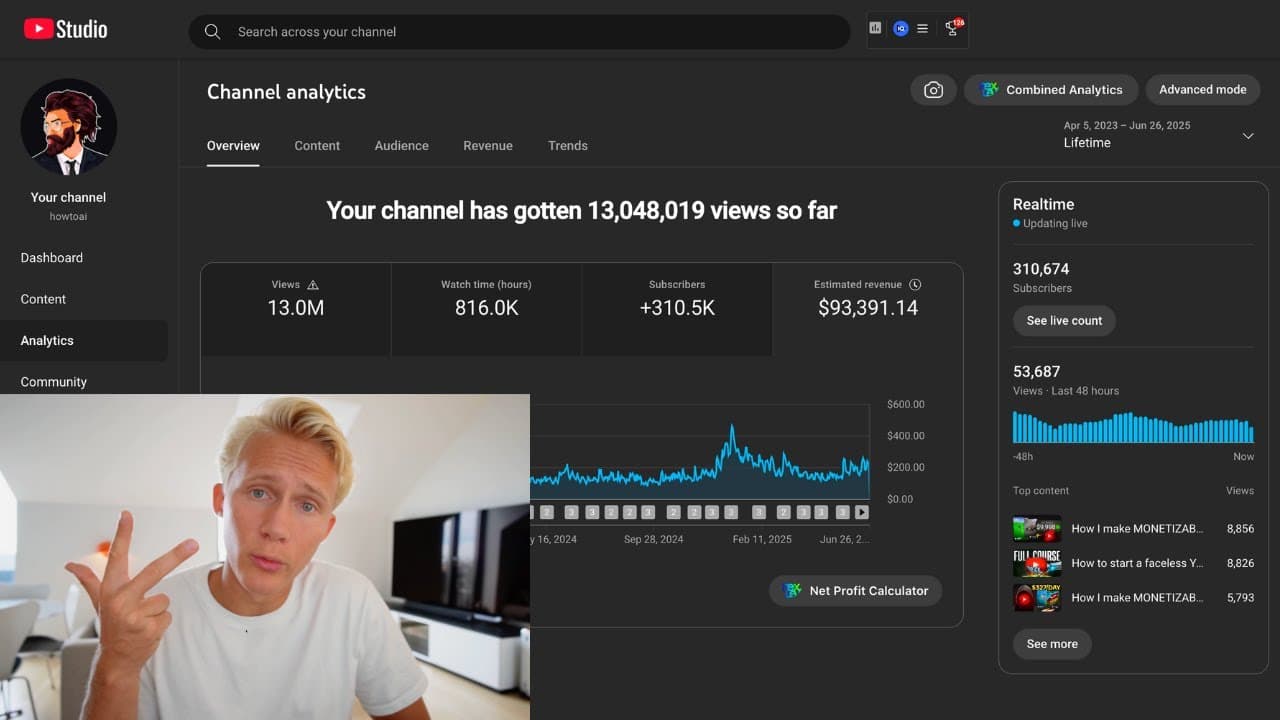
Choose a niche by finding recently launched channels with low subscriber counts and unusually high views, then validate each opportunity through detailed competitor analysis. AI-assisted paid tools can shorten the research process, while YouTube itself offers a free research path. Strong demand improves the odds of success, but sustained effort and consistent publishing remain necessary.
Transcript
If your first faceless YouTube video looks something like this, you know, two views, one subscriber, you got 37 impressions, then you're most likely trying to get into a niche that is very bad and you don't know too much about. Maybe even a niche that someone on Twitter has told you like, "Hey man, this is the best niche ever. Go for this." And it ... Read More
Key Insights
- A strong niche is a topic with visible audience demand, demonstrated by recent channels earning unusually high view counts despite having few subscribers or videos. The creator argues that niche demand can allow midquality content to perform, while weak demand can prevent expensive, polished content from attracting views.
- Recent outlier channels are useful research signals because their results show that a topic may still offer an opportunity for a new entrant. The featured examples include channels launched or repositioned within roughly the previous month that quickly gained viral videos, subscribers, monetization eligibility, or substantial view totals.
- A niche research data sheet is the first organizational tool in the process. It stores multiple niche candidates and supporting observations, helping the researcher compare opportunities systematically instead of relying on memory, excitement, or a recommendation from someone on Twitter.
- Competitor analysis is the second stage of niche validation. After collecting several possible niches, the researcher should examine each one more thoroughly to understand its competition and decide whether it is suitable to enter, rather than treating an isolated viral channel as sufficient proof.
- Paid niche research tools work by highlighting recently created or recently active channels with low subscriber counts and unusually high views. They can also show trending keywords and identify topics whose popularity is increasing or declining, reducing time spent on manual discovery and analysis.
- Shared research dashboards can increase competition because every subscriber may see the same featured channels and topics. The creator therefore warns against entering a niche immediately after discovering it in a paid tool and recommends completing independent due diligence and competitor analysis first.
- YouTube homepage research works better with a relatively fresh account because previous viewing activity can bias recommendations. Loading many homepage videos and sorting for channels with the fewest subscribers relative to their views can help surface promising outliers through the described browser extension.
- YouTube automation is not a get-rich-quick scheme, even when the chosen niche has strong demand. Posting one or ten videos does not guarantee meaningful income, and the creator emphasizes that results require consistent effort over a long period, including periods when uploads perform below expectations.
Install to Summarize YouTube Videos and Get Transcripts
Explore YouTube Video Summarizer or Get YouTube Transcript Extractor
Questions & Answers
Q: How do you find viral faceless YouTube niches?
Find recently launched or recently repositioned channels that have low subscriber counts, few uploads, and unusually high video views. Record several of these potential niches in a research data sheet, then perform detailed competitor analysis on each candidate. The strongest opportunities show recent audience demand and appear realistically reproducible, rather than depending on one unusual channel or video.
Q: What signals indicate that a YouTube niche has strong demand?
A promising signal is a new channel gaining unusually high views with only a small subscriber base and a limited number of uploads. The transcript highlights channels that began posting in a niche within roughly the previous month and quickly produced viral results. Multiple recent examples are more useful than one isolated success because they provide stronger evidence of current demand.
Q: Why does niche selection matter for faceless YouTube channels?
Niche selection matters because audience demand affects whether YouTube can find viewers interested in the content. According to the creator, a strong niche may allow midquality videos to gain substantial reach, while a niche with little demand can leave even polished and expensive videos without meaningful views. Content quality remains relevant, but it cannot create an audience that does not want the topic.
Q: How should a niche research data sheet be used?
A niche research data sheet should hold a collection of potential topics and the evidence supporting each opportunity. Its purpose is to keep discovery structured while the researcher gathers many candidates. Once enough possibilities have been recorded, those entries can move into a separate competitor analysis stage, where competition, channel recency, view performance, and practical suitability receive closer examination.
Q: Why is competitor analysis necessary before entering a niche?
Competitor analysis helps determine whether a promising niche is genuinely suitable or merely looks attractive because of one viral example. It should examine the channels already serving the topic, how recently successful channels appeared, and whether their content can be recreated. This step is especially important when using shared paid tools because many users can see and pursue the same highlighted opportunities.
Q: How can paid AI tools speed up YouTube niche research?
Paid tools can reduce manual work by surfacing recently added outlier channels, displaying subscriber and view relationships, and showing trending keywords. The transcript describes a platform that highlights new channels receiving exceptional views and a Chrome extension that brings filtering into YouTube. These tools can save hours or days, but their findings still require independent validation before choosing a niche.
Q: How can YouTube itself be used for niche research?
YouTube can support niche discovery by providing homepage recommendations that researchers inspect for unusual view performance. The described process involves loading many homepage videos and using filters to prioritize channels with low subscriber counts but high views. A relatively fresh YouTube account is preferable because an account with extensive watch history may produce recommendations biased toward previously viewed subjects.
Q: Can YouTube automation generate quick income from a few videos?
YouTube automation does not guarantee quick income from one video or even ten videos. The creator explicitly describes it as something other than a get-rich-quick scheme and says sustained consistency is required, including when uploads underperform. A well-researched niche may save months during early channel growth, but it does not remove the need to learn the process and continue publishing over time.
Summary & Key Takeaways
-
The method begins with identifying recently launched channels that have few subscribers but unusually successful videos. These outlier channels can reveal topics with current audience demand. The creator recommends recording multiple possibilities in a niche research data sheet instead of immediately copying the first promising channel discovered through a tool or YouTube search.
-
After gathering possible niches, each option should undergo deeper competitor analysis. The goal is to determine how much competition exists, whether the content format can realistically be recreated, and whether several recent channels are succeeding. A single viral example is insufficient because paid research dashboards expose the same opportunities to many users.
-
Paid tools can surface recently added outlier channels, trending keywords, subscriber-to-view relationships, and other useful signals. A lower-cost Chrome extension can integrate similar filters into YouTube. Free research is also possible directly on the platform, preferably with a relatively fresh account so previous viewing behavior does not heavily bias homepage recommendations.
Read in Other Languages (beta)
Share This Summary 📚
Summarize YouTube Videos and Get Video Transcripts with 1-Click
Try YouTube Summary with ChatGPT & Claude or YouTube Transcript Generator
Explore More Summaries from Leo Grundström 📚

![how to make ORIGINAL faceless YouTube channels with AI [FULLY AUTOMATED] thumbnail](/_next/image?url=https%3A%2F%2Fi.ytimg.com%2Fvi%2FYnASDGOMvFo%2Fhqdefault.jpg&w=750&q=75)

![Easiest way to make money online using AI [FULL COURSE] thumbnail](/_next/image?url=https%3A%2F%2Fi.ytimg.com%2Fvi%2FNJpbv2Yddh8%2Fhqdefault.jpg&w=750&q=75)
Summarize YouTube Videos and Get Video Transcripts with 1-Click
Try YouTube Summary with ChatGPT & Claude or YouTube Transcript Generator