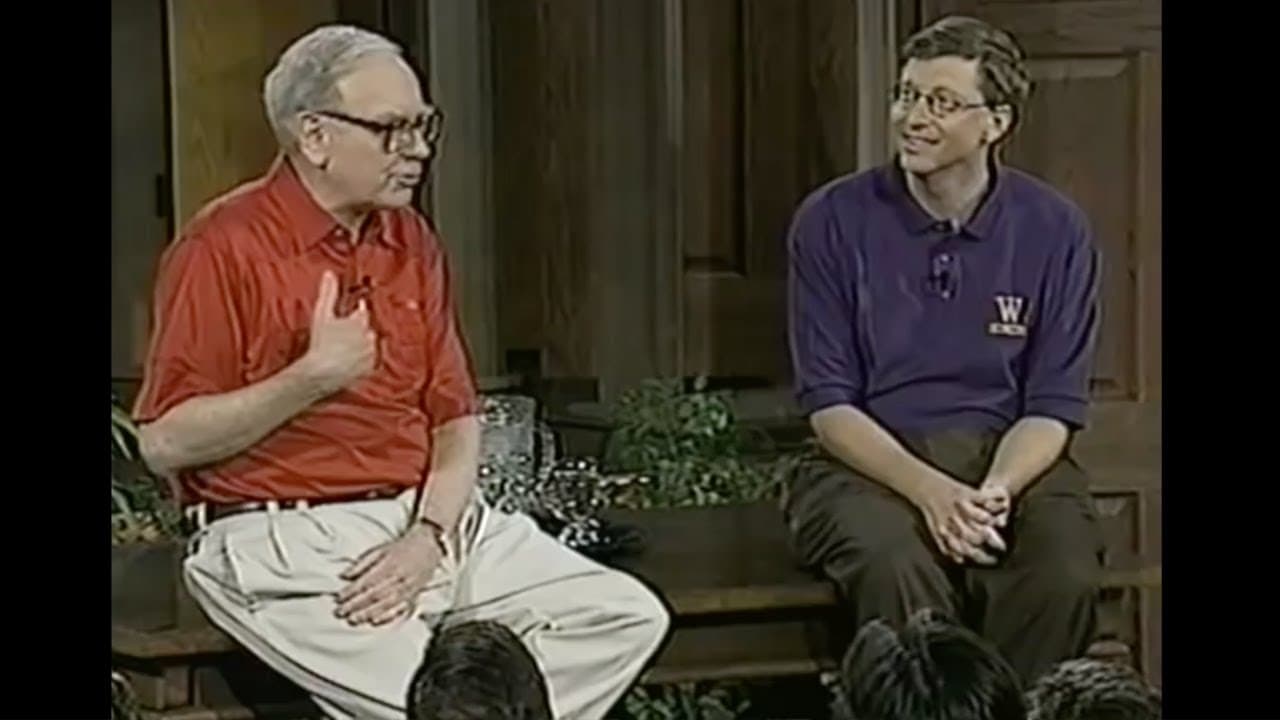
Warren Buffett | Bill Gates | Lecture | University Of Washington | 1998
TL;DR
Personal success comes from doing work you enjoy with people you admire, while developing habits that convert talent into effective action. Warren Buffett emphasizes rationality, character, and happiness at work, while Bill Gates credits early exposure to computers, a clear technological vision, teamwork, intense focus, and entering the software industry near its beginning.
Transcript
you ought to be happy where you are working and i always worry about people who say you know i'm going to do this for 10 years i really don't like it very well then i'll do 10 more years of this i mean that's a little like saving up sex for your old age i mean not a very good idea when i started microsoft i didn't think of it as all that risky you'... Read More
Key Insights
- Rationality is the factor Buffett identifies as converting intelligence and talent into useful output. He argues that people with exceptional mental ability can perform below their potential when habits, temperament, or character cause them to behave irrationally or interfere with their own progress.
- Personal habits are qualities that young people can intentionally shape through repeated practice. Buffett advises identifying an admired classmate, listing that person's appealing qualities, and adopting those behaviors, since the traits people respect are generally learnable rather than dependent on rare physical abilities.
- Undesirable behavior can be avoided by studying the qualities that make another person difficult to respect. Buffett recommends listing those qualities and deciding not to practice them, creating a practical contrast between the habits that strengthen character and those that obstruct personal effectiveness.
- Habits become harder to change as they grow stronger over time. Buffett says students will possess in 20 years the habits they choose to practice today, making early, deliberate behavior especially important for future character, rational decision-making, and the productive use of their abilities.
- Microsoft's original vision was based on the expectation that advances in chip technology would make computing broadly accessible. Gates and his friends saw software as a tool for magnifying brain power and imagined computers reaching every desk and every home.
- Focused teamwork helped Gates turn an early technological vision into a company. He describes gathering friends who wrote software, considering the technology's possibilities, working together as a team, and pursuing the opportunity with extraordinary concentration while the personal-computer industry was still beginning.
- Happiness at work is central to Buffett's definition of personal success. He describes doing what he likes every day, working with people he likes, avoiding relationships that make him uncomfortable, and feeling enthusiastic about going to work rather than treating employment as prolonged sacrifice.
- Career fit comes from choosing enjoyable work that matches a person's natural strengths. Buffett says he found the activity he does best and warns against spending decades in disliked work while postponing fulfillment, because immediate engagement with suitable work can support both happiness and success.
Install to Summarize YouTube Videos and Get Transcripts
Explore YouTube Video Summarizer or Get YouTube Transcript Extractor
Questions & Answers
Q: How does Warren Buffett define personal success and happiness?
Warren Buffett connects happiness with doing work he likes every day and doing it alongside people he likes. He values freedom from having to associate with people who make him uncomfortable and describes himself as enthusiastic about going to work. He distinguishes success as getting what a person wants and happiness as wanting what a person gets, while emphasizing that his own work is right for how he is wired.
Q: Why does Warren Buffett consider rationality more important than additional IQ?
Buffett says everyone in the student audience already has more intelligence than required to do his job. He compares IQ and talent to an engine's horsepower, but says actual output depends on how efficiently that power is used. Rational behavior, supported by character, temperament, and productive habits, prevents smart people from interfering with their own abilities and helps them convert more potential into results.
Q: How can students build the character traits they admire?
Buffett recommends selecting the classmate they admire most and writing down the qualities that create that admiration. He says these qualities are generally behaviors students can practice and gradually make habitual, rather than abilities such as throwing a football 70 yards. By deliberately repeating admired conduct, students can make those qualities part of their own character and improve how effectively they use their talents.
Q: How can identifying negative traits improve personal habits?
Buffett advises students to identify the person they can least stand and list the qualities that repel them. They can then decide not to practice those behaviors themselves. Paired with a list of admired qualities, this exercise provides a concrete guide for what to adopt and what to avoid, helping students reduce self-defeating conduct before repeated behavior becomes a deeply established habit.
Q: Why does Buffett say habits should be shaped while people are young?
Buffett says the chains of habit are initially too light to feel but eventually become too heavy to break. He tells students that the behaviors they practice now will become the habits they possess 20 years later. Because he believes his own habits are difficult to change at his age, he urges younger people to choose admirable patterns early, while deliberate practice can still shape lasting behavior.
Q: How did Bill Gates describe the original vision behind Microsoft?
Gates says early exposure to computers fascinated him even though the machines were expensive and limited. He and his friends expected advances in chip technology to make computing useful to everyone. They viewed software as a way to magnify brain power rather than muscle power and pursued a vision of placing a computer on every desk and in every home.
Q: What factors did Bill Gates credit for Microsoft's development?
Gates credits a combination of early technological insight, teamwork, focus, and timing. He and his friends recognized the potential of improving computer chips, recruited friends who could write software, and considered how broadly the technology might be used. By working with extraordinary focus and participating near the industry's beginning, they built a company that played a central role in the developing information age.
Q: What career advice does Warren Buffett give to students?
Buffett advises students to work for organizations they admire and with people they admire, because those surroundings can make work energizing. He warns against spending 10 years in disliked work and then planning to endure another 10 before pursuing enjoyment. His recommendation is to begin doing enjoyable work that fits personal strengths, rather than postponing fulfillment for a distant stage of life.
Summary
Warren Buffett and Bill Gates, two of the most successful business leaders, share their insights and experiences in a conversation with students. They discuss topics such as defining success, the role of innovation, the impact of technology, the importance of heroes/role models, giving back to society, and starting a new company.
Questions & Answers
Q: How do Warren Buffett and Bill Gates define success personally?
Warren Buffett finds happiness in doing what he loves every single day, surrounded by people he enjoys working with. He advises finding a job that you admire and brings you happiness. Bill Gates, on the other hand, defines success as enjoying what you do every day and working with smart people on new problems. He believes that success comes from magnifying brain power instead of muscle power.
Q: Who were the biggest role models for Warren Buffett and Bill Gates growing up and how did they contribute to their success?
Warren Buffett had great parents who were involved in interesting activities and discussed business, law, and politics with their children. He also admired his wife for her exceptional skills in dealing with people. Watching and learning from these role models influenced his success. Bill Gates mentioned his fascination with scientists who came up with new ideas, sparking his interest in technology. Both Buffett and Gates emphasize the importance of having heroes/role models, which can significantly impact one's success.
Q: What is the role of innovation in their respective businesses?
Warren Buffett's main role is to allocate capital and keep his team of managers motivated. He believes his job is not to innovate directly, but to support and enable his managers to innovate. Bill Gates, as the co-founder and CEO of Microsoft, acknowledges that innovation is a constant necessity in the technology industry. His focus is on staying on top of the latest technological advancements and ensuring that Microsoft adapts and innovates to navigate the twists and turns of the industry.
Q: How do Warren Buffett and Bill Gates approach giving back to their communities and encouraging others to do the same?
Both Buffett and Gates have a similar philosophy of giving back to society. They believe that the majority of their wealth should benefit society rather than being hoarded by individuals. Warren Buffett plans to donate 99% or more of his wealth, considering it a moral obligation to support a society that has treated him well. They both emphasize a meritocracy and believe that wealth should be earned through individual effort rather than through inheritance.
Q: How do Warren Buffett and Bill Gates view the impact of technology on businesses and industries globally?
Warren Buffett focuses on investing in businesses with predictable futures, avoiding the more unpredictable impact of technology. He believes in investing in businesses like Coca-Cola that are not heavily affected by technological advancements. Bill Gates, however, sees technology as a disruptive force that can revolutionize businesses. He acknowledges that technology companies are more prone to risks and changes but believes that the potential rewards can be substantial.
Q: How do Warren Buffett and Bill Gates approach the decision to start a new company?
Warren Buffett believes that starting a new company is not as risky as it may seem, especially when you are passionate about what you are doing. He advises considering the potential risks and rewards and finding a business where you can fully utilize your skills and passion. Bill Gates agrees that starting a company requires a lot of energy and determination. He suggests gaining experience by working for an established company to learn how things work before venturing out on your own.
Q: What do Warren Buffett and Bill Gates consider their best business decisions?
Warren Buffett believes that his best business decision was simply getting into the game and pursuing what he loves. Bill Gates considers starting Microsoft and believing in the potential of personal computers as his best decision. Both acknowledge that successful business decisions often involve taking risks and having a passion for what you do.
Q: How do Warren Buffett and Bill Gates view the opportunities and challenges of the information age globally?
Both Buffett and Gates see tremendous opportunities for growth and development in the information age. They acknowledge that developed countries, especially the United States, are in a favorable position to benefit from these advancements. However, they emphasize that developing countries, with a focus on education and technology adoption, can also benefit greatly and reduce the income gap. They believe that globalization and advancements in technology will create a more level playing field for individuals around the world.
Q: How do Warren Buffett and Bill Gates view the impact of technology on businesses and industries globally?
Warren Buffett focuses on investing in businesses with predictable futures, avoiding the more unpredictable impact of technology. He believes in investing in businesses like Coca-Cola that are not heavily affected by technological advancements. Bill Gates, however, sees technology as a disruptive force that can revolutionize businesses. He acknowledges that technology companies are more prone to risks and changes but believes that the potential rewards can be substantial.
Q: How do Warren Buffett and Bill Gates approach the decision to start a new company?
Warren Buffett believes that starting a new company is not as risky as it may seem, especially when you are passionate about what you are doing. He advises considering the potential risks and rewards and finding a business where you can fully utilize your skills and passion. Bill Gates agrees that starting a company requires a lot of energy and determination. He suggests gaining experience by working for an established company to learn how things work before venturing out on your own.
Takeaways
Warren Buffett and Bill Gates share valuable insights in this conversation. They emphasize the importance of happiness and passion in one's work. Both stress the role of heroes or role models in shaping success. They believe in giving back to society and the importance of a meritocracy. While Buffett focuses on investing in predictable businesses, Gates highlights the disruptive potential of technology. They both see opportunities for global growth in the information age but emphasize the need for developing countries to invest in education and technology adoption.
Summary & Key Takeaways
-
Warren Buffett argues that exceptional performance depends less on additional intelligence than on rationality, temperament, character, and habits. He compares talent to an engine whose potential can be wasted through self-defeating behavior. Students can improve their output by deliberately practicing admirable qualities and rejecting behaviors they find objectionable in others.
-
Bill Gates describes how early access to expensive, limited computers inspired him and his friends to anticipate the impact of improving chip technology. They believed software could magnify brain power, assembled a team of friends, pursued their vision with intense focus, and helped build a company central to the developing information age.
-
Buffett defines happiness through daily alignment between work, personal strengths, and chosen relationships. He enjoys his work, associates with people he likes, and advises students to join organizations and colleagues they admire. Instead of enduring years of disliked work, people should begin pursuing enjoyable work that fits how they are naturally wired.
Read in Other Languages (beta)
Share This Summary 📚
Summarize YouTube Videos and Get Video Transcripts with 1-Click
Try YouTube Summary with ChatGPT & Claude or YouTube Transcript Generator
Explore More Summaries from Investor Archive 📚




Summarize YouTube Videos and Get Video Transcripts with 1-Click
Try YouTube Summary with ChatGPT & Claude or YouTube Transcript Generator