Can Machines Truly Think Like Humans?
TL;DR
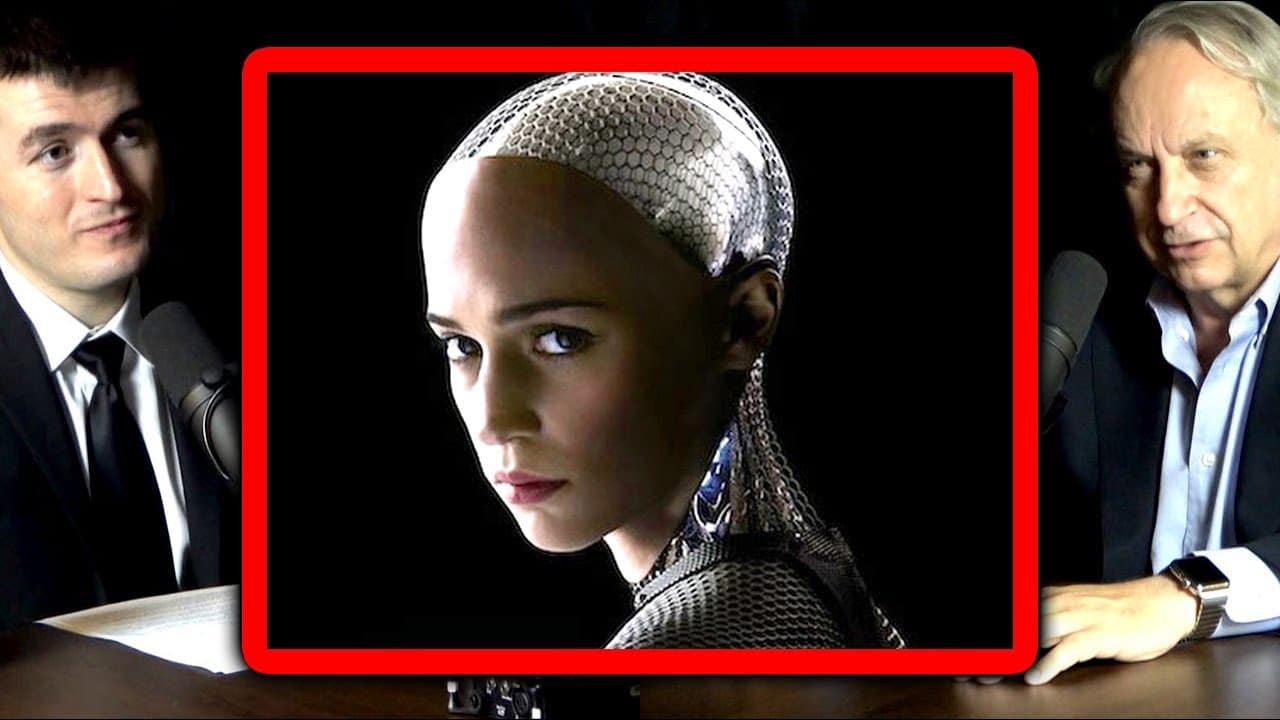
Machines can think, but creating devices with human-like intelligence is still an ongoing challenge. This discussion traces the evolution of computation from Turing's early concepts to modern interpretations, highlighting the complex relationship between human intelligence and artificial systems.
Transcript
just uh a decade or so before in in 1950 alan turing wrote the paper that formulated the touring test and he opened that paper with the question can machines so let me ask you this question can machines think can your ice cube tray one day think um certainly machines can think because i believe you're a machine and i'm a machine and i believe we bo... Read More
Key Insights
- 🦾 Computation, as defined by Turing, is a formalized model of mechanical processes for calculation.
- 👖 The history of computation spans centuries, with significant contributions from individuals like Babbage, Lovelace, and Hilbert.
- 🛰️ Various disciplines, such as artificial intelligence, neuroscience, and artificial life, have embraced computation as a metaphor for understanding and simulating complex systems.
- 🔨 Computation is a powerful tool but may not fully capture the intricacies and nuances of human intelligence.
- 🔨 Metaphors, like computation, are necessary tools for understanding complex concepts beyond our cognitive capabilities.
- 🤔 The limitations of human thinking and our desire for metaphorical understanding can sometimes hinder scientific progress.
- 👶 The future of computation as a dominant metaphor may evolve as new scientific discoveries challenge its applicability.
- 🎙️ More videos with Rodney Brooks:
Install to Summarize YouTube Videos and Get Transcripts
Explore YouTube Video Summarizer or Get YouTube Transcript Extractor
Questions & Answers
Q: Can machines think?
Yes, machines can think because thinking is not exclusively limited to humans. As both machines and humans are essentially information processing systems, they can engage in cognitive processes.
Q: What is computation and how was it defined by Turing?
Computation, as defined by Turing, involves a mechanical process that can produce an arbitrary number of digits based on a set of rules. It is a formalized representation of the way humans perform calculations using pencil and paper.
Q: Is there a fundamental difference between human and computer intelligence?
From a philosophical standpoint, there may be significant differences. The book "Not Even Wrong" argues that the biological computer in our brains is distinct from the mechanical computers envisioned by Turing. The nature of intelligence involves more than just computation.
Q: Why has computation become a dominant metaphor in various fields?
Computation offers a conceptual framework that is relatively easy to implement and understand. It has been adopted by fields like artificial intelligence, neuroscience, and artificial life due to its ability to capture the essence of certain processes and behaviors.
Summary & Key Takeaways
-
The concept of computation and its history, starting from Alan Turing's paper in 1950, is discussed.
-
The distinction between human intelligence and the type of computation Turing envisioned is explored.
-
The book "Not Even Wrong" delves into the history of computation and the different disciplines that have adopted it as their primary metaphor.
-
Computation is seen as a powerful tool but may not fully capture the complexity of human thinking.
Read in Other Languages (beta)
Share This Summary 📚
Summarize YouTube Videos and Get Video Transcripts with 1-Click
Try YouTube Summary with ChatGPT & Claude or YouTube Transcript Generator
Explore More Summaries from Lex Clips 📚

Summarize YouTube Videos and Get Video Transcripts with 1-Click
Try YouTube Summary with ChatGPT & Claude or YouTube Transcript Generator