How to Start Building AI Agents with LangGraph
TL;DR
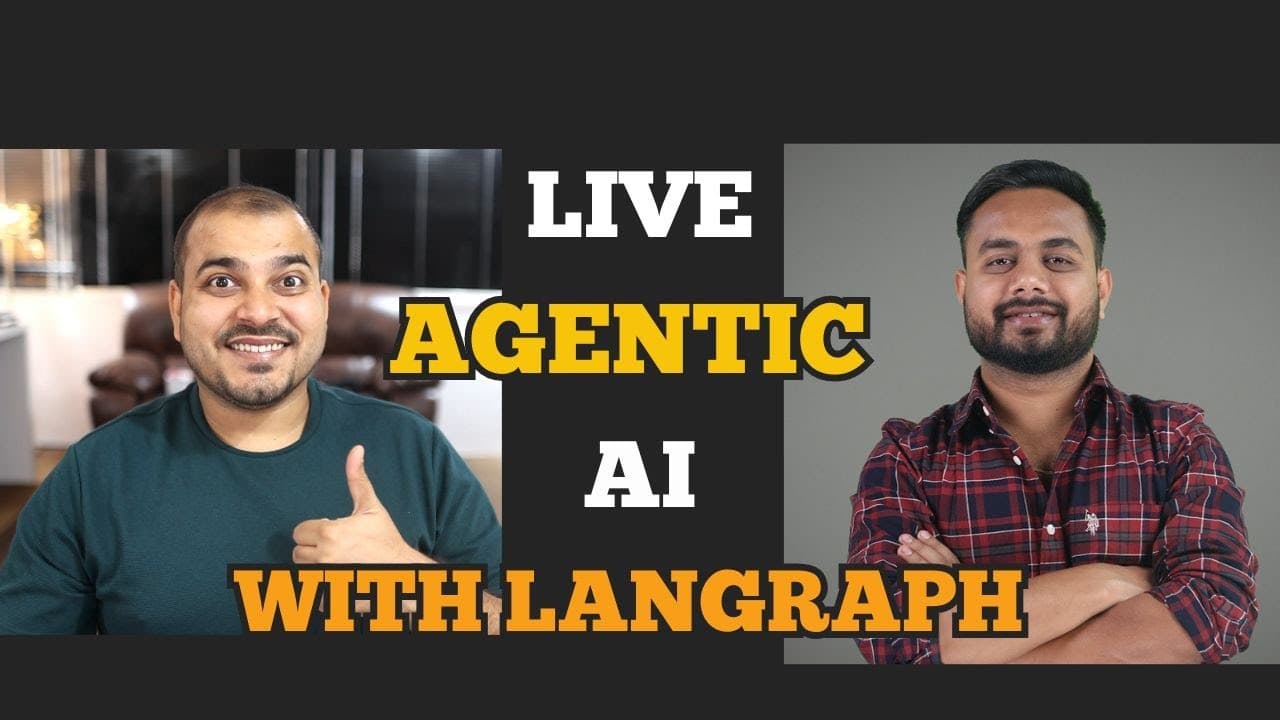
Start building AI agents with LangGraph by first understanding agents and available frameworks, then configuring model access, API keys, and LangSmith tracking before creating an agentic chatbot. This live session introduces an ongoing series with additional sessions planned for Monday and Tuesday, while human-in-the-loop workflows are reserved for later. Read on for the prerequisites, agenda, project goal, and related bootcamp details.
Transcript
hey guys can you give me a quick confirmation if everybody is able to hear me out I'll just wait for some time so that everybody joins hello everyone hello Kesh hello hello everybody hello I hope everybody's doing well I hope everybody's doing fine today we are just going to have one another amazing session uh I'll talk about the agenda each and ev... Read More
Key Insights
- AI agents are the starting concept for the series, with the instructor planning to explain what they are and why they matter before introducing implementation details. This conceptual foundation is intended to clarify what makes the planned chatbot agentic.
- LangGraph is presented as an important framework for building AI agents. The session plans to examine its documentation, explain its setup, and demonstrate how to code an agentic application from scratch rather than treating it only as a theoretical topic.
- The practical workflow begins with configuring access to a model and setting the required API keys. These setup tasks are positioned as prerequisites for writing LangGraph code and creating the planned chatbot application.
- LangSmith is proposed as the tracking mechanism for executions and instructions. The instructor says it can be configured through an API key, allowing activity to be inspected through LangSmith instead of requiring a separately developed custom logging system.
- An agentic chatbot is the main application planned for the LangGraph demonstration. The instructor intends to use this project to connect the introductory explanation of agents with framework setup, model access, tracking, and code written from scratch.
- Human-in-the-loop functionality is identified as a LangGraph concept, but it is not scheduled for the introductory session. The instructor says it will be explained later as the series continues through upcoming sessions.
- The LangGraph material is planned as a continuing series rather than a single isolated class. Additional sessions are expected on Monday and Tuesday, with future lessons adding theoretical presentations and concepts such as human-in-the-loop workflows.
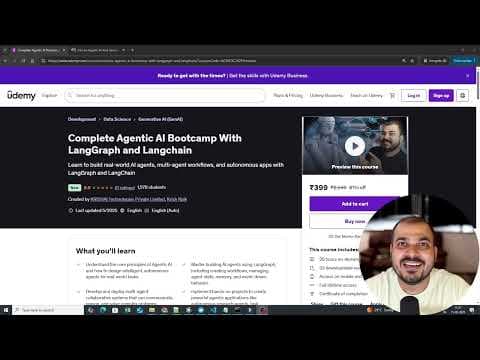
- The associated bootcamp combines agentic AI and generative AI application development with AWS and GCP. Its stated scope includes frameworks, end-to-end projects, fine-tuning, application building, deployment, LangSmith, AutoGen, Langflow, and other topics across approximately 28 modules.
Install to Summarize YouTube Videos and Get Transcripts
Explore YouTube Video Summarizer or Get YouTube Transcript Extractor
Questions & Answers
Q: How should beginners start building AI agents with LangGraph?
Begin by understanding what AI agents are, why they matter, and which frameworks are available. Then review LangGraph documentation, configure model access and API keys, connect LangSmith for tracking, and apply the setup by building an agentic chatbot from scratch.
Q: What application does the LangGraph session plan to build?
The session plans to build an end-to-end agentic AI application using LangGraph, with an agentic chatbot as the practical project. The instructor connects that project to model access, API-key configuration, LangSmith tracking, and coding from scratch.
Q: What must be configured before coding with LangGraph?
The planned setup includes access to a model and the necessary API keys. LangSmith is also configured with an API key so instructions and executions can be tracked during the LangGraph workflow.
Q: How is LangSmith used in the LangGraph workflow?
LangSmith is presented as the mechanism for tracking instructions and executions. After its API key is configured, activity can be inspected through LangSmith instead of requiring a custom logging system.
Q: What topics are included in the LangGraph session agenda?
The agenda starts with AI agents, their importance, and an overview of available agent frameworks. It then covers LangGraph documentation, environment and model setup, API keys, LangSmith tracking, coding from scratch, and the planned agentic chatbot.
Q: Does this introductory session cover human-in-the-loop workflows?
No. Human-in-the-loop is identified as a LangGraph concept, but the instructor reserves it for a later lesson as the series continues.
Q: Will the LangGraph material continue after this live session?
Yes. The instructor says the LangGraph series will not be limited to the current session and plans additional sessions for Monday and Tuesday. Later lessons are expected to add more theory and concepts such as human-in-the-loop workflows.
Q: What does the associated agentic AI and generative AI bootcamp cover?
The bootcamp focuses on agentic AI and generative AI application development for AWS and GCP, from fine-tuning through building and deployment. Its syllabus includes approximately 28 modules, multiple frameworks, end-to-end projects, LangSmith, AutoGen, and Langflow, and the announced batch starts January 25, 2025, from 3 PM to 6 PM IST every Saturday and Sunday.
Summary & Key Takeaways
-
The live session introduces a planned LangGraph series focused on building agentic AI applications from scratch. Its agenda begins with the meaning and importance of AI agents, continues with an overview of available agent frameworks, and then moves toward LangGraph documentation, environment setup, model access, API keys, and practical coding.
-
A central practical goal is to create an agentic chatbot with LangGraph. Before that implementation, the instructor plans to demonstrate the required setup and connect LangSmith so executions and instructions can be tracked without creating a custom logging system. The supplied transcript ends during the introductory agenda rather than the completed build.
-
The broader program described alongside the session covers agentic AI and generative AI application development for AWS and GCP. The announced bootcamp starts January 25, 2025, runs from 3 PM to 6 PM IST on Saturdays and Sundays, and includes approximately 28 modules, projects, deployment, and fine-tuning topics.
Read in Other Languages (beta)
Share This Summary 📚
Summarize YouTube Videos and Get Video Transcripts with 1-Click
Try YouTube Summary with ChatGPT & Claude or YouTube Transcript Generator
Explore More Summaries from Krish Naik 📚

Summarize YouTube Videos and Get Video Transcripts with 1-Click
Try YouTube Summary with ChatGPT & Claude or YouTube Transcript Generator