How Does Light Connect Timelessness and Matter?
TL;DR
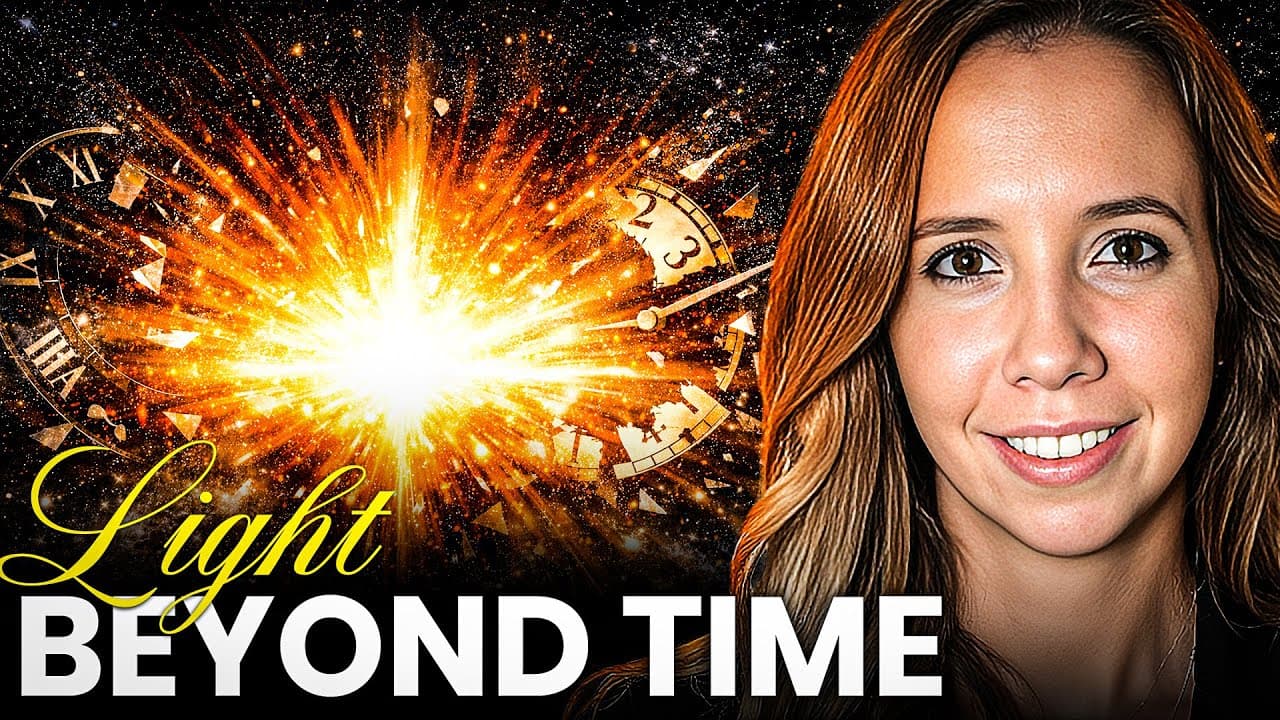
The central argument is that light links timelessness to the emergence of matter: photons travel at light speed, while confined energy contributes to the mass and stability of physical structures. The presentation connects special relativity and quantum chromodynamics with Genesis, then extends the comparison into theological claims about creation, incarnation, consciousness, prayer, and the human body's measurable photon emissions.
Transcript
What if I told you that light doesn't experience time? Not metaphorically, not spiritually, but according to the fundamental equations of physics. Photons exist in a timeless state. And what if I told you that almost all of your mass, 99% of what makes you physically real, comes from massless particles trapped in a confinement. You're already made ... Read More
Key Insights
- Light is presented as timeless because a freely traveling photon moves exactly at light speed, and the mathematical limit of special relativity assigns zero elapsed proper time to its path from creation to destruction.
- The Genesis creation account is interpreted as beginning with light because light allegedly shares a timeless quality with God. The command "Let there be light" is therefore framed as establishing a bridge between eternity and the unfolding temporal universe.
- Most human mass is described as arising from protons and neutrons, which contain quarks and massless gluons. The presentation argues that interactions and confinement within these particles produce mass even though a key constituent, the gluon, has zero rest mass.
- Mass is characterized as emergent rather than fundamental. According to the video's explanation, energy confined within stable, bounded patterns can contribute to mass, making physical matter comparable to energy that has cooled, condensed, and formed lasting structures.
- Photons are said to carry finite energy and momentum despite having zero rest mass. The presentation uses the idea of an indeterminate mathematical form to describe how light occupies a boundary condition between zero mass and motion at light speed.
- The incarnation is compared with mathematical indeterminacy because Jesus is described as fully divine and fully human, infinite and finite at once. The presentation treats this theological paradox as analogous to light crossing the conceptual boundary between timelessness and temporal existence.
- A photon's path is described as containing no experienced journey because no proper time elapses between emission and absorption. The presentation connects this picture with the theological belief that God holds past, present, and future together in an eternal present.
- Living cells are described as emitting biophotons, weak but measurable particles of light. The presentation cites Alexander Gerwitch's 1923 discovery and Masaki Kobayashi's imaging work, then claims that human light emissions vary with health and states of consciousness.
Install to Summarize YouTube Videos and Get Transcripts
Explore YouTube Video Summarizer or Get YouTube Transcript Extractor
Questions & Answers
Q: Why does the presentation say that light does not experience time?
The presentation applies special relativity to a freely traveling photon. As an object approaches light speed, time dilation increases relative to other observers. Because photons always travel exactly at light speed, the presentation says zero proper time separates their creation and destruction. A photon emitted by a distant star and later absorbed by an eye is therefore described as having no experienced interval or journey.
Q: How does the video connect light with the Genesis creation account?
The presentation interprets the command "Let there be light" as more than the beginning of visible illumination. Because light is characterized as having no elapsed proper time, it is compared with God's eternal nature and the divine name "I am." Light consequently becomes a proposed bridge between eternity and the temporal universe that develops after the opening act of creation.
Q: How can massless particles contribute to the mass of matter?
The presentation explains that most human mass comes from protons and neutrons, which are composed of quarks and gluons. Gluons have zero rest mass, but they are confined within an extremely small region and interact through the strong nuclear force. The associated motion, interaction, and trapped energy contribute to the mass of the composite particle, supporting the video's claim that mass can emerge from confined energy.
Q: What does the phrase matter is frozen light mean here?
The phrase expresses the presentation's view that matter is not fundamentally separate from energy. Energy can become confined, cool, and settle into stable patterns that behave as solid physical structures. The video compares this process with water freezing into ice: the form and properties change, but the underlying reality remains. It consequently describes the human body as energy crystallized into an enduring physical arrangement.
Q: What is the video's explanation for photon momentum?
The presentation says photons have zero rest mass but still carry energy and transfer momentum while moving at light speed. It describes the relativistic momentum equation as producing an indeterminate boundary condition when zero rest mass is combined with the light-speed limit. This mathematical framing is offered as the reason a photon can possess finite, nonzero momentum without having rest mass or violating physical laws.
Q: How does the presentation compare light with the incarnation?
The incarnation is described as a union of apparently opposing qualities: Jesus is fully God and fully human, eternal and temporal, infinite and finite. The presentation compares that theological claim with the mathematical boundary conditions associated with light. In its analogy, both provide a way for something timeless to enter temporal existence without surrendering its original nature, making the phrase "light of the world" ontological rather than merely metaphorical.
Q: What would the universe be like along a photon's path?
The presentation says that no proper time elapses along a freely traveling photon's path and that length contracts in its direction of motion. It therefore depicts emission and absorption as sharing a single instant, regardless of the distance measured by outside observers. The photon is not said to perceive events or undertake a journey. Instead, the thought experiment illustrates the video's concept of timeless physical existence.
Q: What are biophotons, according to the presentation?
Biophotons are described as weak but measurable particles of light emitted by living cells. The presentation attributes their discovery to Alexander Gerwitch in 1923 and says Masaki Kobayashi later photographed human light emissions using photon detection. It further claims that these emissions are not random and may vary with health, prayer, meditation, focused intention, and other states of consciousness.
Summary & Key Takeaways
-
The presentation begins with the claim that no time passes along a freely traveling photon's path. It interprets this feature of light through Genesis, proposing that the command to create light established a bridge between God's eternal nature and the temporal universe that would subsequently develop into matter and distinct physical beings.
-
Most bodily mass is attributed to energy associated with protons and neutrons, which contain quarks and massless gluons. The presentation describes confinement as the process through which interacting energy contributes to mass, then characterizes matter as energy condensed into stable patterns, using frozen water as an analogy for physical embodiment.
-
The final sections compare mathematical indeterminacy with the incarnation, imagine the universe along a photon's path, and connect timelessness with prayer, prophecy, and consciousness. They also discuss biophotons, weak measurable light emissions from living cells, as physical evidence supporting the broader theme that human bodies literally emit light.
Read in Other Languages (beta)
Share This Summary 📚
Summarize YouTube Videos and Get Video Transcripts with 1-Click
Try YouTube Summary with ChatGPT & Claude or YouTube Transcript Generator
Explore More Summaries from Julia McCoy 📚




Summarize YouTube Videos and Get Video Transcripts with 1-Click
Try YouTube Summary with ChatGPT & Claude or YouTube Transcript Generator