What Is Learning Rate Decay and How Does It Work?
TL;DR
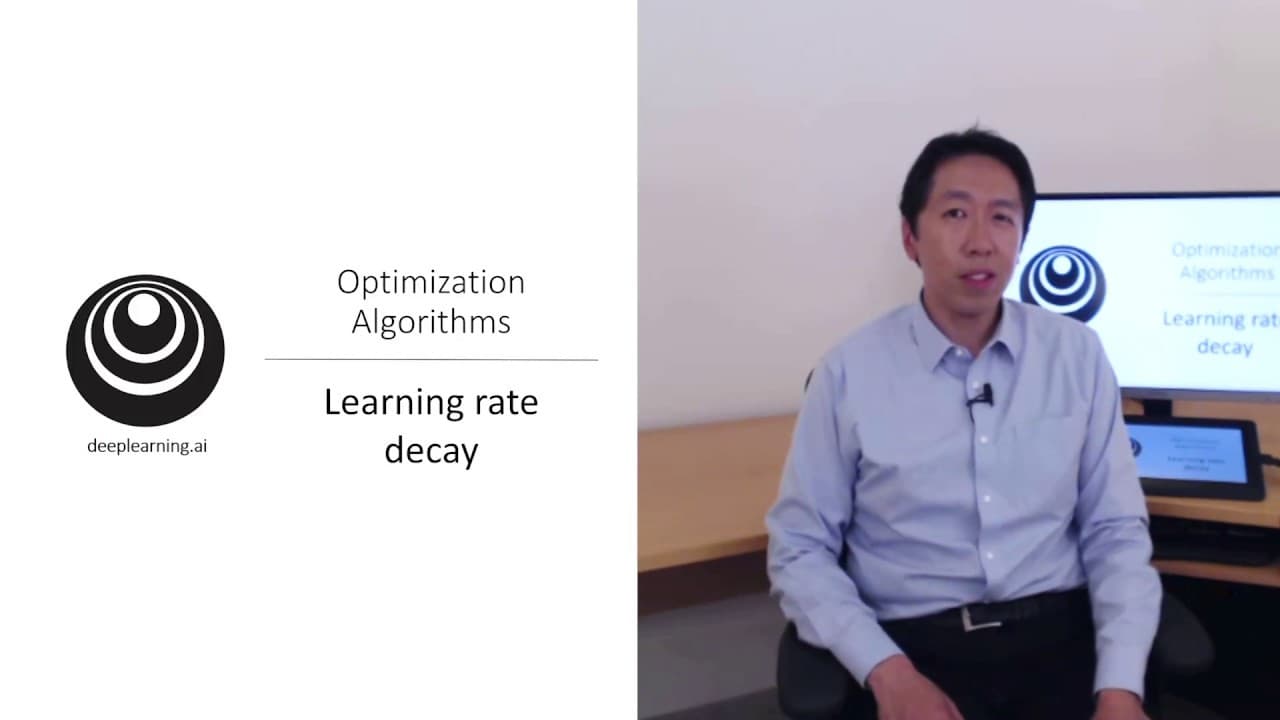
Learning rate decay is a technique that gradually reduces the learning rate in algorithms to improve convergence and minimize noise, particularly in mini-batch gradient descent. By starting with a larger learning rate and decreasing it over time, the algorithm can take smaller, more precise steps towards the minimum. Various methods, like exponential and staircase decay, can be used to implement this approach.
Transcript
one of the things that might help speed up your learning algorithm is to slowly reduce your learning rate over time we call this learning rate decay let's see how you can implement this let's start - an example of why you might want to implement learning rate decay suppose you're implementing mini batch gradient descent with a reasonably small mini... Read More
Key Insights
- ☠️ Learning rate decay helps minimize noise and improve convergence in mini-batch gradient descent.
- 😚 Gradually reducing the learning rate allows for smaller steps closer to the minimum and prevents wandering behavior.
- ☠️ Different formulas can be used for learning rate decay, including exponential decay and discrete staircase decay.
Install to Summarize YouTube Videos and Get Transcripts
Explore YouTube Video Summarizer or Get YouTube Transcript Extractor
Questions & Answers
Q: Why might you want to implement learning rate decay?
Learning rate decay is beneficial when using mini-batch gradient descent with small mini-batches, as it reduces noise and prevents the algorithm from wandering around without converging.
Q: How can learning rate decay be implemented?
Learning rate decay can be implemented by adjusting the learning rate using a formula that takes into account the number of epochs and a decay rate. The learning rate gradually decreases over time, allowing for slower and smaller steps.
Q: What are some other formulas for learning rate decay?
Besides the formula mentioned, other options for learning rate decay include exponential decay, decay based on epoch number and mini-batch number, and discrete staircase decay.
Q: Is manually controlling the learning rate a viable option?
Manually controlling the learning rate can be effective when training only a small number of models. However, it is not practical for large-scale training and is often replaced by automated techniques.
Summary & Key Takeaways
-
Learning rate decay is useful in minimizing noise and ensuring convergence in mini-batch gradient descent algorithms.
-
By gradually reducing the learning rate, the algorithm takes smaller steps towards the minimum, leading to better convergence.
-
Implementing learning rate decay involves adjusting the learning rate based on the number of epochs and a decay rate.
Read in Other Languages (beta)
Share This Summary 📚
Summarize YouTube Videos and Get Video Transcripts with 1-Click
Try YouTube Summary with ChatGPT & Claude or YouTube Transcript Generator
Explore More Summaries from DeepLearningAI 📚





Summarize YouTube Videos and Get Video Transcripts with 1-Click
Try YouTube Summary with ChatGPT & Claude or YouTube Transcript Generator