Conductors and Insulators - Electrical Conductivity
TL;DR
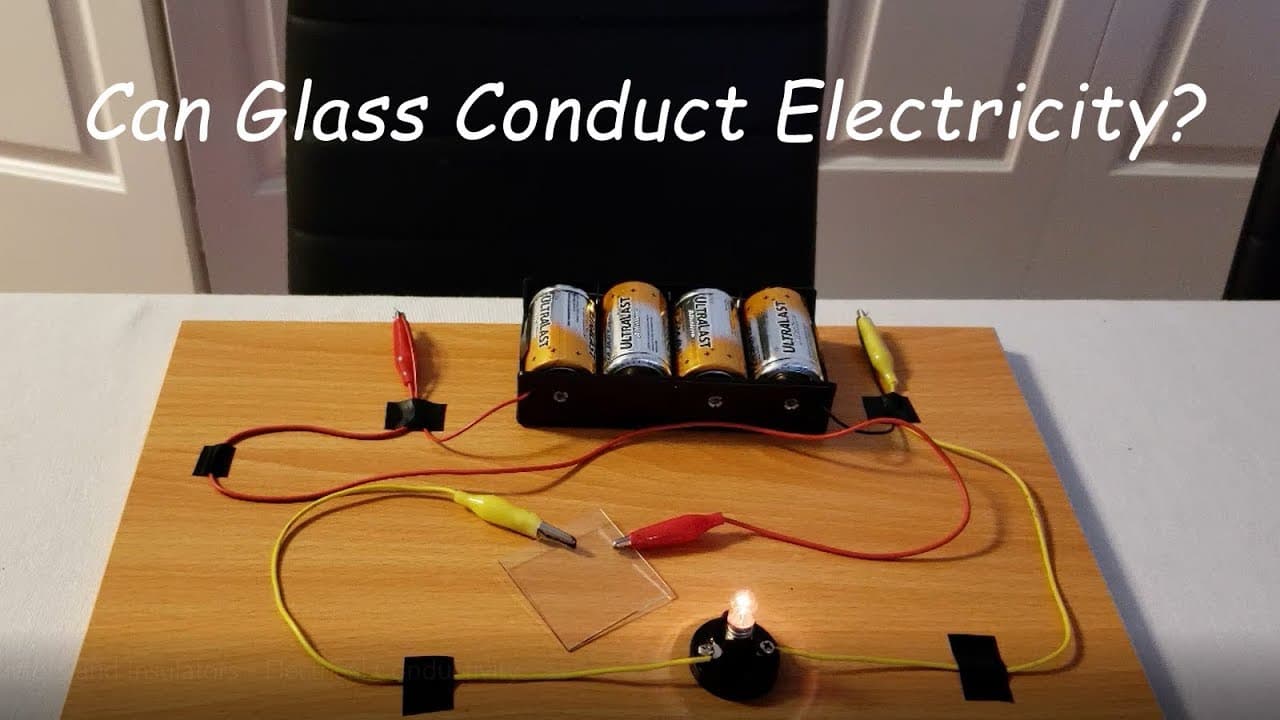
This video explains the properties of materials as electrical conductors or insulators and showcases various examples.
Transcript
in this video we're going to see what materials act as electrical conductors and what materials act as electrical insulators so when i connect the material from the yellow wire to the red wire if the light bulb lights up it's a conductor if it does not then it's an insulator as you can see wood doesn't conduct electricity wood is an insulator so he... Read More
Key Insights
- 😎 Materials such as wood, plastic, and glass are insulators and do not conduct electricity.
- 🥶 Metals are excellent conductors of electricity due to the free movement of electrons within their structures.
- 😎 Molten glass can conduct electricity, unlike its solid form.
- 😎 The special type of glass called ito glass is transparent and conducts electricity with measurable resistance.
- 😑 Water is generally considered an insulator, but saltwater conducts electricity due to the presence of ions.
- 😑 Saltwater's electrical conductivity increases as salt dissolves and allows more ions to move freely.
- 🈶 Mobile charge carriers, such as ions or free electrons, are necessary for a material or solution to conduct electricity.
Install to Summarize YouTube Videos and Get Transcripts
Explore YouTube Video Summarizer or Get YouTube Transcript Extractor
Questions & Answers
Q: Why is wood considered an insulator?
Wood is an insulator because it does not allow the free flow of electrons, preventing the passage of electric current through it. Its structure does not have a significant concentration of charge carriers.
Q: What makes metals good conductors of electricity?
Metals have free electrons that are not bound to individual atoms, allowing them to move freely within the material. These mobile charge carriers can carry electric current through the metal.
Q: Why does molten glass conduct electricity?
Molten glass conducts electricity because its structure changes when heated, allowing ions and charged particles to move more freely. The increased mobility of these charged particles enables the conduction of electrical current.
Q: How does saltwater become an electrical conductor?
Saltwater conducts electricity because it contains ions, which are charged particles. When salt is dissolved in water, it dissociates into positively and negatively charged ions, enabling the flow of electric current through the solution.
Summary & Key Takeaways
-
The video demonstrates the concept of electrical conductivity by connecting materials to a circuit and observing their effect on a light bulb.
-
Metals are conductors of electricity because their free-flowing electrons can carry charge.
-
Wood, plastic, and glass are insulators and do not allow electric current to flow.
Read in Other Languages (beta)
Share This Summary 📚
Summarize YouTube Videos and Get Video Transcripts with 1-Click
Try YouTube Summary with ChatGPT & Claude or YouTube Transcript Generator
Explore More Summaries from The Organic Chemistry Tutor 📚




Summarize YouTube Videos and Get Video Transcripts with 1-Click
Try YouTube Summary with ChatGPT & Claude or YouTube Transcript Generator