What Are Cumulative Distribution Functions and PDFs?
TL;DR
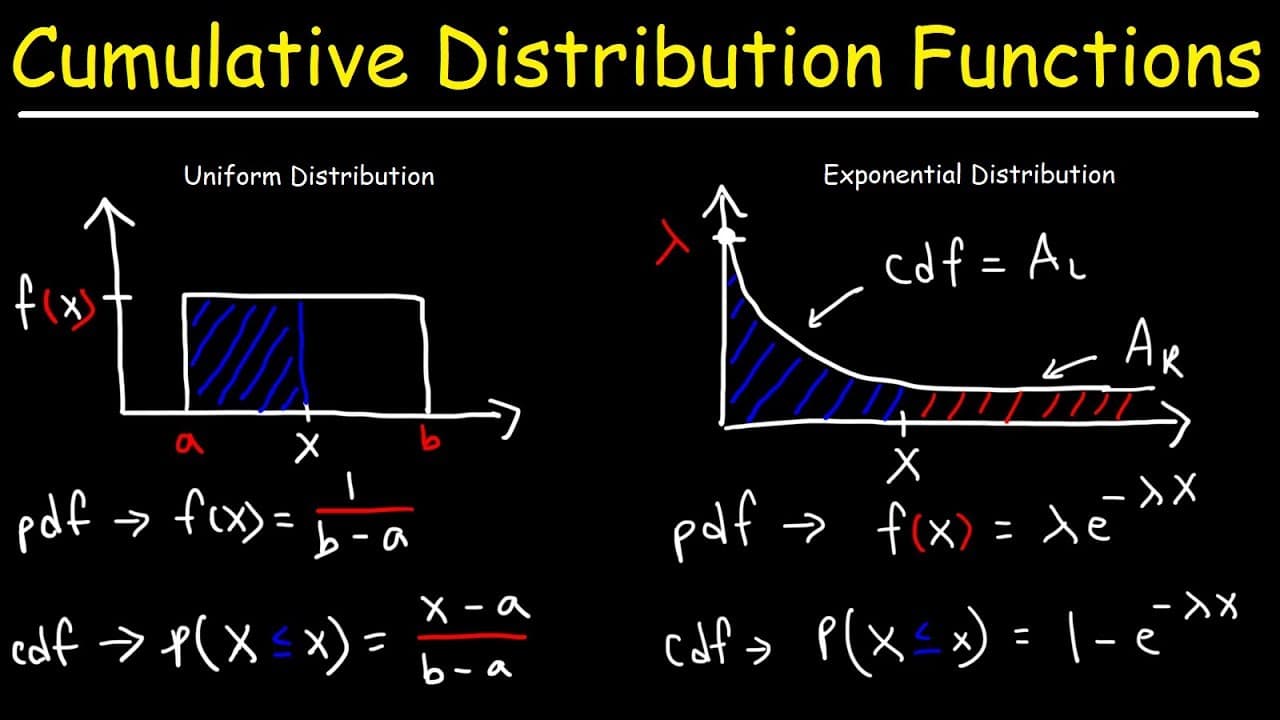
Cumulative Distribution Functions (CDFs) calculate the area under the curve to the left of a specific value, representing accumulated probability. In contrast, Probability Density Functions (PDFs) describe the shape of a distribution and indicate the height of the curve at particular points, providing insights about the likelihood of different outcomes.
Transcript
in this video we're going to talk about cumulative distribution functions the cumulative distribution function or CDF these functions are used to calculate the area under the curve specifically the area to the left of some point of interest now these functions they're used to calculate the accumulative sadar on the accumulated probability now keep ... Read More
Key Insights
- 😥 CDFs are used to calculate the accumulated probability up to a certain point, while PDFs describe the shape of a distribution.
- 👈 The PDF for a uniform distribution is a constant value, while the CDF gives the area to the left of a point of interest.
- ☠️ The PDF for an exponential distribution is lambda e^(-lambda*X), where lambda is the rate parameter.
- 👈 The CDF for an exponential distribution gives the area to the left of a point, and the area to the right is equal to e^(-lambda*X).
Install to Summarize YouTube Videos and Get Transcripts
Explore YouTube Video Summarizer or Get YouTube Transcript Extractor
Questions & Answers
Q: What is the purpose of Cumulative Distribution Functions (CDFs)?
CDFs are used to calculate the area under the curve to the left of a certain value and provide the accumulated probability up to that point.
Q: How are PDFs different from CDFs?
PDFs describe the shape of a distribution, while CDFs give the accumulated probability up to a certain point.
Q: What is the formula for calculating the CDF for a uniform distribution?
The CDF for a uniform distribution is given by the formula (X - a) / (B - a), where X is the point of interest and a and B are the minimum and maximum values of the distribution.
Q: Can the probability that X is exactly a single value be calculated using CDFs?
No, the probability that X is exactly a single value is 0, as it requires a range of values to calculate the area under the curve.
Summary & Key Takeaways
-
Cumulative Distribution Functions (CDFs) are used to calculate the area under the curve to the left of a point of interest.
-
Probability Density Functions (PDFs) describe the shape of a distribution and give the height of the curve at a specific point.
-
CDFs give the accumulated probability up to a certain point, while PDFs give the probability density at a specific point.
Read in Other Languages (beta)
Share This Summary 📚
Summarize YouTube Videos and Get Video Transcripts with 1-Click
Try YouTube Summary with ChatGPT & Claude or YouTube Transcript Generator
Explore More Summaries from The Organic Chemistry Tutor 📚





Summarize YouTube Videos and Get Video Transcripts with 1-Click
Try YouTube Summary with ChatGPT & Claude or YouTube Transcript Generator