What Are Regular Expressions and Their Uses?
TL;DR
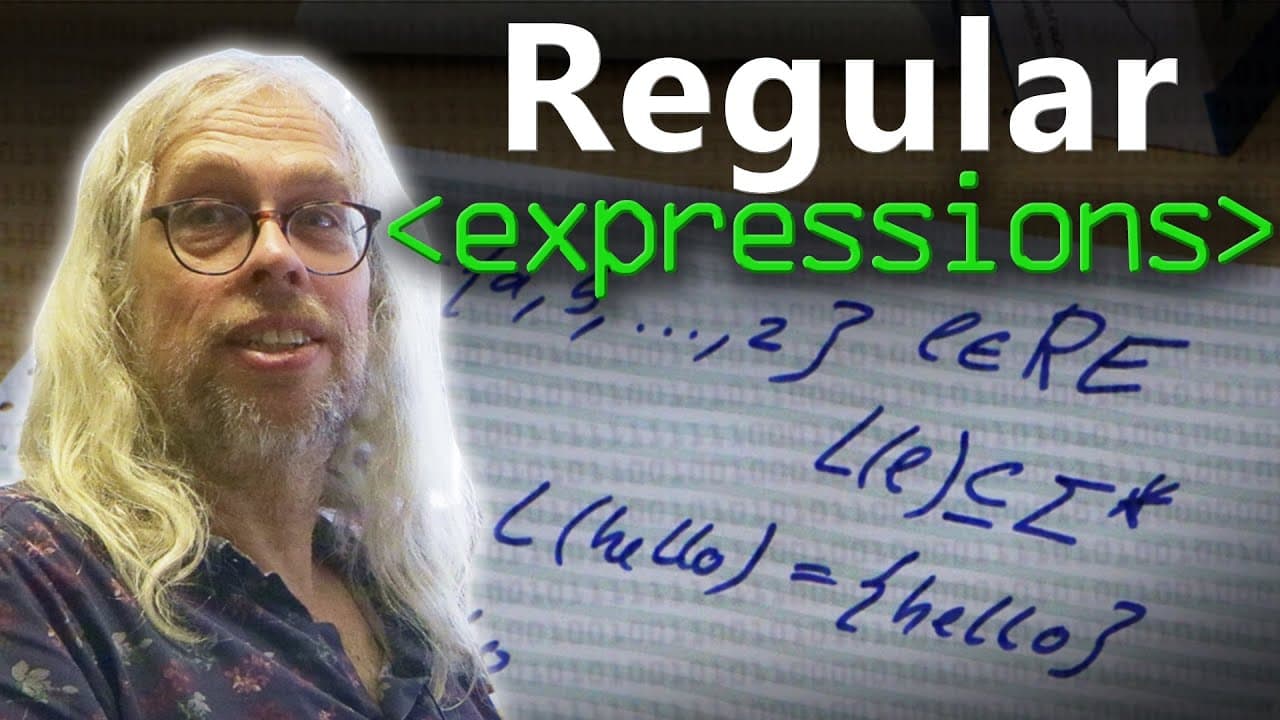
Regular expressions are a powerful tool for defining and recognizing patterns in text, forming the foundation of regular languages. They are widely used in text processing tasks like searching, editing, and filtering information. Understanding how to translate regular expressions into non-deterministic finite automata (NFAs) allows for efficient pattern recognition in programming.
Transcript
we started doing some sort of autometer Theory earlier this year and then we have a bit of a break because I think you went ganting in Far Away places and I was busy with other things as well and now we going to pick up the threat again and continue talking about uh autom Theory and formal languages and stuff um I mean if it is regular Expressions ... Read More
Key Insights
- 😑 Regular expressions are a concise way to define regular languages and recognize patterns in text.
- 😑 Regular expressions are commonly used in text processing and programming to perform tasks like searching, replacing, and filtering text.
- 😑 Translating regular expressions into NFAs allows for efficient pattern matching and recognition.
Install to Summarize YouTube Videos and Get Transcripts
Explore YouTube Video Summarizer or Get YouTube Transcript Extractor
Questions & Answers
Q: What are regular expressions used for?
Regular expressions are used to define and recognize patterns in text, making them useful in text processing, programming, and editor commands.
Q: How are regular expressions related to deterministic finite automata (DFAs) and non-deterministic finite automata (NFAs)?
DFAs and NFAs are types of finite automata that recognize regular languages, with DFAs being deterministic and NFAs allowing for non-determinism. Regular expressions can be translated into both DFA and NFA representations.
Q: What practical applications do regular expressions have?
Regular expressions are used in a variety of applications, including text editing commands, stream editing, and pattern matching in compiler writing. They are also useful for learning and understanding regular languages.
Q: Can regular expressions handle infinite languages?
Regular expressions provide a high-level description of infinite languages, but to actually recognize strings in these languages, they need to be translated into NFAs or DFAs.
Summary & Key Takeaways
-
Regular expressions are used to define regular languages, which can be recognized by computer programs using fixed memory.
-
Regular expressions provide a descriptive, high-level view of regular languages and are commonly used in editor commands and text processing.
-
Regular expressions can be translated into non-deterministic finite automata (NFAs) to efficiently recognize patterns in text.
Read in Other Languages (beta)
Share This Summary 📚
Summarize YouTube Videos and Get Video Transcripts with 1-Click
Try YouTube Summary with ChatGPT & Claude or YouTube Transcript Generator
Explore More Summaries from Computerphile 📚




Summarize YouTube Videos and Get Video Transcripts with 1-Click
Try YouTube Summary with ChatGPT & Claude or YouTube Transcript Generator