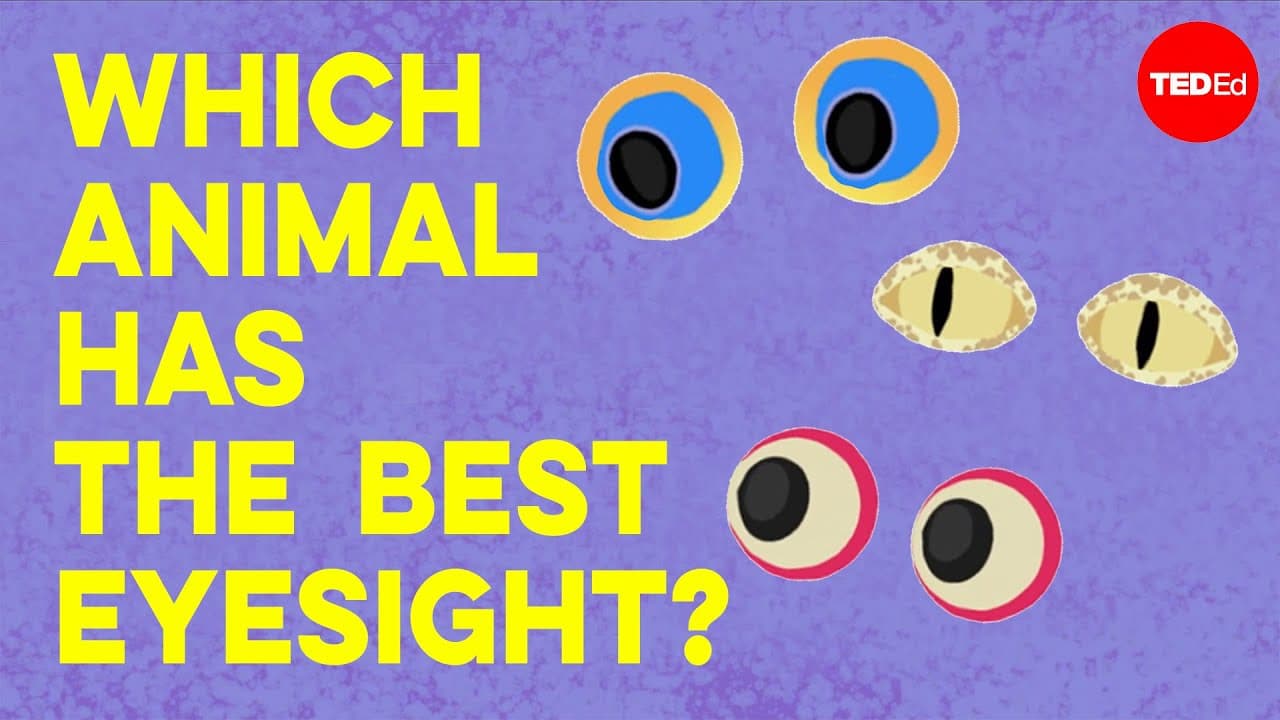
Which animal has the best eyesight? - Thomas W. Cronin
TL;DR
Animals have unique eyes for different purposes like seeing in the dark, detecting motion, and discerning colors.
Transcript
The animal kingdom boasts an incredible diversity of eyes. Some rotate independently, while others have squiggly-shaped pupils. Some have protective lids, others squirt blood. But which creature has the best sight? Which sees best in the darkness? Which sees the most detail? Which animal sees the most color? And finally, which detects motion the ... Read More
Key Insights
- 🙂 Colossal squids have the largest known eyes in existence to excel in low light vision by capturing available light efficiently.
- 🐦 Birds of prey like Peregrine falcons have sharp vision with a deep fovea and increased photoreceptors for detail perception.
- 🤑 Mantis shrimp possess 16 photoreceptors, including UV-sensitive ones, but their color discrimination abilities are debated.
- 📺 Goldfish can discern subtle differences in shades effectively with just four color photoreceptors, showcasing specialized color vision capabilities.
- 🙂 Insects like flies have rapid motion detection abilities with photoreceptors that sense light changes 10 times faster than humans.
- 👀 Animals adapt their eyes for specific purposes, like seeing in darkness (reindeer), discerning motion (insects), and detecting colors (birds and fish).
- 📺 Different animals excel in various categories like low light vision, detail perception, color vision, and motion detection due to specialized adaptations.
Install to Summarize YouTube Videos and Get Transcripts
Explore YouTube Video Summarizer or Get YouTube Transcript Extractor
Questions & Answers
Q: Which animal has the best low light vision and why?
Colossal squids have the best low light vision due to their soccer-ball-sized eyes, which capture more available light to detect faint glows in the darkness, like that from sperm whales disturbing light-producing organisms.
Q: How do birds of prey achieve sharp vision for detail perception?
Birds of prey like Peregrine falcons have an especially deep fovea in their eyes, which accommodates a higher density of photoreceptors, enabling them to have vision more than twice as sharp as humans to zero in on prey from far distances.
Q: Why do some insects like flies have exceptional motion detection abilities?
Insects like flies have photoreceptors that register changes in light 10 times faster than humans, allowing them to detect rapid motion accurately, making them hard to catch due to their quick visual processing capacity.
Q: How do goldfish excel at discerning shades with just four types of color photoreceptors?
Goldfish have specialized color photoreceptors that enable them to discern subtle differences in shades effectively, showcasing that the number of photoreceptors can influence color vision capabilities.
Summary & Key Takeaways
-
Animals have diverse eyes adapted for specific functions like seeing in darkness, capturing motion, and discerning colors with unique photoreceptors.
-
Different animals excel in specific categories like low light vision (colossal squids), detail perception (birds of prey), color vision (mantis shrimp), and motion detection (insects).
-
Each animal species has specialized eyes for their environment, from the deep sea to the skies, showcasing the incredible diversity of vision in the animal kingdom.
Read in Other Languages (beta)
Share This Summary 📚
Summarize YouTube Videos and Get Video Transcripts with 1-Click
Try YouTube Summary with ChatGPT & Claude or YouTube Transcript Generator
Explore More Summaries from TED-Ed 📚




Summarize YouTube Videos and Get Video Transcripts with 1-Click
Try YouTube Summary with ChatGPT & Claude or YouTube Transcript Generator