How Did Chemistry Evolve From Alchemy?
TL;DR
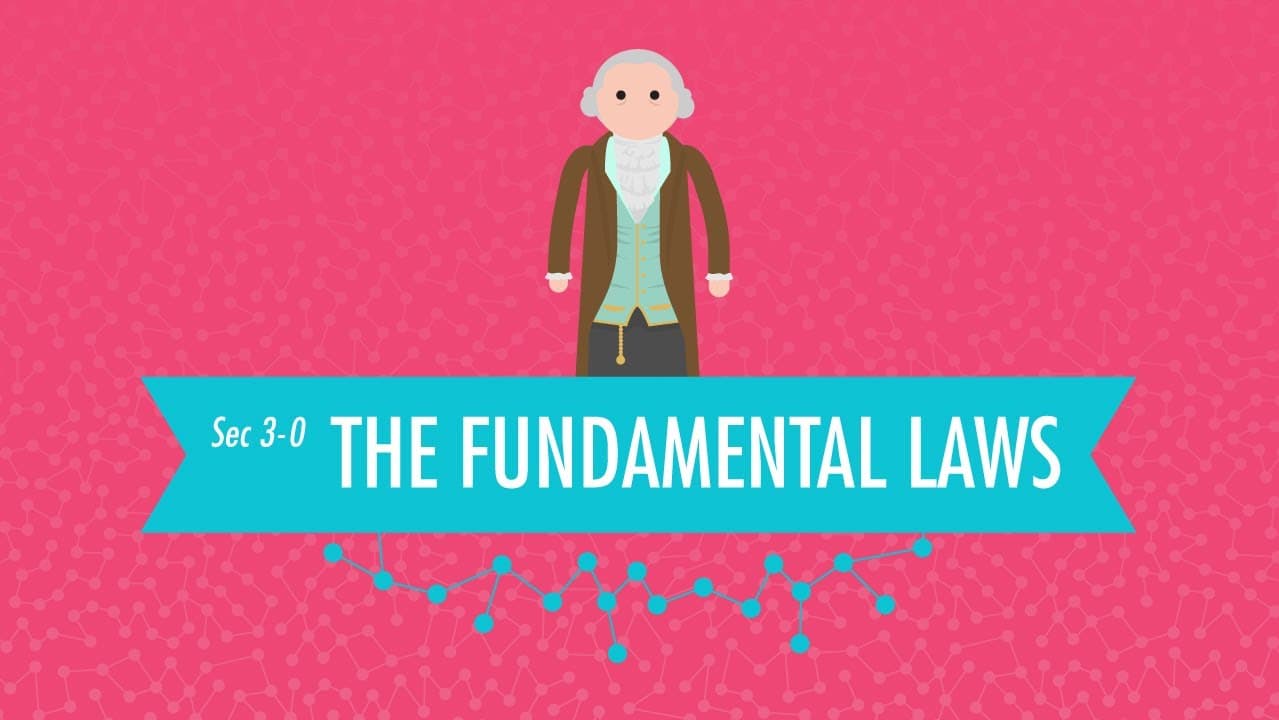
Antoine Lavoisier revolutionized chemistry by introducing the Law of Conservation of Mass, marking the transition from alchemy. His work laid the foundation for modern chemistry, though it was his wealth that enabled his research. Other scientists like Joseph Proust and John Dalton expanded on his ideas, leading to a deeper understanding of chemical compounds and atoms.
Transcript
You got a pretty good idea of what chemistry is, right? It's atoms and molecules doing stuff and making cars and food and life and everything. And of course it's the study of those things. But like how did we get here? There's certainly no everyday evidence for much of what we have discovered through the science of chemistry. Discoveries that were ... Read More
Key Insights
- Antoine Lavoisier is considered the father of modern chemistry due to his introduction of the Law of Conservation of Mass.
- Lavoisier's wealth allowed him to conduct precise experiments, crucial for his discoveries.
- Marie-Anne Lavoisier played a significant role in translating and analyzing scientific work.
- The Law of Definite Proportions, originally Proust's Law, states that a chemical compound always contains the same proportion of elements.
- John Dalton's experiments provided early evidence for the existence of atoms, though he initially confused atoms with molecules.
- Avogadro proposed that equal volumes of gases contain equal numbers of molecules, leading to Avogadro's Law.
- Joseph-Louis Gay-Lussac demonstrated that gases react in simple whole number ratios, supporting the concept of molecules.
- Lavoisier's execution was a result of his political and financial associations during the French Revolution.
Install to Summarize YouTube Videos and Get Transcripts
Explore YouTube Video Summarizer or Get YouTube Transcript Extractor
Questions & Answers
Q: How did Antoine Lavoisier contribute to modern chemistry?
Antoine Lavoisier is credited with founding modern chemistry by introducing the Law of Conservation of Mass, which states that mass is conserved in chemical reactions. This principle debunked the phlogiston theory and laid the groundwork for understanding chemical reactions as transformations rather than losses or gains of material. His precise measurements and experiments were pivotal in shifting from alchemy to chemistry.
Q: What role did Marie-Anne Lavoisier play in her husband's work?
Marie-Anne Lavoisier played a crucial role in her husband's scientific achievements by translating important scientific works and assisting in experiments. Her translations and insights helped Antoine Lavoisier critique and build upon existing theories, leading to significant advancements in chemistry. She was not only a collaborator but also an intellectual partner in the development of modern chemical understanding.
Q: What is the significance of the Law of Definite Proportions?
The Law of Definite Proportions, initially known as Proust's Law, is significant because it states that a chemical compound always contains the same proportion of elements by mass. This discovery was crucial in establishing the concept of chemical compounds as distinct entities with fixed compositions, paving the way for the development of chemical formulas and the understanding of chemical reactions at the molecular level.
Q: How did John Dalton's work support the atomic theory?
John Dalton's work supported atomic theory by demonstrating that elements combine in simple, whole-number ratios to form compounds. His experiments revealed that fixed amounts of one element would combine with varying amounts of another, leading to the formation of different compounds. This provided evidence for the existence of indivisible atoms, although Dalton initially misunderstood the distinction between atoms and molecules.
Q: What was Avogadro's hypothesis about gases?
Avogadro's hypothesis proposed that equal volumes of gases, at the same temperature and pressure, contain the same number of molecules. This idea, known as Avogadro's Law, was groundbreaking because it allowed scientists to relate the volume of gas to the number of molecules present, leading to a better understanding of molecular mass and the behavior of gases. Despite its initial neglect, Avogadro's hypothesis became fundamental to chemical science.
Q: Why was Lavoisier executed during the French Revolution?
Antoine Lavoisier was executed during the French Revolution due to his involvement as a tax collector, which made him unpopular with revolutionary forces. Despite his contributions to science and support for the revolution, his association with the old regime and financial dealings led to his downfall. His execution on May 8, 1794, was a result of the turbulent political climate and the revolution's increasing radicalism.
Q: What was the impact of Lavoisier's wealth on his scientific work?
Lavoisier's wealth had a significant impact on his scientific work, as it allowed him to acquire sophisticated equipment necessary for precise experiments. His financial resources enabled him to conduct groundbreaking research that required meticulous measurement and experimentation, which were crucial for his discoveries in chemistry. This highlights the role of economic resources in advancing scientific knowledge during his time.
Q: How did the scientific community eventually accept Avogadro's ideas?
The scientific community eventually accepted Avogadro's ideas after decades of skepticism, largely due to the work of other scientists who validated his hypothesis through experimental evidence. The concept of molecules and atoms became more widely understood, and Avogadro's Law was recognized for its explanatory power in gas behavior. His contributions were acknowledged through the naming of Avogadro's Law and Avogadro's number, cementing his legacy in chemistry.
Summary & Key Takeaways
-
Antoine Lavoisier transformed the field of chemistry by establishing the Law of Conservation of Mass, which states that mass is neither created nor destroyed in chemical reactions. His work marked the end of alchemy and the beginning of modern chemistry. Lavoisier's wealth enabled him to conduct the precise measurements necessary for his groundbreaking discoveries.
-
Marie-Anne Lavoisier was instrumental in her husband's work, translating key scientific texts and contributing to his experiments. The couple's collaboration led to significant advancements in understanding chemical reactions and the nature of elements.
-
Subsequent scientists like Joseph Proust and John Dalton expanded on Lavoisier's ideas, leading to the development of the Law of Definite Proportions and early atomic theory. Avogadro's hypothesis about gas volumes furthered the understanding of molecular structure, though it took decades for his ideas to gain acceptance.
Read in Other Languages (beta)
Share This Summary 📚
Summarize YouTube Videos and Get Video Transcripts with 1-Click
Try YouTube Summary with ChatGPT & Claude or YouTube Transcript Generator
Explore More Summaries from CrashCourse 📚


Summarize YouTube Videos and Get Video Transcripts with 1-Click
Try YouTube Summary with ChatGPT & Claude or YouTube Transcript Generator