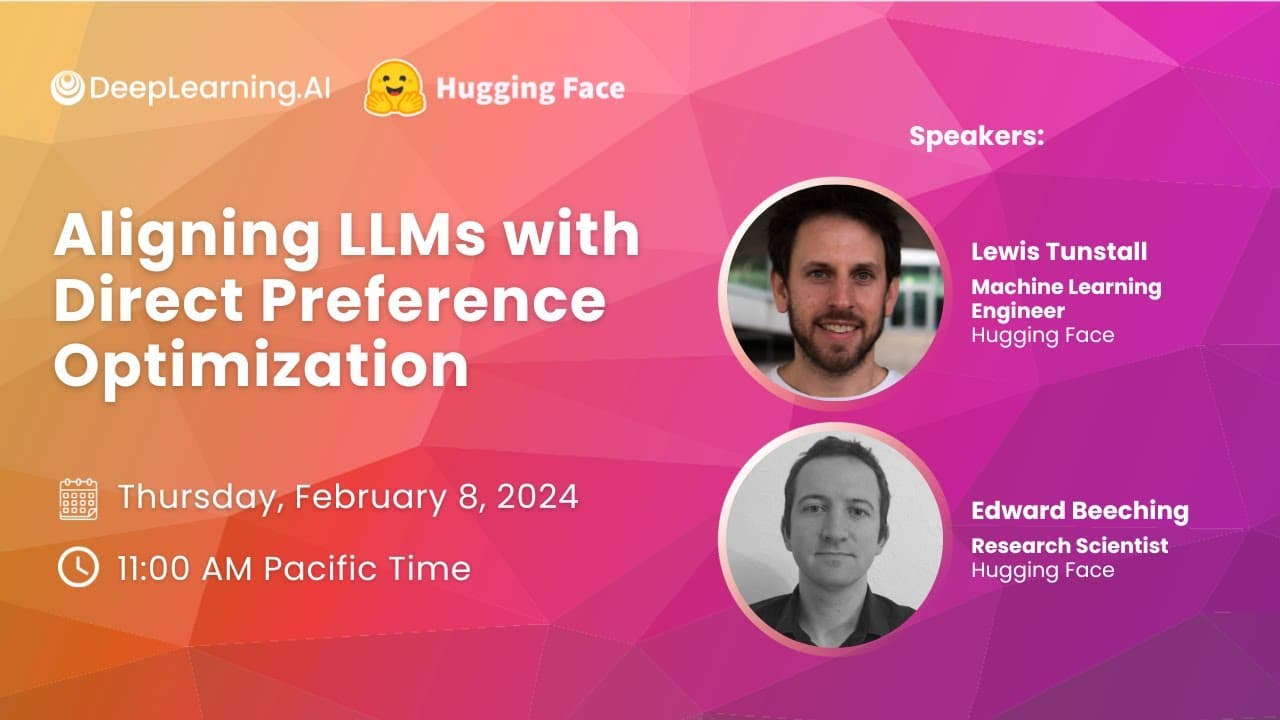
What Is Direct Preference Optimization for LLM Alignment?
TL;DR
Direct Preference Optimization (DPO) is a technique that enhances language model alignment with human preferences, improving chatbot performance. Unlike traditional reinforcement learning methods, DPO simplifies the process by directly optimizing model responses based on human feedback, leading to faster convergence and effectively aligned models.
Transcript
hey everyone my name is di Chan Morgan and I'm part of the community team here at deeplearning.ai today we have really special guests to talk to us about direct preference optimization and really excited to dive in for everything just for everyone's information the session will be recorded and the slides and notebooks will be available after the ev... Read More
Key Insights
- 🈸 DPO is a powerful technique for aligning language models with human preferences, improving their performance in chatbot applications.
- 🪡 It simplifies the training process by eliminating the need for reinforcement learning algorithms.
- 😫 DPO can be applied to various data sets and tasks, including image generation models.
- ❓ The size of the model can impact the performance and computational requirements of DPO.
Install to Summarize YouTube Videos and Get Transcripts
Explore YouTube Video Summarizer or Get YouTube Transcript Extractor
Questions & Answers
Q: What is DPO?
DPO, or direct preference optimization, is a technique used to train language models by aligning them with human preferences. It involves using a reward model to rate model outputs and adjust the language model accordingly.
Q: How does DPO differ from reinforcement learning?
DPO is an alternative to reinforcement learning for aligning language models with human preferences. It simplifies the training process and avoids the potential pitfalls of reinforcement learning algorithms.
Q: How do you evaluate the quality of alignment data sets?
The quality of alignment data sets can be evaluated by manually inspecting the data for biases or inconsistencies. Additionally, comparing model performance on benchmark datasets can provide insights into the effectiveness of the alignment process.
Q: Is DPO applicable to image generation models?
DPO can be applied to optimize metrics in image generation models, such as LPips, ArcFace loss, etc. However, the specific implementation and evaluation metrics may vary depending on the model architecture and task.
Q: How does the size of the model impact DPO?
DPO has been shown to work effectively with large language models, including models with billions of parameters. Scaling up the model size can allow for more accurate alignment with human preferences, but it may also increase the computational requirements of training.
Summary & Key Takeaways
-
DPO is a technique to train language models, like chatbots, using human preferences to improve their performance.
-
It involves using a reward model to rate model outputs and adjusting the language model based on these ratings.
-
DPO has shown promising results in improving chatbot performance and aligning models with user preferences.
Read in Other Languages (beta)
Share This Summary 📚
Summarize YouTube Videos and Get Video Transcripts with 1-Click
Try YouTube Summary with ChatGPT & Claude or YouTube Transcript Generator
Explore More Summaries from DeepLearningAI 📚


![How Does the Logistic Regression Decision Boundary Work? — #33 Machine Learning Specialization [Course 1, Week 3, Lesson 1] thumbnail](/_next/image?url=https%3A%2F%2Fi.ytimg.com%2Fvi%2F0az8RjxLLPQ%2Fhqdefault.jpg&w=750&q=75)
Summarize YouTube Videos and Get Video Transcripts with 1-Click
Try YouTube Summary with ChatGPT & Claude or YouTube Transcript Generator