How to Write Hooks That Stop Viewers Scrolling
TL;DR
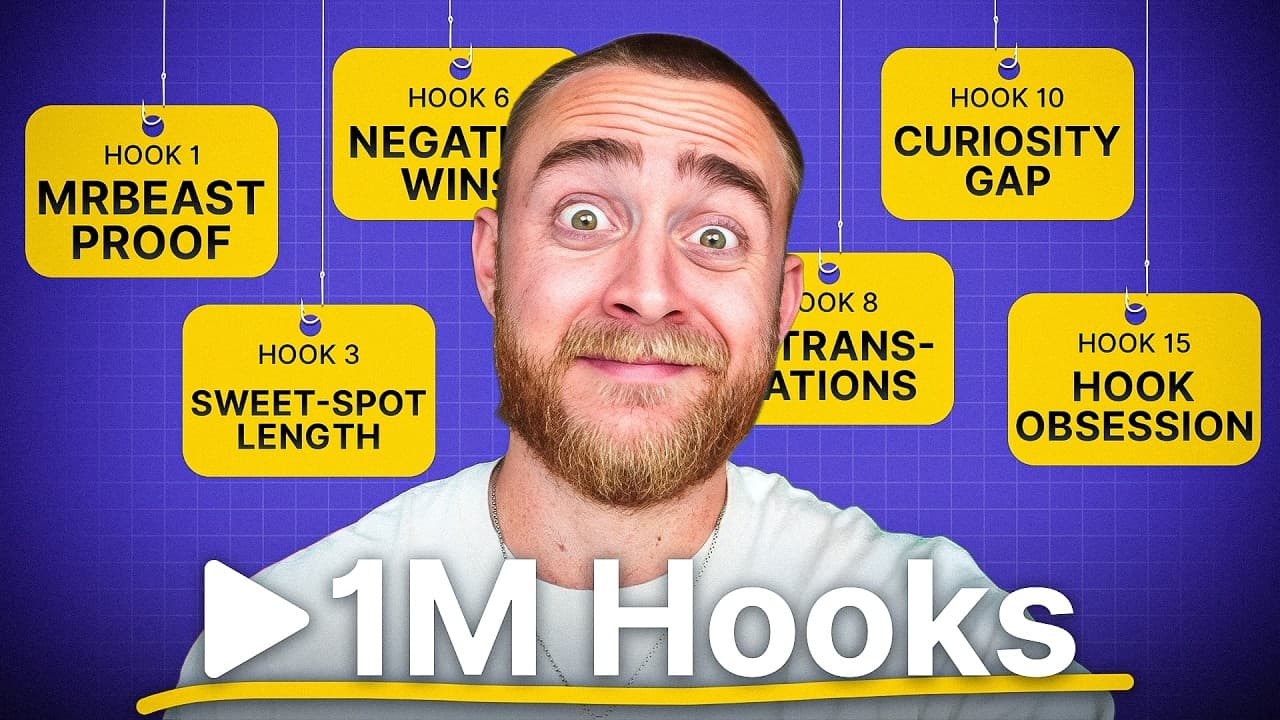
Write short hooks in simple language, then pair them with an immediately relevant visual. The strongest viral examples averaged 7.7 words, commonly used five to eight words, stayed below a fifth-grade reading level, and often framed ideas negatively. Because viewers process images before text, the opening frames should visibly demonstrate the subject instead of relying on a clever sentence alone.
Transcript
I studied the hooks on over 1,300 viral Instagram reels. And in today's episode, I'm going to share with you everything that I found. But first and foremost, why did I go on this crazy endeavor? Well, because the hook is the most important part of your content. If your content is super valuable, educational, hilarious, funny, entertaining, captivat... Read More
Key Insights
- The hook is the most important part of short-form content because it determines whether viewers stay for the remaining value, entertainment, or education. Improving only the opening can increase views, engagement, and follower growth even when the rest of the post remains unchanged.
- The most viral hooks averaged 7.7 words, with five to eight words generally performing best. Some successful examples reached 12 words, but performance showed diminishing returns when openings expanded to 13, 14, 15, or more words.
- Very short hooks are uncommon because fewer than four words often cannot communicate a complete idea. Phrases such as "unpopular opinion" or "stop scrolling" can attract attention, but they appeared as outliers rather than the dominant pattern among the analyzed examples.
- Simple language is essential because the analyzed hooks averaged below a fifth-grade reading level. Social media viewers are distracted by thousands of videos, so complex vocabulary, insider language, and unfamiliar acronyms create confusion that gives them a reason to leave.
- Negative hooks outperform positive counterparts on average because people are more attentive to threats and losses. Terms such as "don't," "stop," "avoid," "cancel," "stay away from," "no," and "loss" can therefore attract more immediate attention than positive framing.
- The opening visual matters more than the written or spoken words because viewers process what appears on screen before reading headline text. The first frames must communicate the subject clearly instead of depending entirely on a polished sentence to establish relevance.
- Relevant visuals connect the setting and action to the topic. A fitness coach should appear in a gym and preferably exercise, a food blogger should show or eat the food, and a real estate agent should tour the property being discussed.
- Language-free short-form videos can reach beyond audiences who speak the creator's language. MrBeast said his most-viewed Reels and short-form posts on Instagram and Facebook were ones where he did not speak, while Meta's automatic dubbing and translation can also reduce language barriers.
Install to Summarize YouTube Videos and Get Transcripts
Explore YouTube Video Summarizer or Get YouTube Transcript Extractor
Questions & Answers
Q: How long should an Instagram Reel hook be?
An Instagram Reel hook should generally contain five to eight words. Across more than 1,300 viral hooks, the average length was 7.7 words. Successful examples sometimes reached 12 words, but hooks containing 13, 14, 15, or more words showed diminishing returns. Fewer than four words were also uncommon because such short phrases often struggle to express a complete idea.
Q: What reading level should a social media hook use?
A social media hook should use language at or below a fifth-grade reading level. The analyzed viral hooks averaged below that level, supporting the recommendation to keep wording extremely simple. Viewers are processing thousands of videos and may leave when they encounter elaborate vocabulary, unfamiliar acronyms, or insider terminology. A strong opening should make sense without additional context or explanation.
Q: Why do negative hooks attract more attention?
Negative hooks attract attention because people are naturally more alert to possible threats and losses than to positive information. In the analyzed examples, negative openings far outperformed their positive counterparts on average. Words such as "don't," "stop," "avoid," "cancel," "stay away from," "no," and "loss" can signal risk or a mistake quickly enough to interrupt scrolling.
Q: Are visuals more important than words in Reel hooks?
Visuals matter more than spoken or written hook wording because viewers comprehend the image on screen before they finish reading the text. The first few frames therefore carry substantial responsibility for earning attention. Strong wording still helps, but it cannot compensate fully for footage that feels unrelated, generic, or visually disconnected from the subject being introduced.
Q: How should the opening visual match a Reel topic?
The opening visual should directly show the environment, object, or activity discussed in the Reel. A fitness creator should demonstrate the exercise in a gym, a food blogger should show or eat the featured food, and a real estate agent should tour the home. This alignment lets viewers understand the subject immediately, even before processing every written or spoken word.
Q: Can a hook with fewer than four words work?
A hook with fewer than four words can work, but the analysis found relatively few viral examples at that length. Short phrases such as "unpopular opinion" and "stop scrolling" can attract attention, yet they were outliers. Most topics need additional words to communicate a complete thought, establish relevance, or give viewers a clear reason to continue watching.
Q: How much content creation effort should go into hooks?
The recommended allocation is 80% of the time, energy, and effort spent creating a post because the hook determines whether the rest receives attention. Valuable, funny, educational, or entertaining material has little opportunity to perform when viewers leave immediately. Improving the opening alone can help a post receive more views and engagement and can contribute to follower growth.
Q: How can creators make short-form videos accessible across languages?
Creators can reduce language barriers by relying on visuals that communicate without speech or by using Instagram's automatic translation and dubbing. MrBeast said his most-viewed Instagram and Facebook short-form videos were ones where he did not speak. The described Instagram feature can translate and dub English Reels into nine languages while imitating the creator's voice and adjusting visible mouth movements.
Summary & Key Takeaways
-
The analysis of more than 1,300 viral Instagram Reel hooks found that effective openings were usually concise and easy to understand. The average was 7.7 words, five to eight words performed especially well, and results diminished beyond 12 words. Most successful wording also remained below a fifth-grade reading level.
-
Negative language frequently outperformed positive wording because people naturally notice potential threats and losses. Words such as "don't," "stop," "avoid," "cancel," and "no" can attract attention quickly. However, the hook still needs clarity, since unfamiliar vocabulary, insider terminology, and unexplained acronyms can confuse distracted viewers and prompt them to scroll away.
-
Visuals carry more weight than spoken or written hook text because viewers comprehend the opening image first. The footage should directly match the topic: fitness creators should demonstrate exercises, food bloggers should show or eat food, and real estate agents should tour homes. Relevant action makes the subject understandable before viewers finish reading.
Read in Other Languages (beta)
Share This Summary 📚
Summarize YouTube Videos and Get Video Transcripts with 1-Click
Try YouTube Summary with ChatGPT & Claude or YouTube Transcript Generator
Explore More Summaries from Build Your Tribe 📚
Summarize YouTube Videos and Get Video Transcripts with 1-Click
Try YouTube Summary with ChatGPT & Claude or YouTube Transcript Generator