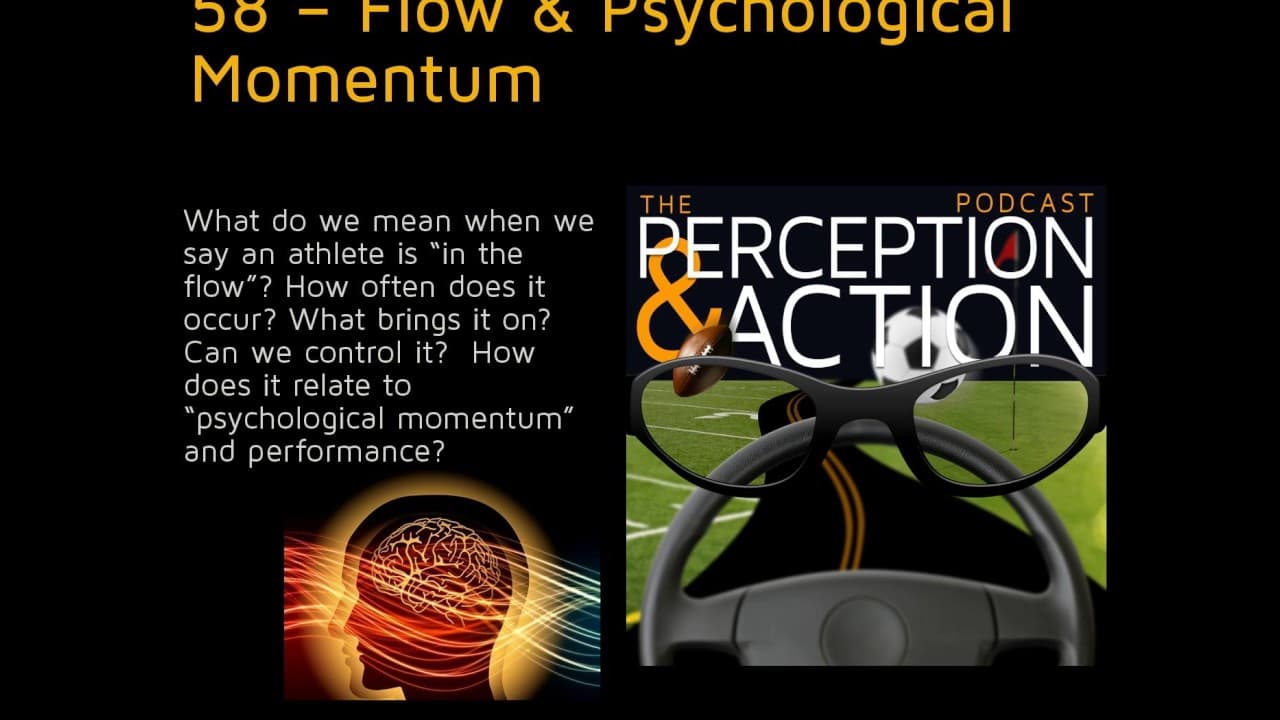
How to Achieve Flow and Psychological Momentum
TL;DR
Flow is a state of intense focus and absorption in an activity, often leading to peak performance and enjoyment. It occurs when there's a balance between skill and challenge, but is elusive and difficult to control. Psychological momentum, a related concept, suggests that past successes can enhance future performance through increased confidence.
Transcript
today on the perception and action podcast a look at flow in sports what exactly is it how often does it occur can an athlete control it and how does it relate to the concept of psychological momentum so it's time for a call to action hi everyone this is Rob Gray from Arizona State University and perception action.com welcome to the perception and ... Read More
Key Insights
- Flow is a state of deep focus and optimal experience, first defined by Mihaly Csikszentmihalyi in 1975.
- Flow is characterized by intense focus, merging of action and awareness, loss of self-consciousness, a sense of control, and altered perception of time.
- Achieving flow requires a balance between skill level and challenge, clear goals, and unambiguous feedback.
- Flow is rare and difficult to maintain, with less than 30% of athletes experiencing it frequently.
- Flow is not effortless; athletes often exert high effort, but it is enjoyable and lacks negative strain.
- Flow might be contagious at a team level, though this has not been extensively studied.
- Psychological momentum refers to the effect of past performance on future outcomes, often through changes in confidence and self-efficacy.
- Recent studies suggest flow involves increased brain activity related to attention and decision-making, challenging the 'quiet brain' hypothesis.
Install to Summarize YouTube Videos and Get Transcripts
Explore YouTube Video Summarizer or Get YouTube Transcript Extractor
Questions & Answers
Q: What is flow in sports psychology?
Flow in sports psychology is a state of deep immersion and focus on an activity, leading to optimal performance and enjoyment. It occurs when there's a perfect balance between the challenge presented by the activity and the athlete's skill level. This state is characterized by a merging of action and awareness, loss of self-consciousness, and altered perception of time. Achieving flow can enhance performance, but it is often elusive and difficult to maintain.
Q: How can athletes achieve flow?
Athletes can achieve flow by ensuring a balance between their skill level and the challenge of the task. Setting clear goals and receiving unambiguous feedback are crucial for facilitating flow. Athletes should focus on the task at hand, allowing for a merging of action and awareness. While flow is not effortless, maintaining a positive mindset and optimal arousal levels can help in reaching this state.
Q: What are the key characteristics of flow?
The key characteristics of flow include intense concentration on the task, merging of action and awareness, loss of self-consciousness, a sense of control over the outcome, and a transformation in the perception of time, often feeling like it slows down. These elements contribute to a deeply rewarding and enjoyable experience, often leading to peak performance.
Q: Can flow be controlled or induced?
Flow can be somewhat controlled or induced through preparation, positive thinking, and reaching an optimal arousal state. Some interventions, such as hypnosis, imagery, and music, have been explored, but their effectiveness is not well-established. The experience of flow varies greatly among individuals and sports, making it challenging to consistently induce.
Q: How is flow related to brain activity?
Flow is related to increased brain activity in areas associated with selective attention, decision-making, and goal-directed actions. This challenges the 'quiet brain' hypothesis, which suggested decreased activity for effortless performance. Recent research indicates that flow involves efficient use of attention and mental effort, aligning with a balance between challenge and skill.
Q: What is psychological momentum?
Psychological momentum refers to the effect of previous performance on future outcomes, where past successes increase confidence and self-efficacy, leading to further success. It suggests a psychological state where athletes feel empowered and capable, often resulting in improved performance. This concept is linked to flow, as both involve psychological factors influencing performance.
Q: How does psychological momentum affect performance?
Psychological momentum affects performance by enhancing an athlete's confidence and self-efficacy, creating a positive feedback loop where success breeds further success. This momentum can lead to improved focus, motivation, and performance consistency. However, it requires psychological changes to mediate the relationship between consecutive successes, and not all athletes experience it equally.
Q: What challenges exist in researching flow and momentum?
Researching flow and momentum presents challenges due to their complex and subjective nature. Defining and measuring these states requires capturing multiple components, such as effort and focus, rather than single indicators. Additionally, separating psychological constructs from performance itself is difficult, as they often move hand in hand. Future research needs rigorous methods to address these complexities.
Summary & Key Takeaways
-
Flow is a psychological state where athletes experience deep focus and optimal performance. It requires a balance between challenge and skill, clear goals, and feedback. Achieving flow is rare and often fleeting, with athletes reporting high effort but positive engagement.
-
Research on flow has explored its characteristics, factors influencing it, and its potential for control. Flow is linked to brain activity, particularly in areas related to attention and decision-making, suggesting it is not entirely effortless.
-
Psychological momentum is related to flow, involving the impact of past successes on future performance. It enhances confidence and self-efficacy, potentially leading to sustained success. Research continues to explore these complex psychological phenomena.
Read in Other Languages (beta)
Share This Summary 📚
Summarize YouTube Videos and Get Video Transcripts with 1-Click
Try YouTube Summary with ChatGPT & Claude or YouTube Transcript Generator
Explore More Summaries from Rob Gray 📚


Summarize YouTube Videos and Get Video Transcripts with 1-Click
Try YouTube Summary with ChatGPT & Claude or YouTube Transcript Generator