Can AI Self-Improve Its Own Architecture?
TL;DR
AI systems are now capable of improving their own architecture, conducting autonomous experiments to discover innovative designs. This marks a shift from automated optimization to automated innovation, potentially accelerating technological advancements. However, skepticism remains about the validity of these claims, and replication by other labs is needed for confirmation.
Transcript
There's a new paper out of China making some big claims. They come right out and say it. The big problem in AI research is humans. We're the ones that are slowing everything down. This paper is called Alph Go Moment for model architecture discovery. And if this is true, if this is replicatable by other AI labs, then this is indeed a big big deal. M... Read More
Key Insights
- AI can now autonomously improve its own architecture, marking a significant shift in AI research.
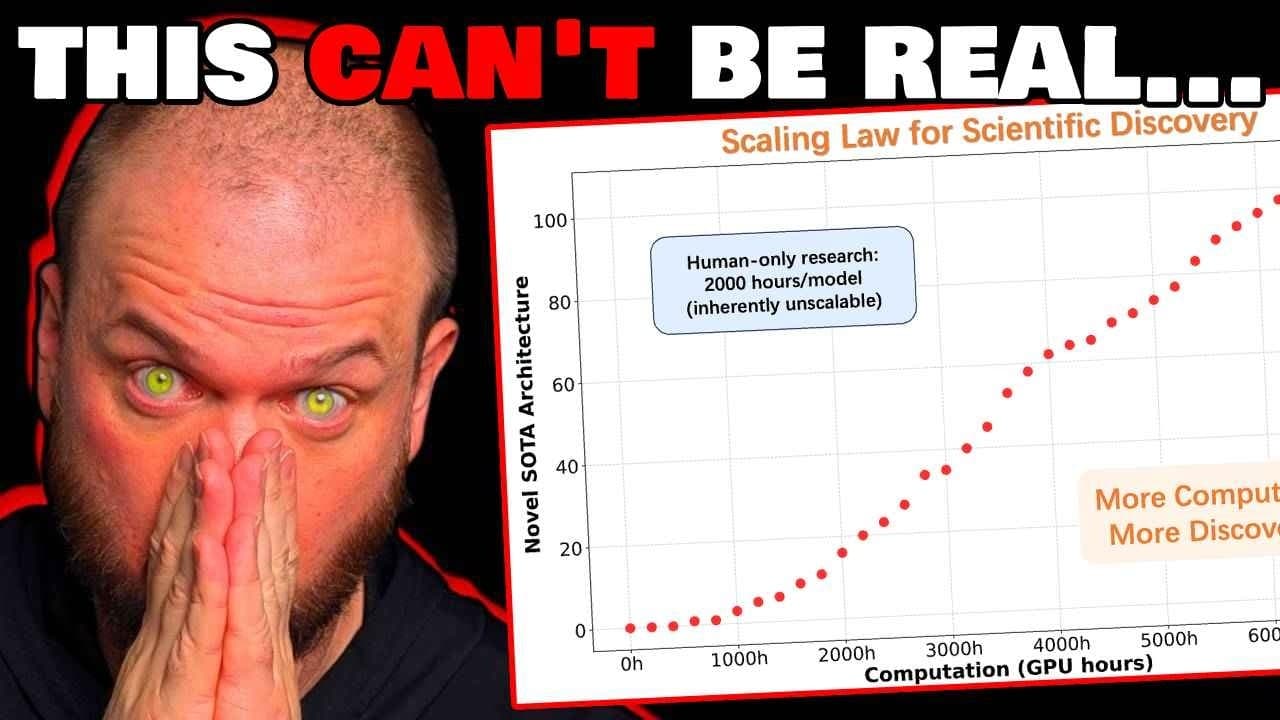
- The ASI Arch system conducted nearly 2,000 experiments, discovering 106 state-of-the-art linear attention architectures.
- AI systems are moving from automated optimization to automated innovation, potentially accelerating technological progress.
- The research introduces a new scaling law for scientific discovery, suggesting more computation leads to better results.
- The Pareto principle applies in AI research, with a small percentage of approaches yielding most breakthroughs.
- 48.6% of new AI innovations came from mining existing knowledge, while 44.8% came from analyzing its own experiments.
- Skepticism exists about the validity of these claims, with concerns about data manipulation to fit hypotheses.
- The research is open source, allowing for replication and validation by other labs to confirm its findings.
Install to Summarize YouTube Videos and Get Transcripts
Explore YouTube Video Summarizer or Get YouTube Transcript Extractor
Questions & Answers
Q: How does AI improve its own architecture?
AI improves its own architecture by conducting autonomous experiments to discover innovative designs. The ASI Arch system, for instance, runs experiments to test different approaches, evaluates their effectiveness, and refines its methods based on these results. This process allows AI to innovate beyond human-designed baselines, potentially accelerating technological advancements.
Q: What is the significance of automated innovation in AI?
Automated innovation in AI signifies a shift from merely optimizing existing processes to creating entirely new methods and architectures autonomously. This advancement could lead to faster technological progress, as AI systems can explore a vast number of possibilities and improve themselves without human intervention, potentially leading to breakthroughs in various fields.
Q: What is the new scaling law for scientific discovery in AI?
The new scaling law for scientific discovery in AI suggests that increasing computational resources leads to better results in AI architecture innovation. This means that as more GPU hours and computational power are dedicated to AI research, the more effective the AI becomes at discovering new, state-of-the-art designs, potentially accelerating technological progress.
Q: How does the Pareto principle apply to AI research?
The Pareto principle in AI research indicates that a small percentage of approaches or components yield the majority of breakthroughs. In the context of AI architecture discovery, certain methods consistently produce better results, while others are less effective. This principle helps focus efforts on the most promising strategies, optimizing resources and accelerating progress.
Q: What percentage of AI innovations came from existing knowledge?
In the ASI Arch system, 48.6% of AI innovations came from mining existing knowledge, such as previous scientific papers and experiments. This highlights the importance of leveraging past research to inform new discoveries, allowing AI systems to build upon established findings and refine their approaches for better results.
Q: What concerns exist about the validity of the AI research claims?
Concerns about the validity of the AI research claims include potential data manipulation to fit hypotheses, such as discarding results that do not align with expected outcomes. Skeptics argue that these practices could skew the findings, and replication by other labs is necessary to confirm the research's validity and reliability.
Q: How can the AI research findings be validated?
The AI research findings can be validated through replication by other labs. Since the research is open source, other researchers can access the data and methods used, attempt to reproduce the experiments, and verify the results. Successful replication would confirm the claims and establish the findings as credible advancements in AI research.
Q: What potential impact could self-improving AI have on the future?
Self-improving AI could significantly impact the future by accelerating technological advancements across various fields. As AI systems become capable of autonomously innovating and refining their own architectures, they could drive breakthroughs in areas such as medicine, energy efficiency, and transportation, leading to transformative changes in society and industry.
Summary & Key Takeaways
-
AI systems have reached a point where they can autonomously improve their own architecture, conducting experiments to discover innovative designs. This shift from automated optimization to automated innovation could accelerate technological advancements significantly. However, there is skepticism about the validity of these claims, and replication by other labs is necessary for confirmation.
-
The ASI Arch system conducted nearly 2,000 experiments and discovered 106 state-of-the-art linear attention architectures. This represents a new scaling law for scientific discovery, suggesting that more computation leads to better results. The Pareto principle applies, with a small percentage of approaches yielding most breakthroughs.
-
Skepticism remains about the validity of the research, with concerns about potential data manipulation to fit hypotheses. The research is open source, allowing for replication and validation by other labs. If confirmed, this represents a significant advancement in AI capabilities and could lead to recursive self-improvement.
Read in Other Languages (beta)
Share This Summary 📚
Summarize YouTube Videos and Get Video Transcripts with 1-Click
Try YouTube Summary with ChatGPT & Claude or YouTube Transcript Generator
Explore More Summaries from Wes Roth 📚






Summarize YouTube Videos and Get Video Transcripts with 1-Click
Try YouTube Summary with ChatGPT & Claude or YouTube Transcript Generator