How Can AI Help Mathematicians Discover Laws?
TL;DR
AI can accelerate scientific discovery by generating many hypotheses, but useful progress requires precise data, reliable verification, and judgment about which patterns deserve attention. Kepler’s discoveries show both the promise and danger of empirical pattern hunting: a relationship found from limited data may reveal a law of nature, or it may be a numerical coincidence that fails when new evidence appears.
Transcript
Today, I'm chatting with Terence Tao, who needs no introduction. Terence, I want to begin by having you retell the story of how Kepler discovered the laws of planetary motion because I think this will be a great jumping off point to talk about AI for math. I've always had an amateur interest in astronomy. I've loved stories of how the early... Read More
Key Insights
- Kepler’s original planetary model was based on mathematical beauty, with five Platonic solids placed between the orbital spheres of the six known planets. Tycho Brahe’s observations showed that this elegant construction missed the data by roughly 10 percent.
- Tycho Brahe’s dataset was essential because his naked-eye observations were ten times more precise than previous measurements. That extra decimal point gave Kepler enough accuracy to reject attractive but incorrect models and determine the actual structure of planetary motion.
- Kepler’s discoveries emerged through repeated hypothesis generation and empirical testing. After years of trying circles, geometric adjustments, harmonies, and other relationships, he concluded that planets follow ellipses and sweep out equal areas in equal times.
- Kepler’s third law was derived from only five or six planetary data points. His curve fitting, described as a form of regression, produced the square-cube relationship, but the small dataset meant that the conclusion could not be considered statistically reliable by modern standards.
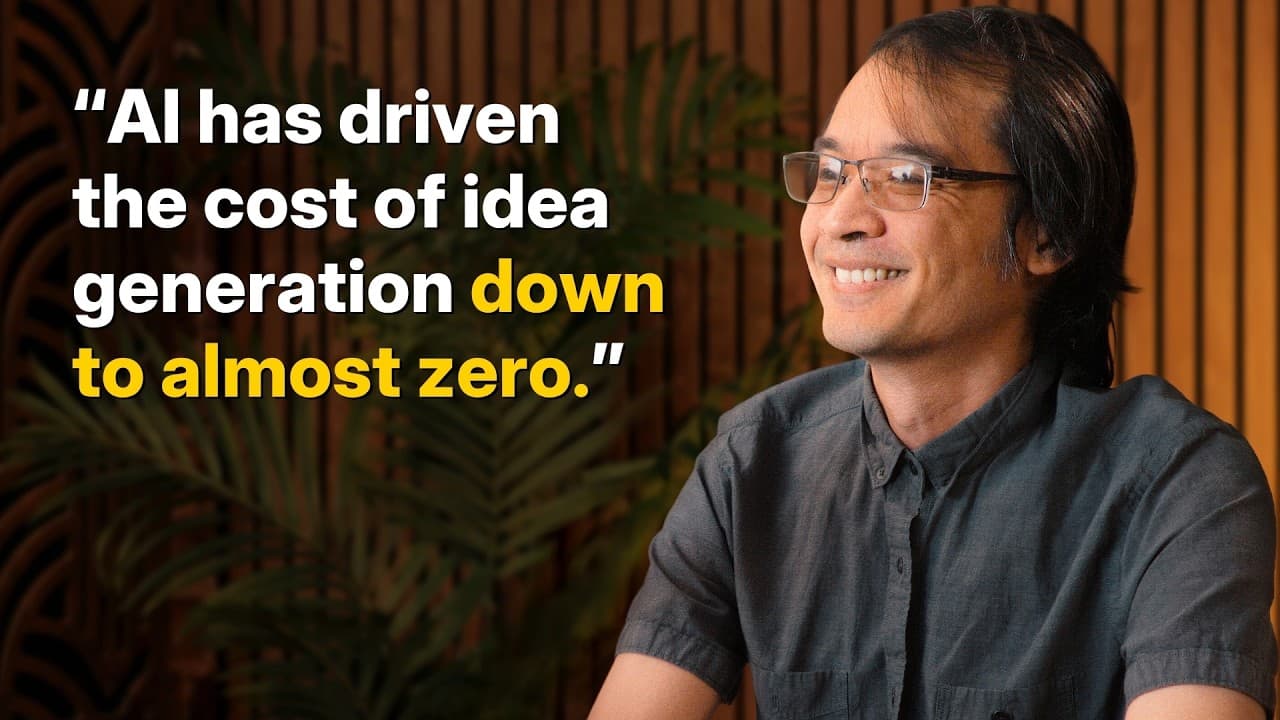
- AI could function as a high-temperature hypothesis generator by trying enormous numbers of relationships against verifiable datasets. Its ability to explore ideas without prestige concerns or fatigue becomes scientifically useful only when proposed patterns can be checked rigorously.
- Verification is as important as idea generation because unconstrained hypotheses produce slop rather than science. Scientific discovery also requires selecting worthwhile problems, collecting data, developing analytical strategies, validating results, and communicating explanations, not merely producing an inspired conjecture.
- Modern scientific practice increasingly reverses the classical sequence of hypothesis followed by experiment. Large datasets may now be collected first, after which statistics, machine learning, and data analysis identify patterns that can become candidate laws or theories.
- Bode’s planetary-distance pattern illustrates the danger of fitting laws to sparse data. Its apparent success with Uranus and Ceres generated excitement, but Neptune did not fit, revealing that an impressive numerical relationship can still be a coincidence.
Install to Summarize YouTube Videos and Get Transcripts
Explore YouTube Video Summarizer or Get YouTube Transcript Extractor
Questions & Answers
Q: How could AI help scientists discover new mathematical laws?
AI could generate and test many candidate relationships among measurements, geometries, equations, or simulation results. This resembles Kepler’s long search through circles, Platonic solids, harmonies, and other patterns. The approach becomes valuable when every candidate can be checked against precise evidence. Without dependable data and verification, producing more hypotheses merely increases the volume of plausible but unsupported claims.
Q: Why is Kepler compared to a high-temperature language model?
Kepler is compared to a high-temperature language model because he explored many speculative relationships before finding patterns that matched planetary observations. Some ideas involved musical harmonies or Platonic solids and proved incorrect, while others became laws of planetary motion. The analogy emphasizes broad, somewhat random hypothesis generation combined with a trusted dataset that can distinguish productive ideas from imaginative failures.
Q: Why was Tycho Brahe’s planetary dataset so important?
Tycho Brahe spent decades making naked-eye observations whenever weather permitted, producing the only exceptionally high-quality planetary dataset available to Kepler. His measurements were ten times more precise than earlier observations. That added accuracy allowed Kepler to see that his beautiful Platonic-solid model was wrong and provided the empirical foundation needed to calculate the planets’ actual orbital behavior.
Q: What did Kepler discover from Brahe’s observations?
Kepler determined that planetary orbits are ellipses rather than perfect circles. He also found that planets sweep out equal areas in equal times. Roughly ten years later, after working with the more difficult outer planets, he identified a third relationship connecting the time required to complete an orbit with a power of the planet’s distance from the Sun.
Q: Why is verification necessary for AI-generated hypotheses?
Verification separates scientific findings from patterns that merely look meaningful. A system can propose many relationships, but some will fit limited data by coincidence. Kepler’s successful laws depended on Brahe’s precise observations, while Bode’s planetary-distance rule eventually failed when Neptune was discovered. AI-driven science therefore needs validation capacity comparable to its ability to generate candidate explanations and empirical regularities.
Q: How has big data changed the traditional scientific method?
The classical model begins with a hypothesis and then gathers observations to test it. Big data, statistics, and machine learning can reverse that order. Researchers may first collect a massive dataset, analyze it for recurring structures, and then formulate hypotheses from the detected patterns. This makes data analysis a source of candidate laws rather than only a final test of prior ideas.
Q: Why was Kepler’s third law statistically uncertain?
Kepler inferred the relationship from only five or six data points, with each known planet contributing information about orbital length and distance from the Sun. The resulting curve fit was correct, but such a small sample could easily produce misleading regularities. The transcript suggests that Kepler may have treated the third law tentatively because he instinctively recognized the weakness of limited evidence.
Q: What does Bode’s planetary-distance law teach about pattern fitting?
Bode proposed that planetary distances followed a shifted geometric progression and used a gap between Mars and Jupiter to predict a missing planet. Uranus and Ceres appeared to support the pattern, creating excitement about a possible natural law. Neptune later fell far outside it, showing that sparse data can generate persuasive fits and successful-looking predictions that are ultimately numerical flukes.
Summary & Key Takeaways
-
Kepler initially sought mathematical perfection in planetary distances, proposing that the five Platonic solids fit between the spheres of the six known planets. Tycho Brahe’s unusually precise observations disproved this beautiful model, but the same data eventually helped Kepler identify elliptical orbits, equal-area motion, and a relationship between orbital period and distance.
-
The Kepler story suggests a possible role for AI as a prolific generator of scientific hypotheses. Millions of systems could test geometries, equations, simulations, or other relationships against established data. Yet large-scale idea generation produces knowledge only when paired with equally strong validation, because unverified output is merely an accumulation of plausible patterns.
-
Modern science increasingly begins with massive datasets and uses statistics or machine learning to extract possible laws. Kepler anticipated this approach when he fitted a relationship to information about only six planets. The later failure of Bode’s apparent planetary-distance law demonstrates why limited observations can support convincing patterns that eventually prove to be numerical coincidences.
Read in Other Languages (beta)
Share This Summary 📚
Summarize YouTube Videos and Get Video Transcripts with 1-Click
Try YouTube Summary with ChatGPT & Claude or YouTube Transcript Generator
Explore More Summaries from Dwarkesh Patel 📚



Summarize YouTube Videos and Get Video Transcripts with 1-Click
Try YouTube Summary with ChatGPT & Claude or YouTube Transcript Generator