What is Situational Awareness with Leo Aschenbrenner?
TL;DR
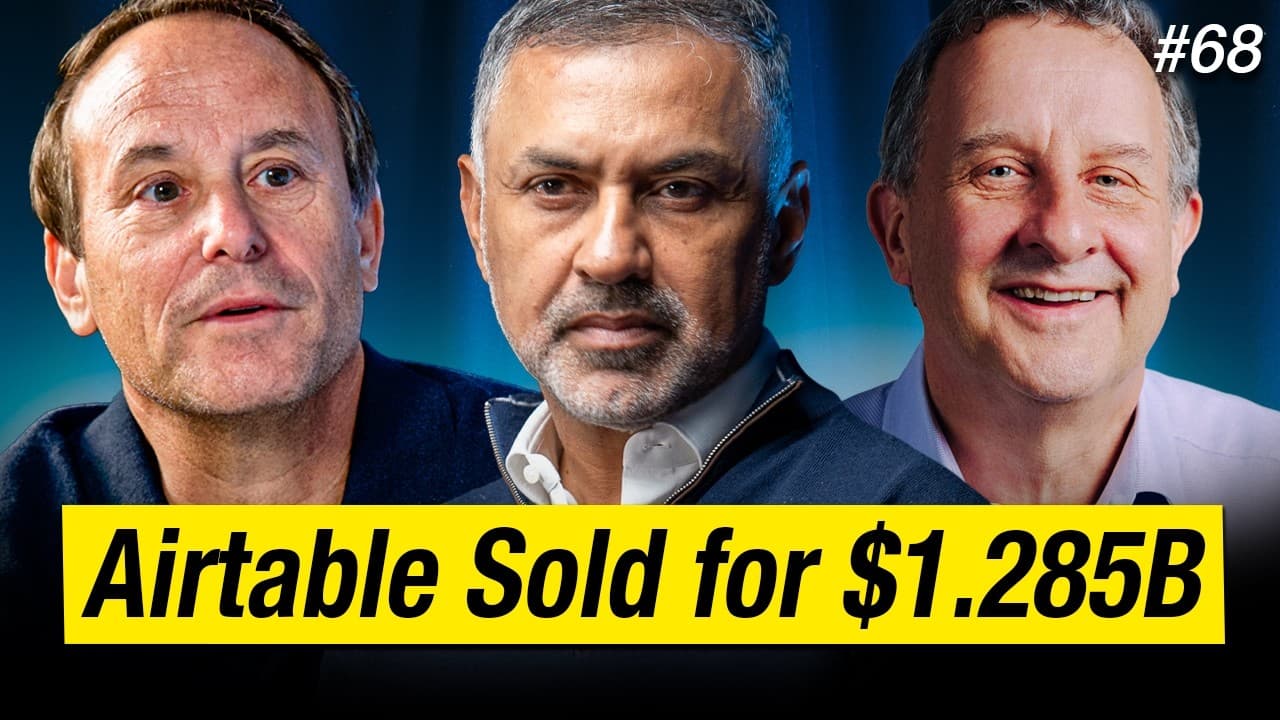
The discussion centers on strategic awareness in tech deals, pricing dynamics, and the evolving SaaS landscape. Airtable sold for 1.285 billion with roughly 485 million revenue and 20 percent growth, prompting debate on founders and PE appetite for AI infused businesses. The talk also covers AI adoption, market valuations, and the broader energy and security context.
Transcript
The long term average intelligence is going to be free and the average intelligence will get smarter. Land, permits, energy. See, this is the thing that is going to get priced for the next 3 to 5 years. And hold up, Nikash Aurora joins us in the studio. Oh yeah, baby. PaloAlto Network CEO, $280 billion company for this incredible session today. And... Read More
Key Insights
- A1. Airtable was acquired for 1.285 billion, illustrating a high profile exit in the SaaS space.
- A2. Airtable reported about 485 million in revenue with 20 percent year one growth, setting a benchmark for deal sizing and expectations.
- A3. The buyers, represented by Bending Spoons, leverage capital and a traded currency to acquire multiple targets, indicating a strategy of scale and consolidation.
- A4. The deal sparked discussion on founder fatigue and whether PE firms have the stomach for turnaround or AI infused infrastructure plays.
- A5. AI infusion is debated as potentially additive but not always transformative for horizontal productivity apps like Airtable.
- A6. The panel suggests that no obvious outside bid emerged despite AI dust and potential strategic value, highlighting market dynamics in bidding.
- A7. The conversation touches on the long term growth rate of SaaS and how it affects valuations and buyout willingness by different owners.
- A8. The chat delves into the notion that the best owner may turn a product into a cash flow machine, even if near term growth slows.
Install to Summarize YouTube Videos and Get Transcripts
Explore YouTube Video Summarizer or Get YouTube Transcript Extractor
Questions & Answers
Q: What was Airtable's sale price and what were its reported revenues and growth?
Airtable was sold for 1.285 billion, with reported revenues around 485 million and growth of about 20 percent in the first year of the deal window. This combination of price, revenue level, and growth rate informs the valuation discussion and reflects how buyers assess profitability and scale potential in software businesses. The panel uses these figures to compare to prior benchmarks and to consider future cash flow expectations.
Q: Why did the sellers not receive a higher bid despite AI dust and market interest?
The panel notes that no PE firm or competitor appeared to outbid, suggesting a combination of founder fatigue, market pricing, and risk tolerance among potential buyers. They discuss how strategic investors may value AI infusion differently, and how current capital availability and market conditions influence willingness to pay. The result indicates a cautious assessment of future growth versus immediate cash flow and risk.
Q: What role does AI infusion play in valuing no code or productivity apps like Airtable?
AI infusion is debated as a potential enhancement rather than a guaranteed driver of long term growth for no code productivity apps. The discussion centers on whether adding AI capabilities translates into meaningful stickiness or just a cosmetic improvement. The panel argues that some buyers see AI as essential while others view it as optional, affecting deal value and strategic fit.
Q: How do the speakers view founder fatigue in SaaS deals?
Founder fatigue is described as a real factor that can influence deal dynamics, with seasoned founders having already navigated ups and downs. This fatigue can affect negotiations, willingness to pivot, and the attractiveness of continuing leadership post acquisition. The commentary suggests that fatigue may lead buyers to favor existing scalable platforms with established governance rather than continuing complex turnarounds.
Q: What is the argument about long term growth rates and SaaS valuations?
The discussion argues that if long term growth rates for SaaS decline, valuations should compress accordingly. When growth becomes a concern, buyers price risk differently, and capital markets may favor steady cash flow over high but uncertain expansion. The panel stresses evaluating growth potential, profitability, and defensible moat in the context of changing market dynamics.
Q: What does the panel say about AirTable within the AI and agent economy?
The panel considers whether Airtable fits into an AI infused workflow ecosystem or if it remains primarily a productivity tool. They debate if there is clear strategic value in AI centric products for corporate buyers and whether Airtable’s current capabilities align with buyers seeking scalable AI driven processes or if the market requires broader platform integration.
Q: What are the broader implications for PE when evaluating AI focused B2B software?
The conversation suggests PE firms may face a supply and demand mismatch as AI infused B2B software matures. They discuss how AI features influence pricing, the risk appetite for transforming legacy products, and the importance of governance, product roadmap, and monetization strategy in evaluating such deals. The takeaway is that capital may flow toward scalable models with clear cash flow potential.
Q: How do the speakers compare Airtable to other no code or database products?
The speakers compare Airtable to earlier no code and database products, noting Airtable’s strength in configurability and user focus but acknowledging that niche or better suited alternatives exist today. They discuss how evolving tools like replete and base infrastructure affect Airtable’s competitive position, and whether no code platforms retain compelling differentiation in a market increasingly driven by AI and specialized solutions.
Summary & Key Takeaways
-
A broad discussion covers how situational awareness shapes decisions in tech deals and market pricing, including the Airtable sale and AI infusion debates.
-
The conversation weighs the value of long term growth, acquisition outcomes, and the role of capital markets in software as a service across different players.
-
The panel highlights the tension between ambitious AI infused product strategies and practical sustainability in equity markets and founder narratives.
Read in Other Languages (beta)
Share This Summary 📚
Summarize YouTube Videos and Get Video Transcripts with 1-Click
Try YouTube Summary with ChatGPT & Claude or YouTube Transcript Generator
Explore More Summaries from 20VC with Harry Stebbings 📚


Summarize YouTube Videos and Get Video Transcripts with 1-Click
Try YouTube Summary with ChatGPT & Claude or YouTube Transcript Generator