What Is the Modern Revolution in History?
TL;DR
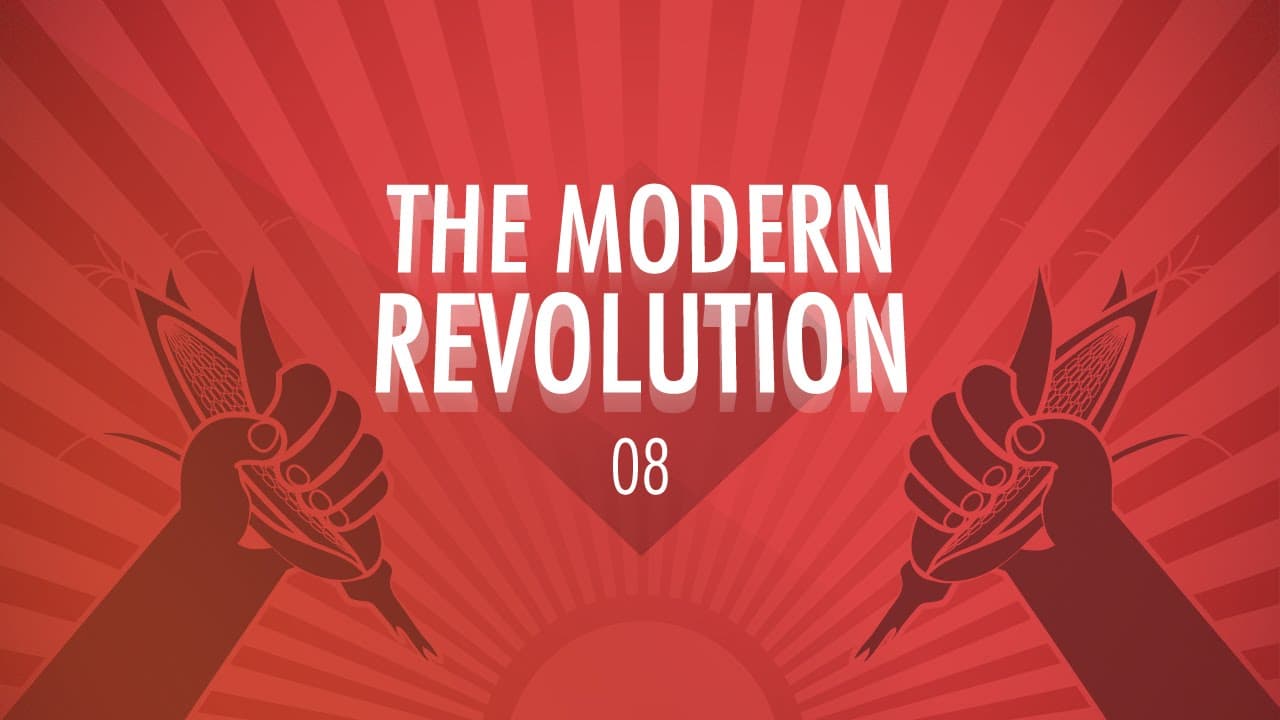
The Modern Revolution marks a significant acceleration in human collective learning and global connectivity, starting around 1750. This period saw the unification of world zones, leading to increased exchange of ideas and resources, which fueled the Industrial Revolution. The result was a dramatic rise in human productivity and complexity, transforming societies worldwide.
Transcript
Hi, I'm John Green. Welcome to Crash Course Big History. Today, we're going to look at the Modern Revolution. Mr. Green! Mr. Green! But, what does modern even mean. I mean, I know that fax machines and Super Nintendo are modern, but like people used to think that toilets that flushed were modern. That's actually a pretty perceptive question, Me Fro... Read More
Key Insights
- The Modern Revolution began around 1750, characterized by increased global connectivity and collective learning.
- European explorations united isolated world zones, enhancing the exchange of ideas and resources.
- The Industrial Revolution in Britain was pivotal, driven by innovations like steam engines and global trade networks.
- China had advanced agricultural methods and potential for industrialization but lacked the global trade networks of Europe.
- The rise in human population and connectivity accelerated cultural evolution, similar to the Cambrian Explosion.
- The unification of world zones had negative effects, such as the spread of diseases and reliance on slave labor.
- The Industrial Revolution marked a shift from agrarian to industrial societies, increasing energy harnessing and production.
- Humanity now faces the Anthropocene era, with potential to raise complexity further but risks exhausting Earth's resources.
Install to Summarize YouTube Videos and Get Transcripts
Explore YouTube Video Summarizer or Get YouTube Transcript Extractor
Questions & Answers
Q: What is the Modern Revolution in history?
The Modern Revolution refers to a period starting around 1750 characterized by rapid advancements in collective learning and global connectivity. It involved the unification of world zones, which allowed for the exchange of ideas and resources that fueled the Industrial Revolution. This era marked a significant transformation in human productivity and societal complexity.
Q: Why did the Industrial Revolution start in Britain?
The Industrial Revolution began in Britain due to several factors, including its global trade networks, access to coal, and innovations like the steam engine. Britain's ability to harness these resources and technologies, combined with a global exchange of ideas, positioned it uniquely for industrialization, unlike other regions such as China, which lacked similar networks.
Q: How did European explorations impact world connectivity?
European explorations in the 15th and 16th centuries united previously isolated world zones, creating a global network that enhanced collective learning. This connectivity facilitated the exchange of ideas, technologies, and resources, which played a crucial role in driving the Industrial Revolution and transforming societies worldwide.
Q: What role did collective learning play in the Modern Revolution?
Collective learning was central to the Modern Revolution, as it allowed for the rapid exchange and accumulation of knowledge across global networks. This process enabled technological advancements and innovations that fueled the Industrial Revolution, leading to increased productivity and societal complexity. It continues to drive human progress in the Anthropocene era.
Q: What were the negative effects of the Modern Revolution?
The Modern Revolution had several negative effects, including the spread of diseases to previously isolated regions, reliance on slave labor, and the exploitation of resources. These consequences highlighted the darker side of increased global connectivity and industrialization, impacting indigenous populations and contributing to long-term environmental and social challenges.
Q: How did the Industrial Revolution change human societies?
The Industrial Revolution transformed human societies by shifting from agrarian to industrial economies, increasing energy harnessing and production. This change led to higher living standards, urbanization, and the development of new technologies. It also facilitated global trade and connectivity, significantly altering social, economic, and cultural landscapes worldwide.
Q: What is the Anthropocene era?
The Anthropocene era refers to a proposed geological epoch characterized by significant human impact on Earth's geology and ecosystems. It follows the Holocene and is marked by unprecedented human control over the biosphere, driven by technological advancements and collective learning. The era presents opportunities for further complexity but also risks of resource exhaustion.
Q: Why didn't the Industrial Revolution happen in China?
Despite China's advanced agricultural methods and potential for industrialization, the Industrial Revolution did not occur there due to a lack of global trade networks and a shift away from innovation and commerce. The right combination of cultural innovations and collective learning required for industrial growth did not align in China as it did in Britain.
Summary & Key Takeaways
-
The Modern Revolution marks a period of accelerated collective learning and global connectivity, beginning around 1750. This era saw the unification of previously isolated world zones, facilitating the exchange of ideas and resources that fueled the Industrial Revolution. The result was a dramatic rise in human productivity and societal complexity, transforming societies worldwide.
-
European explorations played a crucial role in uniting world zones, enhancing collective learning. Despite China's advanced agricultural methods, Europe's global trade networks and innovations like the steam engine propelled the Industrial Revolution. This shift from agrarian to industrial societies increased energy harnessing and production, raising living standards significantly.
-
While the Modern Revolution brought technological progress and improved living standards, it also had negative effects such as the spread of diseases and reliance on slave labor. Humanity now stands on the threshold of the Anthropocene era, with the potential for further complexity but risks of exhausting Earth's resources if not managed wisely.
Read in Other Languages (beta)
Share This Summary 📚
Summarize YouTube Videos and Get Video Transcripts with 1-Click
Try YouTube Summary with ChatGPT & Claude or YouTube Transcript Generator
Explore More Summaries from CrashCourse 📚

Summarize YouTube Videos and Get Video Transcripts with 1-Click
Try YouTube Summary with ChatGPT & Claude or YouTube Transcript Generator