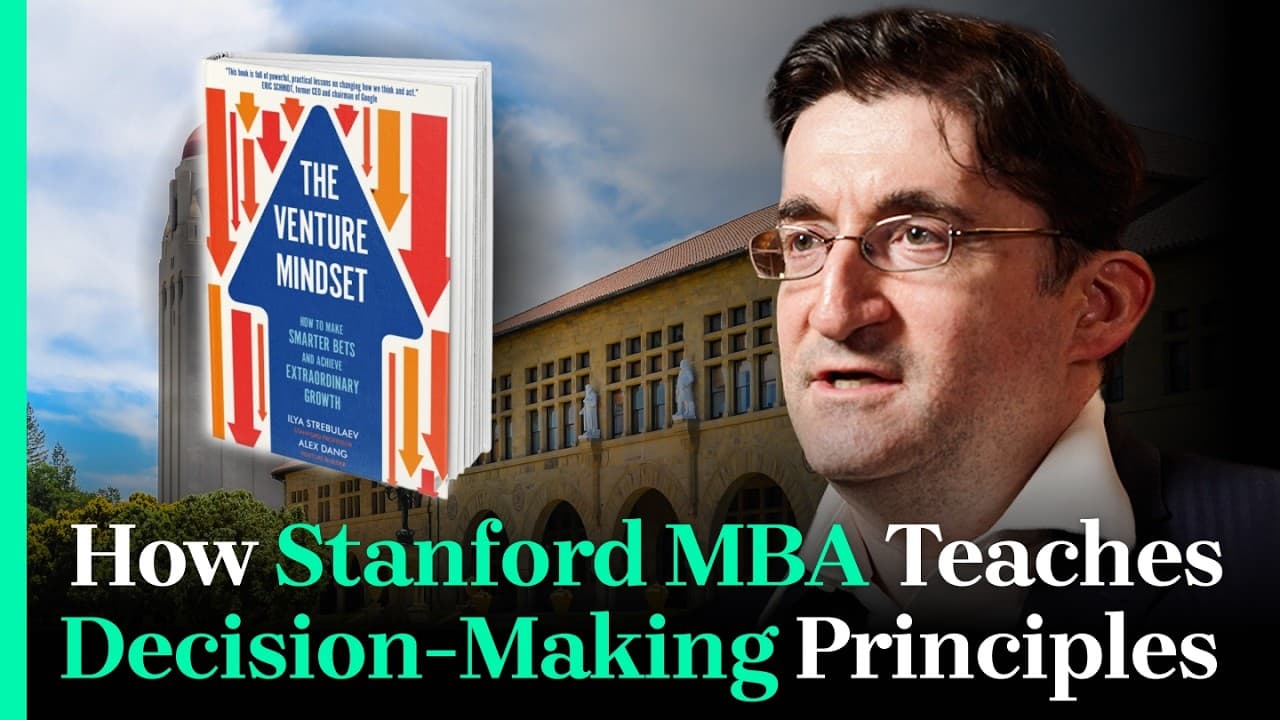
Investors' Principles of Silicon Valley Taught in Stanford MBA | Ilya Strebulaev
TL;DR
Venture capital is strategic, not a gamble, with key success principles.
Transcript
many people who don't know much about Venture Capital but kind of know about startups they think well venture capital is a gamble you gamble on some kind of very uncertain startups and some of them turn out to be great well it is not a Gamble and how do we know you know after 20 years of uh researching at stanfort about uh how Innovation Works ther... Read More
Key Insights
- Venture capital is not a gamble; it's strategic investment in high-growth potential startups, emphasizing the importance of the venture mindset for decision-making.
- The venture mindset prioritizes 'home runs' over failures, with successful investments covering the losses of many unsuccessful ones.
- Venture capitalists actively seek out promising startups, often meeting founders outside traditional office settings to discover hidden opportunities.
- The 'prepared mind' principle emphasizes readiness to seize opportunities, as seen in venture capitalists' quick decision-making and thorough evaluation processes.
- Saying 'no' is crucial in venture capital, with firms rejecting over 100 opportunities for every deal they make, using fast and slow decision-making lanes.
- A well-crafted blurb is vital for attracting venture capital interest, focusing on the founder's unique advantage and the startup's potential impact.
- Constructive failure is valued in venture capital, with lessons learned from failures seen as essential for future success and innovation.
- Persistence and preparation are key traits for venture capitalists, enabling them to consistently identify and invest in high-potential startups.
Install to Summarize YouTube Videos and Get Transcripts
Explore YouTube Video Summarizer or Get YouTube Transcript Extractor
Questions & Answers
Q: What is the venture mindset, and why is it important?
The venture mindset is a decision-making framework used by venture capitalists, emphasizing strategic investment in startups with high growth potential. It prioritizes achieving 'home runs' over avoiding failures, allowing successful investments to cover losses. This mindset is crucial for navigating the fast-paced, innovation-driven world of venture capital, enabling investors to consistently identify and support promising ventures.
Q: How do venture capitalists identify promising startups?
Venture capitalists identify promising startups by actively seeking out opportunities beyond traditional office settings, often meeting founders in informal environments. They use strategies like early detection of rising app rankings and personal interactions to discover hidden gems. This proactive approach, combined with a prepared mind for quick decision-making, helps them find high-potential startups that might otherwise go unnoticed.
Q: What role does failure play in the venture capital industry?
Failure is seen as an integral part of the venture capital industry, with successful firms often having higher failure rates. Constructive failure provides valuable lessons, helping venture capitalists refine their decision-making and improve future investments. The industry values experimentation and risk-taking, understanding that occasional failures are necessary for achieving significant breakthroughs and long-term success.
Q: Why is saying 'no' important for venture capitalists?
Saying 'no' is crucial for venture capitalists because it allows them to focus on the most promising opportunities. With an overwhelming number of investment possibilities, they must efficiently narrow down options using fast and slow decision-making lanes. By rejecting over 100 opportunities for every deal they make, venture capitalists ensure they allocate resources to startups with the highest potential for success.
Q: How can founders attract venture capital interest?
Founders can attract venture capital interest by crafting a concise, impactful blurb that highlights their unique advantage and the startup's potential impact. The blurb should focus on the founder's qualifications, the identified pain point, and the proposed solution. It's essential to capture the venture capitalist's attention quickly, as they have limited time to evaluate numerous opportunities.
Q: What is the significance of the 'prepared mind' principle?
The 'prepared mind' principle emphasizes readiness to seize opportunities when they arise. In venture capital, this means being well-informed and able to make quick, informed decisions when evaluating startups. A prepared mind allows venture capitalists to recognize patterns, assess potential investments swiftly, and capitalize on opportunities that align with their strategic goals, ultimately leading to more successful outcomes.
Q: How do venture capitalists balance risk and reward?
Venture capitalists balance risk and reward by focusing on high-potential startups that can deliver substantial returns, even if many investments fail. They adopt a portfolio approach, understanding that a few successful 'home runs' can compensate for numerous failures. This strategy involves thorough evaluation, strategic decision-making, and a willingness to take calculated risks in pursuit of significant long-term gains.
Q: What lessons can be learned from venture capitalists' approach to failure?
Venture capitalists' approach to failure teaches the importance of viewing failures as learning opportunities. Constructive failure provides insights that can enhance future decision-making and innovation. Embracing failure as part of the process encourages experimentation and risk-taking, essential for achieving breakthroughs. This mindset fosters resilience and adaptability, crucial traits for success in the dynamic world of venture capital and entrepreneurship.
Summary & Key Takeaways
-
Professor Ilya Strebulaev from Stanford discusses the strategic nature of venture capital, highlighting that it's not a gamble but a calculated investment approach. He introduces the concept of the 'venture mindset,' which involves principles that guide successful decision-making in the fast-paced world of innovation.
-
The venture mindset includes focusing on 'home runs' rather than failures, as successful investments can compensate for numerous unsuccessful ones. Venture capitalists often meet founders outside traditional settings, actively seeking promising startups and making quick, informed decisions.
-
Effective communication with venture capitalists is crucial, with emphasis on crafting a concise, impactful blurb that highlights the founder's unique advantage and the startup's potential. Constructive failure is seen as beneficial, providing valuable lessons for future endeavors and fostering innovation.
Read in Other Languages (beta)
Share This Summary 📚
Summarize YouTube Videos and Get Video Transcripts with 1-Click
Try YouTube Summary with ChatGPT & Claude or YouTube Transcript Generator
Explore More Summaries from EO 📚

Summarize YouTube Videos and Get Video Transcripts with 1-Click
Try YouTube Summary with ChatGPT & Claude or YouTube Transcript Generator