Are Indian Stocks Overvalued Based on 2025 Data?

TL;DR
Indian equities appear modestly overvalued, not excessively overvalued, based on the market-cap-to-GDP ratio discussed. The larger concern is whether slower economic growth causes the forward price-to-earnings multiple to contract, while persistent SIP inflows may have already created distinctly expensive pockets within the market.
Transcript
hi everyone welcome to today's video so Professor Daman has come out with a article saying that India market is most expensive now this is creating a lot of panic right and why because f are withdrawing money Indian Market has hasn't done well over the last one one and a half years so this is creating a lot of problem because you know the market if... Read More
Key Insights
- India’s current price-to-earnings ratio is around 24, while the United States is around 26. This simple international comparison does not prove that India is reasonably valued, because each market’s multiple reflects investor expectations about its future growth and earnings.
- A price-to-earnings ratio measures the price investors are willing to pay relative to earnings. A ratio of 100 means investors are paying 100 units of price for one unit of earnings, while higher multiples generally reflect stronger expectations of future growth.
- Forward valuation is more important than the current multiple when growth expectations are changing. India could sustain or expand a high valuation if growth strengthens, but a growth rate near 5.5% to 6%, rather than the expected 8% to 9%, could pressure its multiple.
- Foreign institutional investors have been selling Indian equities for several years, with particularly aggressive selling after the pandemic period. The interpretation offered is that these investors are concerned about future growth and the possibility that India’s price-to-earnings ratio will contract.
- India’s historical growth has been supported by the IT revolution, startups, domestic consumption following the 1991–1992 liberalization reforms, and infrastructure development. Their future contributions differ, with IT described negatively, startups positively, and consumption as dependent on job creation.
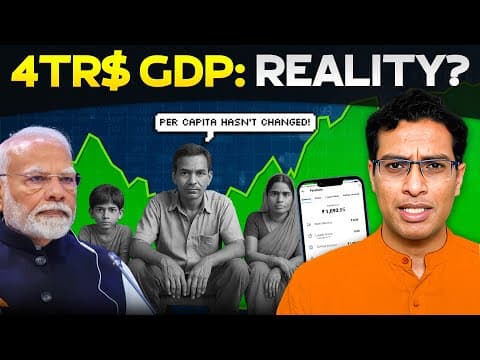
- Domestic consumption accounts for almost 60% of India’s GDP according to the analysis. Further consumption growth requires more high-quality jobs, because per-capita GDP cannot rise merely through expectations. Average incomes must increase sufficiently to support greater household spending.
- India’s market-cap-to-GDP ratio is above 100, which indicates overvaluation in the framework presented. However, the same measure has crossed that level previously, so the evidence supports describing the market as modestly overvalued rather than extremely or irrationally expensive.
- Rapid SIP growth has directed substantial domestic savings into equities. This flow does not mean every part of the Indian market is equally expensive, but it may have created bubbles and clear overvaluation within particular pockets, making selective portfolio decisions important.
Install to Summarize YouTube Videos and Get Transcripts
Explore YouTube Video Summarizer or Get YouTube Transcript Extractor
Questions & Answers
Q: Are Indian stocks excessively overvalued in 2025?
Indian stocks are described as modestly overvalued rather than excessively overvalued. The market-cap-to-GDP ratio is above 100, which signals overvaluation within the framework used, but similar conditions have occurred before. The more important risk is India’s growth problem and whether weaker future growth causes investors to assign a lower price-to-earnings multiple to the market.
Q: What does India’s price-to-earnings ratio reveal?
India’s price-to-earnings ratio is presented as roughly 24, meaning investors currently pay about 24 units of price relative to one unit of earnings. The ratio represents the premium investors assign based partly on expected growth. Its significance therefore depends on whether future earnings and economic growth justify that valuation, rather than on the number alone.
Q: Why can India be expensive when the US has a higher PE ratio?
The United States has a price-to-earnings ratio of around 26, compared with approximately 24 for India, but this does not automatically make India cheaper. Valuation depends on expected future growth. India’s growth was expected to reach about 8% to 9%, while the analysis places it nearer 5.5% to 6%, weakening the justification for its existing premium.
Q: What could make India’s forward PE ratio decline?
India’s forward price-to-earnings ratio could decline if economic and earnings growth fail to meet investor expectations. The analysis illustrates a possible contraction from around 24 to 20 or even 17. Such compression would mean investors are no longer willing to pay the same premium, even if the market’s underlying companies continue producing earnings.
Q: What factors previously supported India’s economic growth?
The analysis identifies the IT revolution, startup activity, liberalization reforms, domestic consumption, and infrastructure development as important growth drivers. IT helped cities such as Pune and Hyderabad become stronger, while the reforms beginning around 1991–1992 opened the economy and supported consumption. More recent government capital expenditure also helped create confidence in Indian market growth.
Q: Can domestic consumption continue driving India’s economy?
Domestic consumption produces almost 60% of India’s GDP according to the analysis, making it a major economic driver. However, continued expansion requires high-quality job creation and rising incomes. A per-capita GDP figure of about $2,500 will not simply increase to $5,000 without employment that generates enough income for people to spend and consume more.
Q: Why might investors continue using equity SIPs despite overvaluation?
Investors have limited alternatives in the environment described. Inflation is stated as roughly 5% to 6%, real estate is unaffordable for many people, fixed deposits lack a major tax advantage, debt is taxed heavily, and sovereign gold bonds are not readily available for new investment. These constraints encourage investors to continue directing savings into equity SIPs.
Q: How should investors respond to overvaluation in Indian equities?
The analysis does not support abandoning Indian equities for five or six years simply because the broad market appears expensive. Instead, investors should distinguish modest overall overvaluation from bubbles in specific pockets. They should examine forward growth prospects, understand where SIP inflows may have inflated valuations, conduct their own due diligence, and build a more resilient portfolio.
Summary & Key Takeaways
-
India’s current price-to-earnings ratio is presented as roughly 24, compared with about 26 for the United States. That comparison alone does not settle whether India is expensive. Investors must assess whether future growth can support the premium, because slower growth could cause India’s forward valuation multiple to contract.
-
India’s earlier economic growth is connected to the IT revolution, the startup ecosystem, domestic consumption following liberalization reforms, and infrastructure development. The outlook is mixed: IT appears weak, startups are presented positively, and further consumption growth requires high-quality jobs that can raise incomes and support additional household spending.
-
The market-cap-to-GDP ratio suggests that Indian equities are overvalued, but not to an extreme degree. Avoiding equities entirely also creates practical difficulties because inflation is high and alternative investments have limitations. Strong SIP growth may keep money entering equities while producing bubbles in particular market segments.
Read in Other Languages (beta)
Share This Summary 📚
Summarize YouTube Videos and Get Video Transcripts with 1-Click
Try YouTube Summary with ChatGPT & Claude or YouTube Transcript Generator
Explore More Summaries from Akshat Shrivastava 📚





Summarize YouTube Videos and Get Video Transcripts with 1-Click
Try YouTube Summary with ChatGPT & Claude or YouTube Transcript Generator