How Will AI Singularity Impact Humanity by 2030?
TL;DR
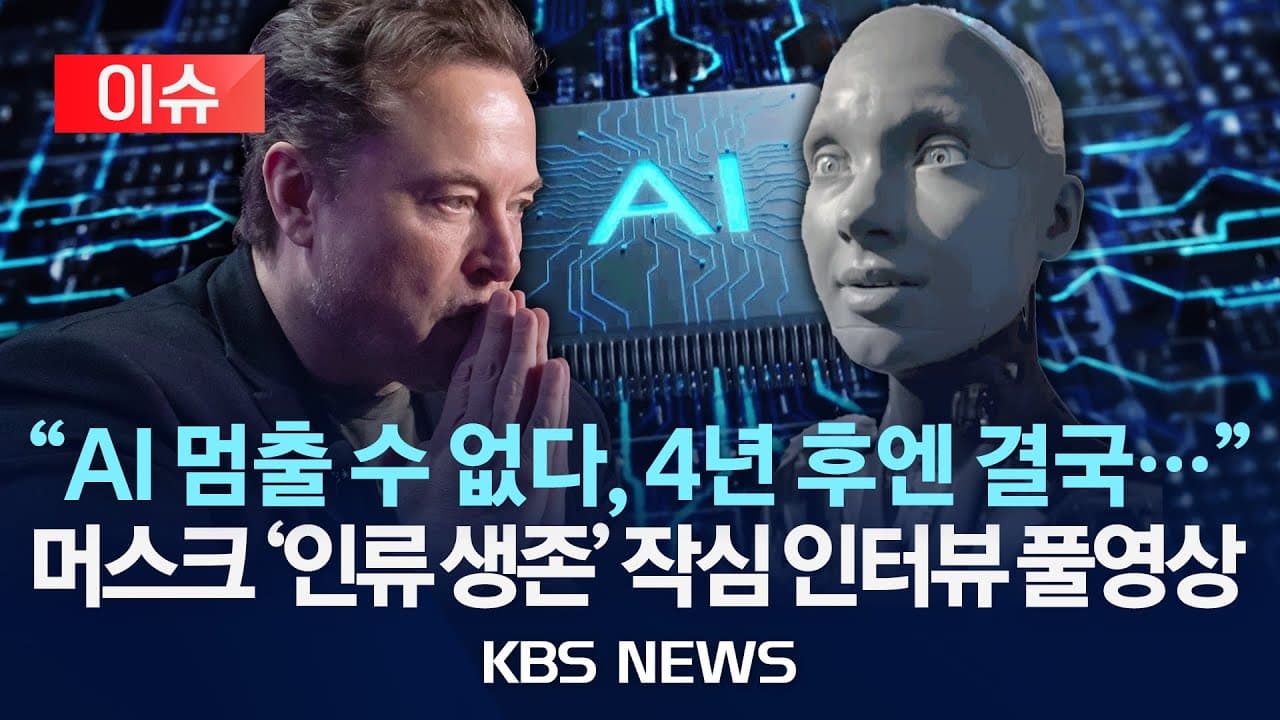
Artificial Intelligence is rapidly approaching a singularity, a point where its development becomes uncontrollable and irreversible. By 2030, AI is predicted to surpass the combined intelligence of all humans. Elon Musk emphasizes the importance of guiding AI development towards truth, curiosity, and beauty to ensure it benefits humanity. The interview also discusses the potential obsolescence of traditional education and the transformative impact of AI on medicine and society.
Transcript
The way this unfolds is fundamentally impossible to predict because of self-improvement of the AI and the accelerating timeline. >> Yeah. It's called singularity for a reason. >> Yeah. Exactly. >> I don't know what goes what what happens after when after the event horizon. >> Exactly. You can never see past the black hole or the event horizon. The ... Read More
Key Insights
- AI is approaching a singularity, making its future developments unpredictable.
- By 2030, AI will likely surpass the intelligence of all humans combined.
- Elon Musk suggests AI should focus on truth, curiosity, and beauty.
- AI's rapid development could render traditional education obsolete.
- Medicine will be revolutionized by AI, with robots surpassing human surgeons.
- AI's intelligence density potential is vastly underestimated.
- The recursive improvement of AI will lead to exponential advancements.
- AI's impact on society will be profound, requiring proactive guidance.
Install to Summarize YouTube Videos and Get Transcripts
Explore YouTube Video Summarizer or Get YouTube Transcript Extractor
Questions & Answers
Q: What is the AI singularity?
The AI singularity refers to a hypothetical point in time when artificial intelligence surpasses human intelligence and becomes capable of self-improvement beyond human control. This event is expected to lead to rapid and unpredictable advancements, fundamentally altering technology and society.
Q: How will AI surpass human intelligence by 2030?
AI is expected to surpass human intelligence by 2030 through continuous advancements in algorithmic efficiency, hardware improvements, and self-improvement capabilities. These developments will enable AI to perform complex tasks and solve problems at a level beyond human capacity, leading to a transformative impact on society.
Q: Why does Elon Musk emphasize truth, curiosity, and beauty in AI?
Elon Musk emphasizes truth, curiosity, and beauty as guiding principles for AI development to ensure it aligns with human values and interests. Truth prevents AI from malfunctioning due to false premises, curiosity fosters engagement with humanity, and beauty encourages AI to contribute positively to human culture and society.
Q: What impact will AI have on traditional education?
AI's rapid advancements could render traditional education models obsolete, as AI systems become capable of performing tasks that require years of human training. This shift will necessitate a reevaluation of educational priorities and methods to prepare individuals for a future where AI plays a central role in various professions.
Q: How will AI revolutionize medicine?
AI is expected to revolutionize medicine by providing superior diagnostic and surgical capabilities through advanced robotics. These AI-driven systems will perform surgeries with greater precision and consistency than human surgeons, democratizing access to high-quality medical care and reducing the cost and time associated with medical training.
Q: What is intelligence density potential in AI?
Intelligence density potential refers to the amount of intelligence that can be achieved per unit of computational resources. Current estimates underestimate this potential, suggesting that AI systems could become significantly more intelligent with the same or fewer resources, leading to exponential improvements in their capabilities.
Q: Why is AI's development described as exponential?
AI's development is described as exponential because its advancements are accelerating at a rapid pace due to improvements in algorithms, hardware, and self-learning capabilities. This exponential growth means that each new development builds upon previous ones, leading to increasingly rapid and significant technological breakthroughs.
Q: How should society guide AI development?
Society should guide AI development by establishing ethical frameworks and priorities that align with human values, such as truth, curiosity, and beauty. Proactive engagement from policymakers, industry leaders, and the public is essential to ensure AI technologies are developed responsibly and contribute positively to societal progress.
Summary & Key Takeaways
-
AI's development is accelerating towards a singularity, making its future unpredictable. By 2030, AI is expected to surpass human intelligence collectively. Elon Musk highlights the importance of steering AI towards truth, curiosity, and beauty to ensure it remains beneficial.
-
Traditional education, including medical training, may become obsolete as AI advances. Robots are predicted to surpass human surgeons in skill and availability, democratizing access to superior medical care globally.
-
The intelligence density of AI is currently underestimated, with potential for vast improvements. AI's recursive development could lead to rapid, exponential advancements, necessitating careful guidance to harness its potential for societal benefit.
Read in Other Languages (beta)
Share This Summary 📚
Summarize YouTube Videos and Get Video Transcripts with 1-Click
Try YouTube Summary with ChatGPT & Claude or YouTube Transcript Generator
Explore More Summaries from KBS News 📚





Summarize YouTube Videos and Get Video Transcripts with 1-Click
Try YouTube Summary with ChatGPT & Claude or YouTube Transcript Generator