Lecture 2.1: Josh Tenenbaum - Computational Cognitive Science Part 1
TL;DR
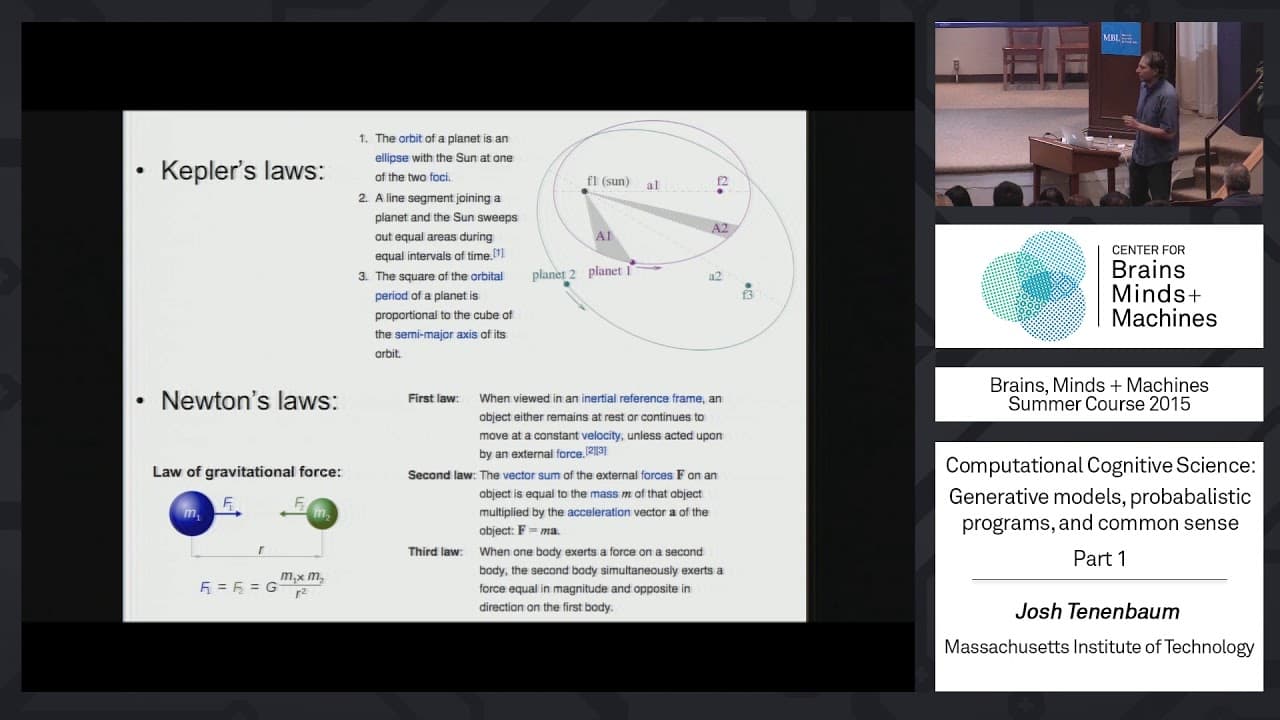
This content introduces the concept of computational cognitive science and emphasizes the importance of generative models and probabilistic programs in understanding the mind.
Transcript
The following content is provided under a Creative Commons license. Your support will help MIT OpenCourseWare continue to offer high quality educational resources for free. To make a donation or view additional materials from hundreds of MIT courses, visit MIT OpenCourseWare at osw.mit.edu. JOSH TENENBAUM: I'm going to be talking about computationa... Read More
Key Insights
- 🤯 Computational cognitive science aims to connect the minds and machines.
- 🤯 Generative models and probabilistic programs are important in understanding the mind and building intelligence.
- 👨🔬 Explanation is a crucial aspect of intelligence but is often overlooked in recent AI and machine learning research.
Install to Summarize YouTube Videos and Get Transcripts
Explore YouTube Video Summarizer or Get YouTube Transcript Extractor
Questions & Answers
Q: What is the difference between classification and explanation in terms of intelligence?
Classification refers to recognizing patterns in data, while explanation involves understanding and modeling the world. Explanation is important for intelligence, but it is often underemphasized in recent AI and machine learning research.
Q: What are some key features of generative models?
Generative models generate the world by positing hidden causal variables that explain observed data. They are not task-specific and can be used for a wide range of tasks. They are also compositional, meaning they consist of parts that can be combined to form larger wholes.
Q: How is learning different for humans compared to deep reinforcement learning systems?
Humans can learn from very little data, often just one or a few examples. Humans also bring prior knowledge and the ability to understand causal connections, which allows for quick learning and generalization. Deep reinforcement learning systems, on the other hand, require large amounts of training data and have limited generalization abilities.
Summary & Key Takeaways
-
Computational cognitive science focuses on connecting the minds and machines, exploring concepts like generative models and probabilistic programs.
-
The content emphasizes the importance of explaining and modeling the world as part of intelligence, in addition to classifying and recognizing patterns in data.
-
The author discusses the need for both pattern recognition and explanatory approaches to understanding the mind, and how they complement each other.
Read in Other Languages (beta)
Share This Summary 📚
Summarize YouTube Videos and Get Video Transcripts with 1-Click
Try YouTube Summary with ChatGPT & Claude or YouTube Transcript Generator
Explore More Summaries from MIT OpenCourseWare 📚



Summarize YouTube Videos and Get Video Transcripts with 1-Click
Try YouTube Summary with ChatGPT & Claude or YouTube Transcript Generator