How Does the Hough Transform Improve Pattern Recognition?
TL;DR
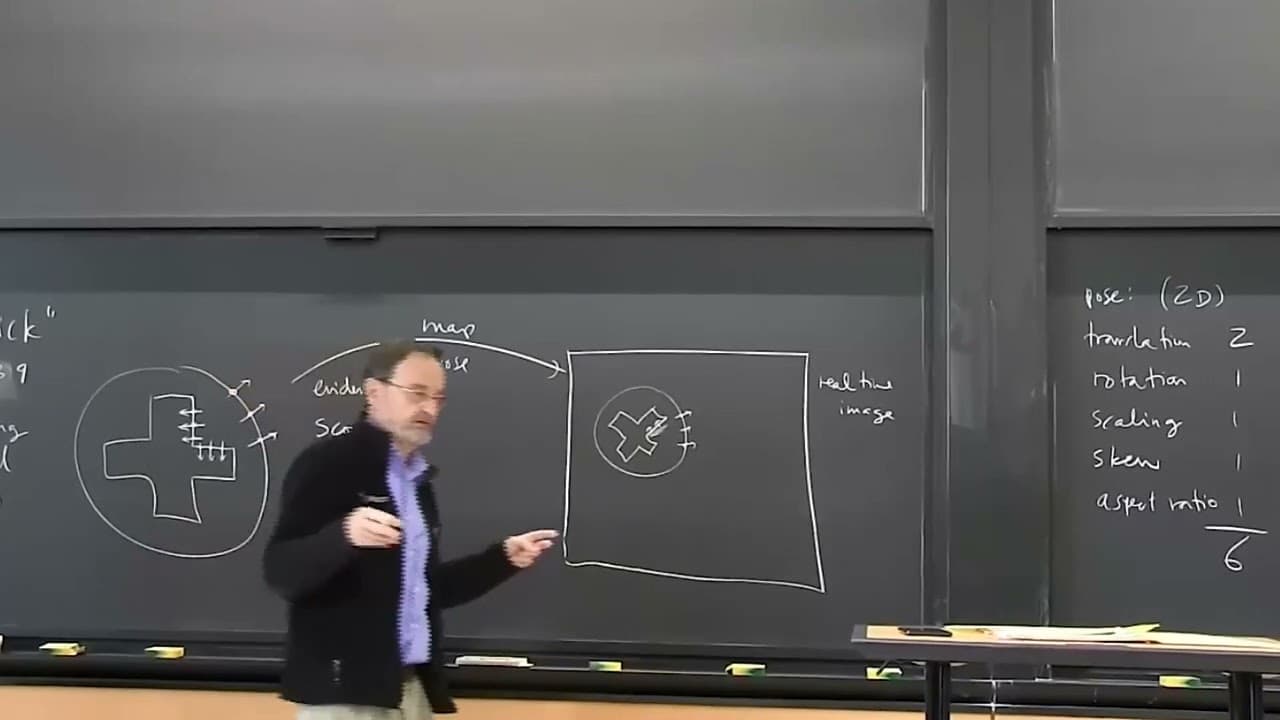
The Hough Transform enhances pattern recognition by effectively detecting lines and shapes in images through mapping image data into parameter space. This method operates efficiently at multiple scales while considering noise, allowing for both quick and precise identification of patterns. It emphasizes the importance of models and scoring functions in gathering evidence for accurate matches.
Transcript
[SQUEAKING] [RUSTLING] [CLICKING] BERTHOLD HORN: "Quick," meaning pattern recognition quickly. And that's in distinction from another pattern we'll look at later, which is slower but gets a more accurate answer. So a number of terms were defined there. One of them was that of a model. So there's a training step that produces a model. And the model ... Read More
Key Insights
- 🎚️ Pattern recognition involves both quick and accurate identification of patterns, depending on the required level of precision.
- 👾 The Hough Transform is a method for detecting patterns, such as lines and circles, in images by mapping the image space to a parameter space.
- 💦 Working at multiple scales and considering noise are important aspects of pattern recognition and the Hough Transform.
Install to Summarize YouTube Videos and Get Transcripts
Explore YouTube Video Summarizer or Get YouTube Transcript Extractor
Questions & Answers
Q: What is the difference between quick pattern recognition and accurate pattern recognition?
Quick pattern recognition focuses on rapid identification of patterns, while accurate pattern recognition involves a more detailed analysis to ensure a more precise identification.
Q: How does the Hough Transform help in detecting lines and circles?
The Hough Transform maps the image space to a parameter space, allowing the detection of lines and circles. Each point in the parameter space corresponds to a potential line or circle in the image, and accumulating evidence in this space helps identify the desired patterns.
Q: What are some challenges when working with the Hough Transform in pattern recognition?
One challenge is choosing an optimal scale for detection, as different patterns may be more apparent at different scales. Another challenge is addressing noise and ensuring that the accumulated evidence accurately represents the desired patterns.
Q: How can the Hough Transform and pattern recognition be applied in real-world scenarios?
The Hough Transform can be used in various applications, such as detecting lines in images of printed circuit boards or recognizing circles in surveillance camera footage. Pattern recognition can be valuable in fields such as object detection, image classification, and tracking.
Summary & Key Takeaways
-
The content introduces the concept of pattern recognition and the distinction between quick pattern recognition and slower, more accurate pattern recognition.
-
It delves into the idea of models and probes in pattern recognition, highlighting the scoring function and the importance of working at different scales.
-
The Hough Transform is introduced as a method for detecting lines and circles in images, and its application in different scenarios is discussed.
Read in Other Languages (beta)
Share This Summary 📚
Summarize YouTube Videos and Get Video Transcripts with 1-Click
Try YouTube Summary with ChatGPT & Claude or YouTube Transcript Generator
Explore More Summaries from MIT OpenCourseWare 📚


Summarize YouTube Videos and Get Video Transcripts with 1-Click
Try YouTube Summary with ChatGPT & Claude or YouTube Transcript Generator