11. Weighted Shortest Paths
TL;DR
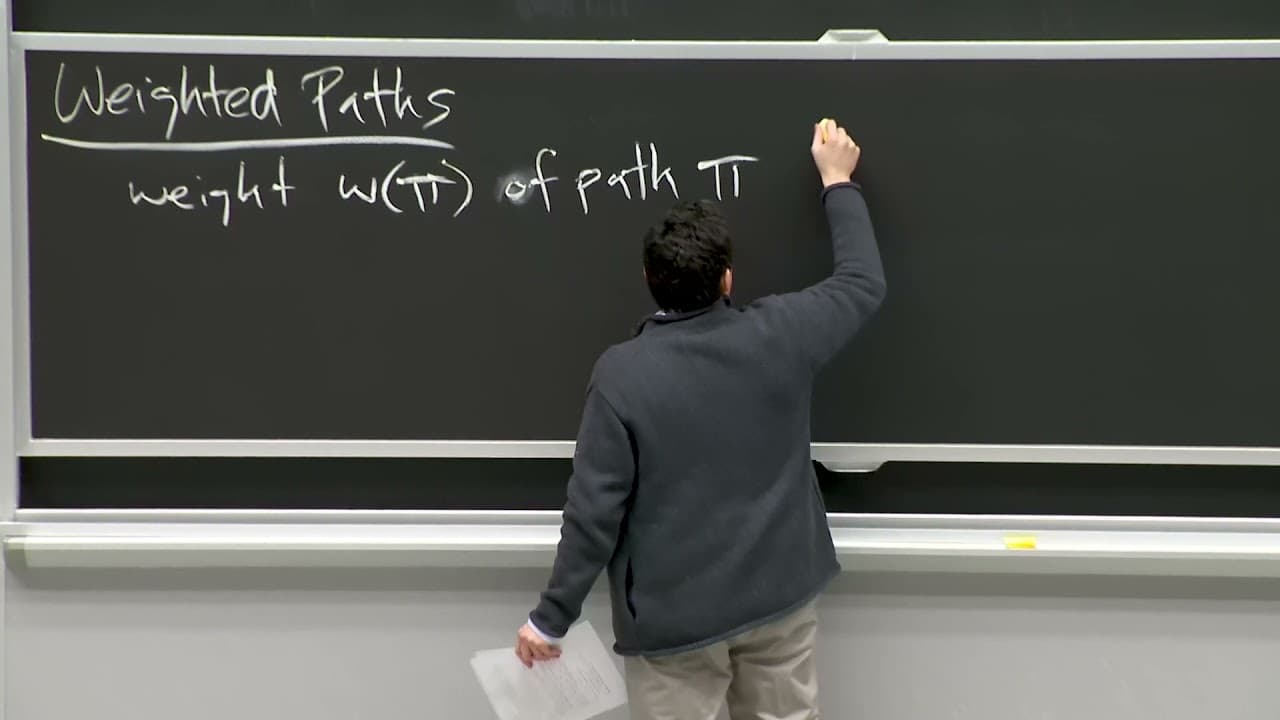
The lecture introduces the concept of weighted shortest paths in a directed acyclic graph (DAG) and explains how to compute them using the DAG relaxation algorithm.
Transcript
[SQUEAKING] [RUSTLING] [CLICKING] JASON KU: Hi, everyone. Welcome to the 11th lecture of 6.006, our first lecture on weighted shortest paths. Until now, we've only been talking about graphs that-- where we measure distance in terms of the number of edges in a path. Today, we're going to generalize that notion. But I just want to go over what we've ... Read More
Key Insights
- 🏋️ Weighted shortest paths generalize unweighted paths by assigning weights to edges.
- 🈸 Weighted paths have various applications in road networks, networks, and social networks.
- 🏋️ DAG relaxation is an algorithm for computing weighted shortest paths in a directed acyclic graph.
- ☺️ DAG relaxation initializes distance estimates and repeatedly relaxes edges by lowering estimates that violate the triangle inequality.
Install to Summarize YouTube Videos and Get Transcripts
Explore YouTube Video Summarizer or Get YouTube Transcript Extractor
Questions & Answers
Q: What is the difference between unweighted paths and weighted paths?
Unweighted paths measure distance in terms of the number of edges, while weighted paths assign an integer weight to each edge and sum the weights along the path.
Q: What are some applications where weighted paths are important?
Weighted paths are used to represent distances in road networks, latency in networks, and strength of relationships in social networks.
Q: How are the weights represented in a graph with weighted paths?
The weights are either stored with each adjacency or in a separate data structure mapping edges to their weights.
Q: How does DAG relaxation algorithm work?
DAG relaxation initializes distance estimates to infinity, sets the source vertex estimate to 0, and then repeatedly relaxes edges by lowering distance estimates that violate the triangle inequality. This process is repeated for each vertex in topological sort order.
Q: What is the time complexity of the DAG relaxation algorithm?
The DAG relaxation algorithm has a linear time complexity, as it visits each vertex and its outgoing neighbors once.
Q: Can the DAG relaxation algorithm handle negative weight cycles?
No, the DAG relaxation algorithm assumes that there are no negative weight cycles in the graph. Handling negative weight cycles is discussed in the next lecture on the Bellman-Ford algorithm.
Q: How are parent pointers computed in weighted shortest paths?
Distance estimates are computed first, and then parent pointers can be reconstructed from the shortest path distances by relaxing edges and setting parent pointers to the source vertex along the shortest paths.
Summary & Key Takeaways
-
The lecture begins by summarizing the previous two lectures on breadth-first search and depth-first search algorithms.
-
Weighted shortest paths are introduced as a generalization of unweighted paths, where distances are measured using weights assigned to edges.
-
A weighted graph representation is discussed, along with the importance of weights in various applications such as road networks and social networks.
-
The lecture then focuses on computing weighted shortest paths in a DAG, explaining the DAG relaxation algorithm.
-
DAG relaxation involves initializing distance estimates, relaxing edges by minimum weight, and repeatedly lowering distance estimates until they converge to the true shortest path distances.
Read in Other Languages (beta)
Share This Summary 📚
Summarize YouTube Videos and Get Video Transcripts with 1-Click
Try YouTube Summary with ChatGPT & Claude or YouTube Transcript Generator
Explore More Summaries from MIT OpenCourseWare 📚



Summarize YouTube Videos and Get Video Transcripts with 1-Click
Try YouTube Summary with ChatGPT & Claude or YouTube Transcript Generator