What Happens in a One-Dimensional Elastic Collision?
TL;DR
In a one-dimensional elastic collision, both momentum and kinetic energy are conserved. The final velocities of two colliding particles can be determined using the quadratic formula, and the solutions reflect both the initial and final states of the system. Understanding these principles is essential for analyzing collisions in physics.
Transcript
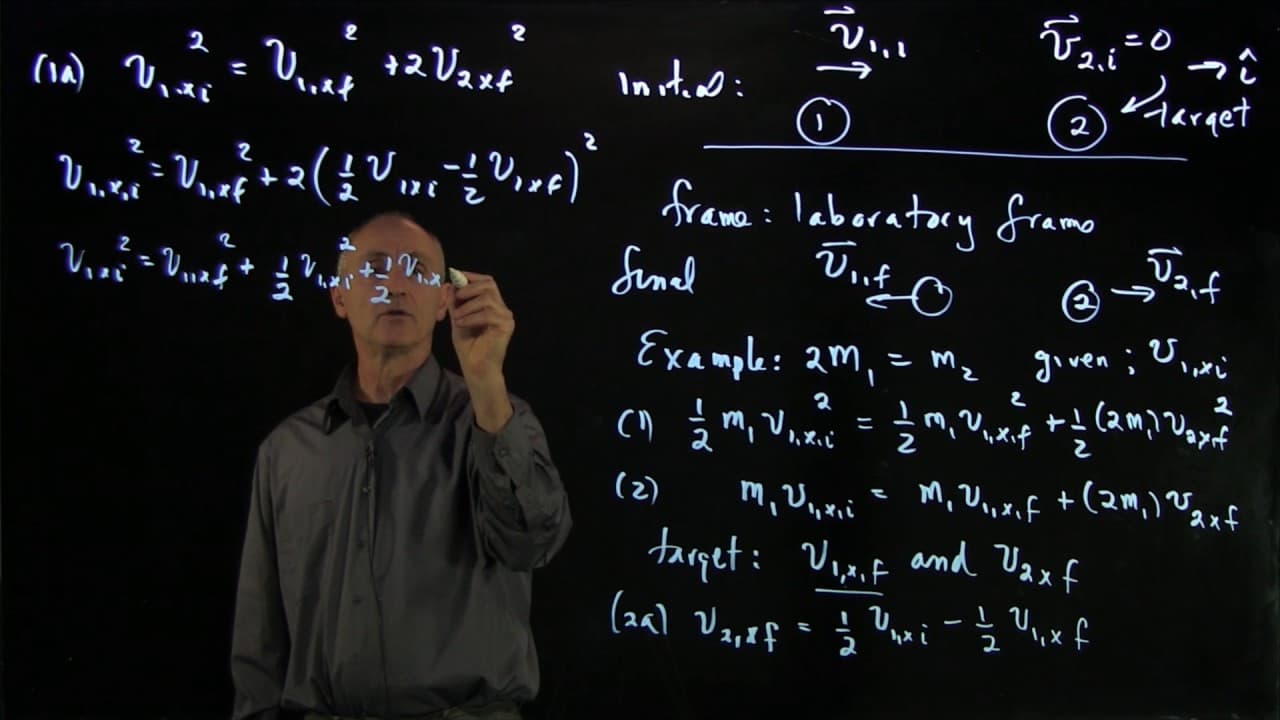
Let's look at some examples of one dimensional elastic collisions with no external forces between two particles. So suppose I have particle 1 and particle 2, and we have them moving on a frictionless surface. And let's choose a reference frame in which we'll call-- the laboratory frame-- in which the initial velocity of particle 2 0. So our frame i... Read More
Key Insights
- 💥 One-dimensional elastic collisions occur on frictionless surfaces.
- 💥 Both energy and momentum are conserved in these collisions.
- ❓ The energy condition equates the initial and final kinetic energies.
- ❓ The momentum condition equates the initial and final momenta.
- 💥 The quadratic formula can be used to solve for the final velocities in one-dimensional elastic collisions.
- ❓ One solution represents the initial state, while the other represents the final state.
- 💥 Quadratic equations are commonly encountered when dealing with energy and momentum in collisions.
Install to Summarize YouTube Videos and Get Transcripts
Explore YouTube Video Summarizer or Get YouTube Transcript Extractor
Questions & Answers
Q: What is a one-dimensional elastic collision?
A one-dimensional elastic collision is a collision between particles on a frictionless surface in which both energy and momentum are conserved.
Q: How are the initial and final states of the particles defined in a one-dimensional elastic collision?
In the initial state, one particle is moving with an initial velocity, while the other particle (target) is at rest. In the final state, both particles can be moving with final velocities.
Q: What are the energy and momentum conditions in a one-dimensional elastic collision?
The energy condition states that the initial kinetic energy is equal to the final kinetic energy. The momentum condition states that the initial momentum is equal to the final momentum.
Q: How can the quadratic formula be used to solve the two unknowns in one-dimensional elastic collisions?
By substituting the expressions for mass, velocity, and the energy and momentum conditions, a quadratic equation can be derived. The quadratic formula can then be applied to find the values of the final velocities.
Summary & Key Takeaways
-
The video introduces the concept of one-dimensional elastic collisions between particles on a frictionless surface.
-
It explains the reference frame and initial and final states of the particles.
-
The video presents the energy and momentum conditions for these collisions and demonstrates how to solve them using the quadratic formula.
Read in Other Languages (beta)
Share This Summary 📚
Summarize YouTube Videos and Get Video Transcripts with 1-Click
Try YouTube Summary with ChatGPT & Claude or YouTube Transcript Generator
Explore More Summaries from MIT OpenCourseWare 📚


Summarize YouTube Videos and Get Video Transcripts with 1-Click
Try YouTube Summary with ChatGPT & Claude or YouTube Transcript Generator