How to Extract Starch from Potatoes at Home
TL;DR
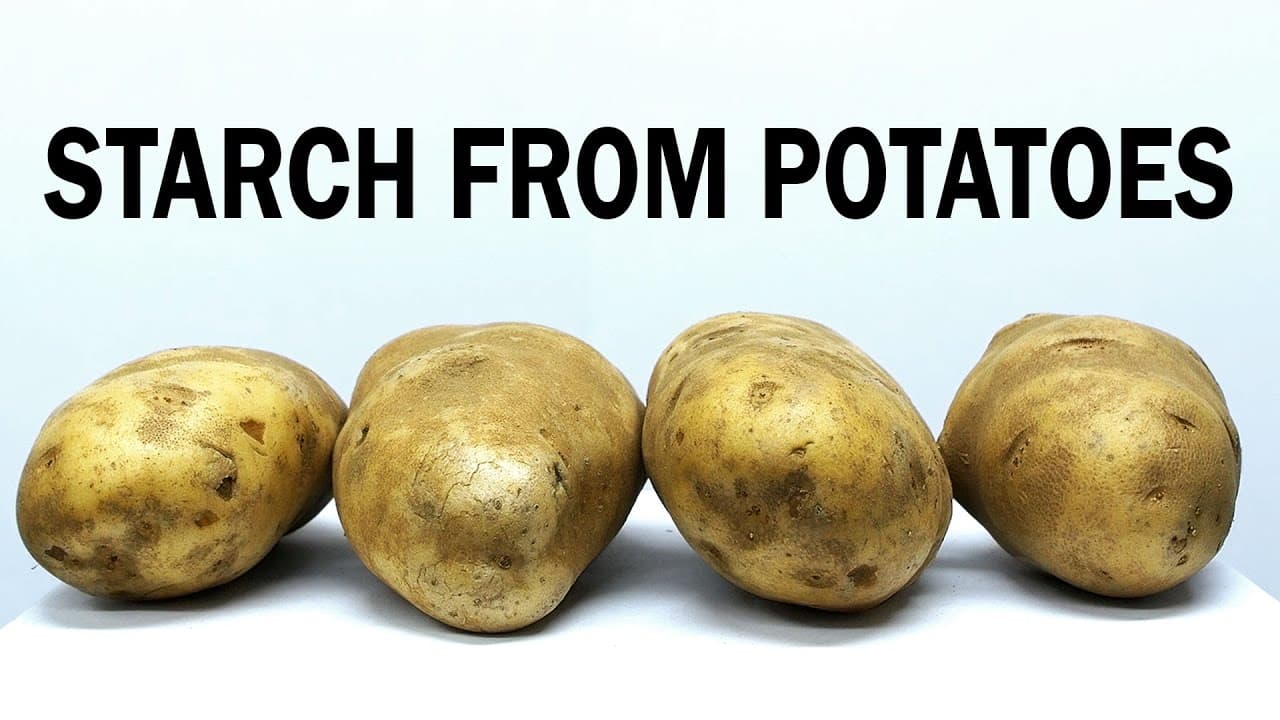
To extract starch from potatoes, grate the peeled potatoes and wash the shavings with lukewarm water to release the starch. After filtering and allowing the mixture to settle, decant the water and repeat the washing process until clean starch remains, which can then be dried. This method is simple, though it yields less starch compared to more efficient techniques.
Transcript
Starch is a large carbohydrate polymer that plants use to store energy. its found in all plants but the amount that they store varies, and the largest amounts can be found in things like potatoes, corn, wheat or rice. The polymer of starch is made up of many glucose units, connected by something known as glycosidic bonds. In starch the type of glyc... Read More
Key Insights
- 🌱 Starch is a vital energy storage polymer in plants, with different sources varying in the amount stored.
- 💄 The glycosidic bonding patterns (alpha 1-4 and 1-6) differentiate starch from cellulose, making cellulose indigestible for most animals.
- 🖤 Potato starch is preferred for certain applications due to its lack of protein and fat contaminants, resulting in a clear solution.
- 🥔 Extracting potato starch involves mechanically breaking potato cells by grating, washing the shavings to remove other components, and multiple filtrations for purification.
- ✋ The extraction method shown in the video is not the most efficient, and other methods may provide higher yields.
- ✋ Idaho potatoes and Russets are recommended for their higher starch content in the extraction process.
- 🥶 Starch can be used as a thickening agent and a gluten-free alternative in baking.
Install to Summarize YouTube Videos and Get Transcripts
Explore YouTube Video Summarizer or Get YouTube Transcript Extractor
Questions & Answers
Q: Can I use any type of potato to extract starch?
While any potato can be used, Idaho potatoes and Russets, with higher starch content, are recommended. The size of the potatoes doesn't matter; smaller ones may require more peeling.
Q: What are the differences between potato starch and corn starch?
Potato starch has lower protein and fat contaminants, resulting in a clear solution. Corn starch, on the other hand, contains more protein and fats, giving a slightly opaque or cloudy appearance.
Q: How can I use the extracted potato starch?
Potato starch can be used for various applications, such as thickening sauces, soups, and gravies, creating clear solutions for experiments or reactions, and even in baking as a gluten-free alternative.
Q: Is the extraction method shown in the video the most efficient?
No, the method used in the video is not the most efficient but still yields a decent amount of starch. Other methods, such as using a blender or a commercial potato starch extractor, may provide higher yields.
Summary & Key Takeaways
-
Starch is a carbohydrate polymer found in all plants, with the largest amounts in potatoes, corn, wheat, and rice. Starch consists of amylose and amylopectin components, linked by alpha 1-4 and 1-6 glycosidic bonds.
-
Humans can break down starch to glucose for energy but lack the enzymes to break down cellulose, which is why most of it is undigested. Potato starch is preferred due to its low protein and fat content compared to other starches.
-
Extracting potato starch involves mechanically breaking the potato cells through grating, washing the shavings to separate the starch, and filtering it multiple times for purification.
Read in Other Languages (beta)
Share This Summary 📚
Summarize YouTube Videos and Get Video Transcripts with 1-Click
Try YouTube Summary with ChatGPT & Claude or YouTube Transcript Generator
Explore More Summaries from NileRed 📚
Summarize YouTube Videos and Get Video Transcripts with 1-Click
Try YouTube Summary with ChatGPT & Claude or YouTube Transcript Generator