Is AI a Bubble or a Lasting Economic Shift?
TL;DR
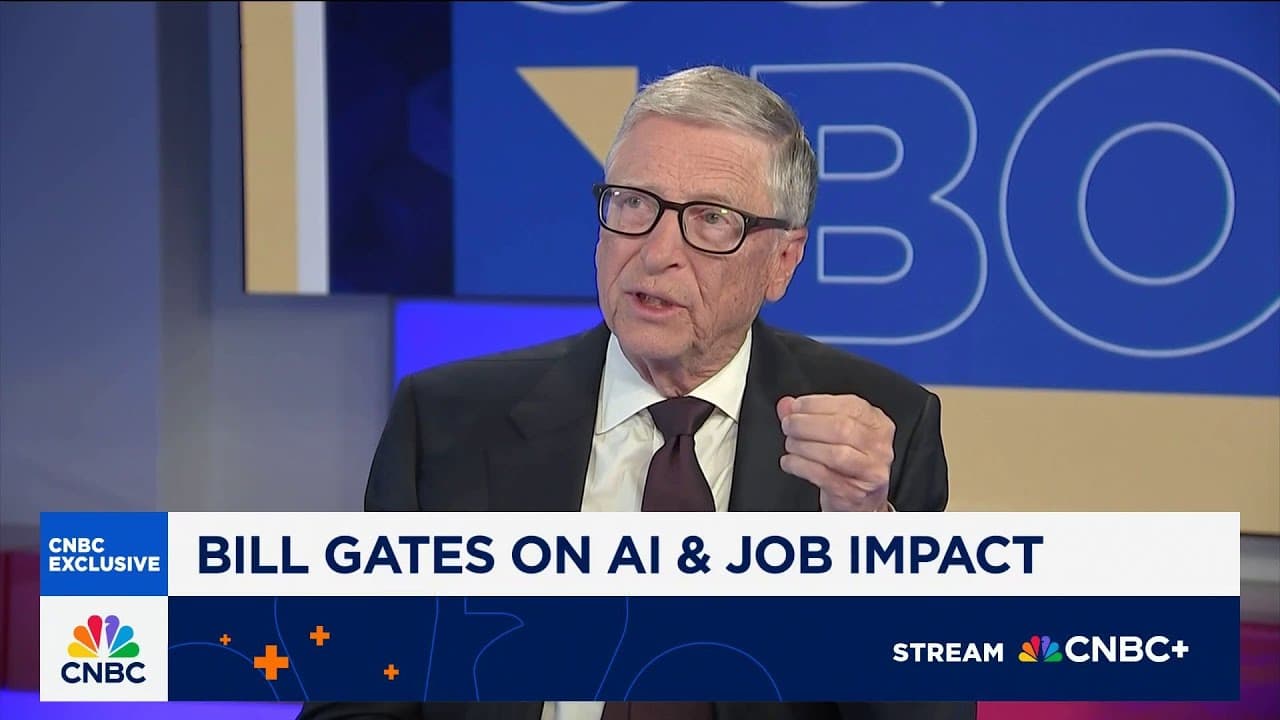
AI is not an empty speculative bubble because it offers substantial economic value through medical advice, tutoring, and drug design. Bill Gates expects an internet-style investment frenzy in which some companies prosper while others waste capital on costly data centers or chips, alongside eventual job-market disruption, energy concerns, and demands for predictable government policy.
Transcript
Microsoft's co-founder, Bill Gates, publishing a new essay on climate. It's aimed at uh to deliver a message ahead of COP 30. And he's suggesting that the climate community should shift its strategy from temperature and emission targets to the impact on human lives. In an exclusive interview on that topic, I also asked him if he is worried about wh... Read More
Key Insights
- AI is not comparable to a purely empty speculative craze because the technology already has uses with significant potential economic value. Gates identifies medical advice, personalized tutoring, and assistance with drug design as examples of intelligence-based services that make the underlying technology consequential.
- The AI investment cycle resembles the internet bubble because a profound technology can coexist with widespread financial failure. Gates expects some companies to succeed while many capital-burning businesses fall behind, even though the technology itself ultimately changes the economy and creates considerable net value.
- AI infrastructure investments can become dead ends when companies misjudge electricity costs, geography, or hardware replacement cycles. A data center may prove uneconomic compared with an overseas alternative, while purchased chips may lose relevance before companies capture their expected value from that generation.
- Technology companies cannot simply withdraw from the AI race because Gates considers the technology too important to ignore. Massive commitments may still be risky, especially for companies that are not earning money from AI while promising substantial spending on chips, data centers, and related infrastructure.
- Public acceptance of AI infrastructure depends partly on protecting residents from higher electricity bills. Gates says communities have not authorized companies to raise household energy costs, so power generation and data-center projects must use locations and business arrangements with strong economics and political support.
- New nuclear projects require a different liability and financing structure from historical utility-led development. Gates argues that next-generation reactors should be placed where residents can clearly see that the project will not increase their electricity bills and where local political acceptance is strong.
- AI will affect the job market even though large-scale employment losses have not yet appeared. Gates expects some impact over the next several years and argues that acknowledging this prospect honestly should not be treated as an attempt to weaken the United States in the technology race.
- Government industrial policy works best when its rules remain predictable over long investment periods. Gates questions whether government ownership could distort competition by favoring companies in which it holds stakes, especially when another company may later offer superior technology.
Install to Summarize YouTube Videos and Get Transcripts
Explore YouTube Video Summarizer or Get YouTube Transcript Extractor
Questions & Answers
Q: Is artificial intelligence currently a speculative bubble?
Artificial intelligence is not an empty bubble comparable to a craze built around something with no lasting substance, according to Gates. He instead compares it with the internet bubble, when an important technology transformed the world despite many failed companies and wasted investments. AI can create substantial value, but the current investment frenzy will still produce winners, losers, and numerous dead ends.
Q: Why does Bill Gates compare AI with the internet bubble?
Gates compares AI with the internet bubble because both combine profound technical change with excessive investment. The internet ultimately created substantial value and changed the world, although many companies burned capital or fell behind. He expects AI to follow a similar pattern, with successful businesses emerging alongside companies whose spending on infrastructure and technology never generates adequate returns.
Q: What economic value can artificial intelligence provide?
Artificial intelligence can supply forms of useful intelligence across several important activities. Gates specifically points to medical advice, tutoring, and assistance with designing drugs as examples. These applications make the technology economically valuable rather than purely speculative. The scale of that value is why he describes AI as the biggest technical development of his lifetime and says its influence is difficult to overstate.
Q: Why could investments in AI data centers fail?
AI data-center investments can fail when their electricity costs make them uncompetitive or when another location, including an overseas location, can provide computing capacity more cheaply. Companies may also purchase a generation of chips without capturing its full value before a newer generation arrives. These timing, energy, and location risks can turn large infrastructure commitments into costly dead ends.
Q: How should communities handle electricity costs from AI data centers?
Communities should not be required to pay higher household electricity bills because companies want to build AI data centers nearby. Gates says the industry lacks permission to impose those costs on residents. Projects should therefore be located where the economics and political acceptance are strong, with dedicated or additional power arrangements that clearly prevent the infrastructure from raising residents' electricity expenses.
Q: What role could nuclear energy play in powering AI?
New generation nuclear reactors could supply energy for AI infrastructure if they are placed in locations where residents can clearly see that their electricity bills will not increase. Gates also says the historical model, in which utilities carried substantial liability, will not be repeated. Successful projects therefore require suitable locations, credible economics, different business arrangements, and strong political acceptance.
Q: How will artificial intelligence affect employment?
Artificial intelligence has not yet caused job-market effects in large numbers, but Gates expects some impact over the next several years. He argues that public discussion should acknowledge this prospect honestly, even when people worry that speaking about job losses could slow the United States in the technology race. Workers' concerns are therefore legitimate and should be discussed frankly.
Q: Why does predictable industrial policy matter to companies?
Predictable industrial policy matters because companies make long-term decisions when they build factories and invest in emerging technologies. Gates argues that tariffs and other rules should not change every year or every day. He also raises concerns that government ownership of companies could create favoritism, particularly if officials support a government-backed company after a competitor develops better technology.
Summary & Key Takeaways
-
Bill Gates compares the current AI boom with the internet bubble, not the Dutch tulip episode. He believes AI has substantial underlying value, but expects many investments to become dead ends. Companies may burn capital by purchasing chips or building data centers without capturing sufficient returns before technology and economics change.
-
AI infrastructure could increase local electricity costs, creating political resistance to new data centers. Gates argues that communities have not granted permission for higher household power bills. New generation nuclear reactors should therefore be located and financed where their economics, liability arrangements, and public acceptance are especially strong.
-
AI has not yet produced large job losses, but Gates expects noticeable labor-market effects over the next several years and calls for honest discussion. He also argues that industrial policy works best when tariffs, investment rules, and government support remain predictable, transparent, and fair to companies with competing technologies.
Read in Other Languages (beta)
Share This Summary 📚
Summarize YouTube Videos and Get Video Transcripts with 1-Click
Try YouTube Summary with ChatGPT & Claude or YouTube Transcript Generator
Explore More Summaries from CNBC Television 📚





Summarize YouTube Videos and Get Video Transcripts with 1-Click
Try YouTube Summary with ChatGPT & Claude or YouTube Transcript Generator