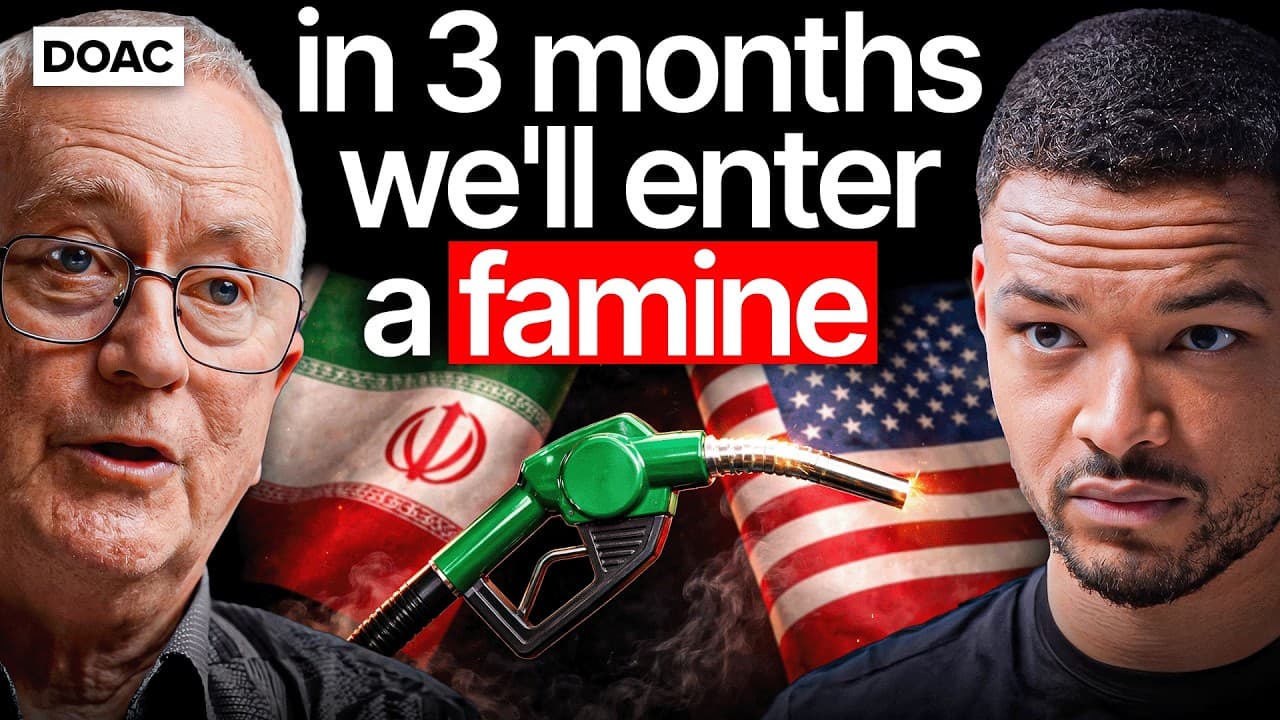
Will the Iran Conflict Lead to Global Famine?
TL;DR
The ongoing conflict involving Iran threatens global stability, with potential disruptions in oil and fertilizer supplies leading to severe economic and food crises. The geopolitical tensions, particularly between Iran and Israel, are exacerbating these issues, creating a fragile global situation. The potential for nuclear escalation and economic manipulation adds further complexity to the crisis.
Transcript
So there are five scenarios in which the war could end because Trump is stupid enough to take on what Israel wanted to do, which was destroy Iran, but they've bitten off far more than they can chew. So scenario one is Iran destroys the Gulf power infrastructure. I think that's highly likely. And if that happens, then Saudi Arabia, Qatar, Dubai, the... Read More
Key Insights
- Iran's control over the Strait of Hormuz poses a significant threat to global oil and fertilizer supplies, impacting food production.
- The geopolitical conflict is driven by long-standing tensions between Iran, Israel, and the United States, with complex motivations.
- Trump's actions in the conflict are seen as both strategic and self-serving, potentially manipulating oil markets for personal gain.
- The potential for nuclear escalation in the Middle East is a major concern, with Israel's nuclear capabilities being a focal point.
- Economic consequences of the conflict could lead to a global recession, affecting energy prices and food availability.
- The conflict highlights the fragility of global supply chains and the interconnectedness of energy and food production.
- Iran's military preparedness and strategic planning have surprised many, challenging assumptions about its capabilities.
- The situation underscores the need for sustainable energy solutions and self-sufficiency to mitigate such geopolitical risks.
Install to Summarize YouTube Videos and Get Transcripts
Explore YouTube Video Summarizer or Get YouTube Transcript Extractor
Questions & Answers
Q: How does the Iran conflict threaten global food supply?
The Iran conflict threatens global food supply primarily through its control of the Strait of Hormuz, a crucial passage for oil and fertilizer exports. Disruptions in these supplies could lead to a significant decrease in global agricultural output, potentially causing a worldwide famine. Fertilizer shortages would particularly impact crop yields, leading to food scarcity and increased prices.
Q: What is the significance of the Strait of Hormuz in this conflict?
The Strait of Hormuz is a strategic chokepoint through which a substantial portion of the world's oil and fertilizer supplies pass. Iran's ability to control or block this passage gives it significant leverage in the conflict, potentially disrupting global energy and food supplies. This control is a major factor in the geopolitical tensions involving Iran, Israel, and the United States.
Q: Why is there concern about nuclear escalation in the Middle East?
There is concern about nuclear escalation in the Middle East due to Israel's nuclear capabilities and the potential for conflict with Iran. If tensions escalate, there is a fear that nuclear weapons could be used, leading to catastrophic consequences not only for the region but globally. The prospect of nuclear conflict raises the stakes significantly in the ongoing geopolitical tensions.
Q: How might Trump's actions impact the oil market during this conflict?
Trump's actions in the conflict are perceived as potentially manipulating the oil market for personal and political gain. By creating uncertainty and tension, he can influence oil prices, benefiting certain economic interests. This manipulation could lead to volatility in the global oil market, affecting energy prices and economic stability worldwide.
Q: What role does Iran's military preparedness play in the conflict?
Iran's military preparedness plays a crucial role in its ability to resist external pressures and project power in the region. Its strategic planning, including decentralizing military command and developing missile capabilities, has surprised many and challenged assumptions about its capabilities. This preparedness complicates the geopolitical landscape and impacts the strategies of other involved nations.
Q: What are the broader economic implications of the Iran conflict?
The broader economic implications of the Iran conflict include potential disruptions in global energy and food supplies, leading to increased prices and economic instability. A prolonged conflict could trigger a global recession, affecting trade, investment, and consumer confidence. The interconnectedness of global supply chains means that regional conflicts can have far-reaching economic consequences.
Q: How does the conflict highlight the fragility of global supply chains?
The conflict highlights the fragility of global supply chains by demonstrating how geopolitical tensions can disrupt critical supplies of energy and food. The reliance on specific chokepoints, like the Strait of Hormuz, makes global supply chains vulnerable to political and military disruptions. This fragility underscores the need for diversification and resilience in global supply networks.
Q: What measures can be taken to mitigate the risks posed by such geopolitical conflicts?
To mitigate risks posed by geopolitical conflicts, measures such as diversifying energy sources, investing in sustainable energy solutions, and enhancing supply chain resilience are crucial. Developing self-sufficiency in critical resources like food and energy can reduce vulnerability. Additionally, diplomatic efforts to de-escalate tensions and promote stability in volatile regions are essential to prevent conflicts from spiraling into global crises.
Summary & Key Takeaways
-
The conflict involving Iran, Israel, and the United States threatens global stability, particularly through control of the Strait of Hormuz, a critical chokepoint for oil and fertilizer supplies. This could lead to severe economic and food crises worldwide. The geopolitical tensions are exacerbated by Iran's strategic military preparedness and the potential for nuclear escalation, with Israel's nuclear capabilities being a focal point of concern.
-
President Trump's actions in the conflict are perceived as both strategic and self-serving, potentially manipulating oil markets for personal gain. The economic consequences of the conflict could lead to a global recession, affecting energy prices and food availability. The situation underscores the fragility of global supply chains and the interconnectedness of energy and food production.
-
The ongoing crisis highlights the need for sustainable energy solutions and self-sufficiency to mitigate geopolitical risks. As the conflict evolves, the potential for nuclear escalation and economic manipulation adds further complexity, necessitating a reevaluation of global political and economic strategies to ensure stability and prevent widespread famine.
Read in Other Languages (beta)
Share This Summary 📚
Summarize YouTube Videos and Get Video Transcripts with 1-Click
Try YouTube Summary with ChatGPT & Claude or YouTube Transcript Generator
Explore More Summaries from The Diary Of A CEO 📚






Summarize YouTube Videos and Get Video Transcripts with 1-Click
Try YouTube Summary with ChatGPT & Claude or YouTube Transcript Generator