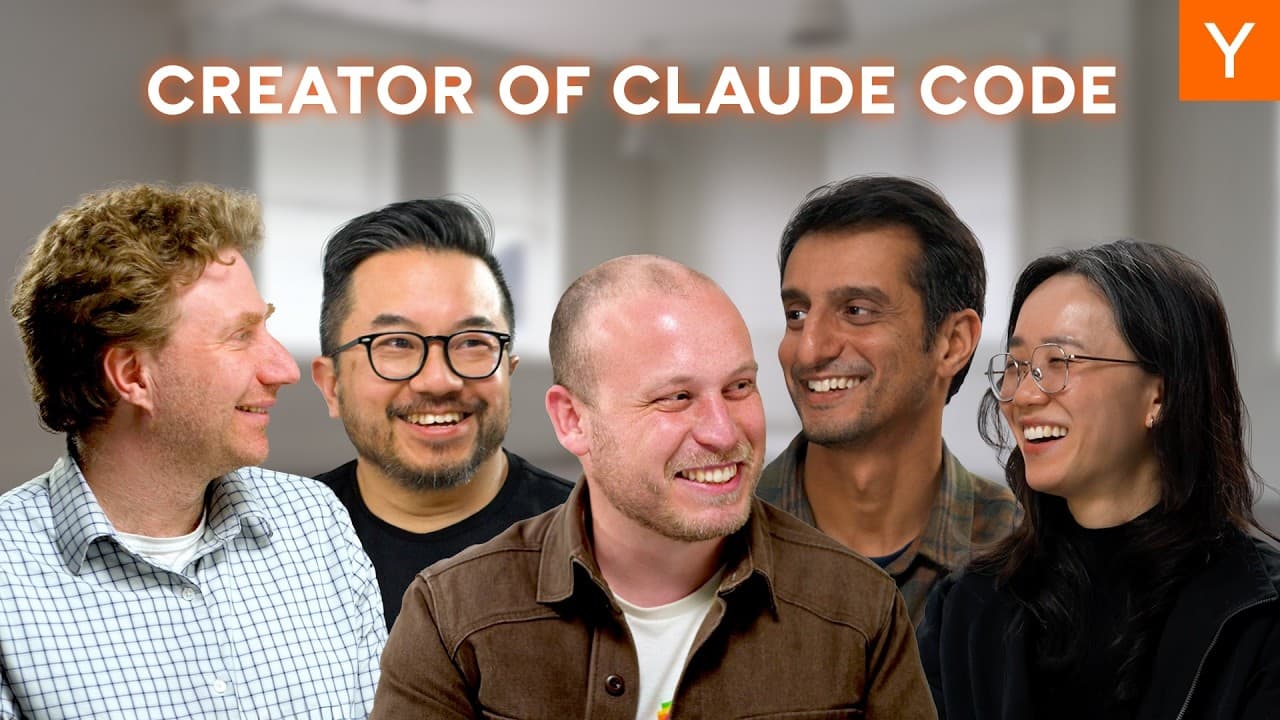
Inside Claude Code: How Did Creator Boris Cherny Build It?
TL;DR
Claude Code began as a small terminal chat app that Boris Cherny built to understand Anthropic’s API, then evolved through repeated testing, user conversations, and rewrites. The team built for models six months ahead, and by February the tool wrote about 10% of Cherny’s code. Read on to discover why the temporary terminal interface endured and how future-model thinking shaped the product.
Transcript
At Enthropic, the way that we thought about it is we don't build for the model of today. We build for the model six months from now. That's actually like still my advice to to founders that are building on LLM. Just try to think about like what is that frontier where the model is not very good at today cuz it's going to get good at it. All of Quad ... Read More
Key Insights
- Claude Code's development focuses on anticipating future model capabilities, not just current ones.
- Latent demand is crucial; successful products make existing tasks easier rather than introducing entirely new tasks.
- AI models are rapidly improving, reducing the need for explicit prompts and scaffolding.
- The terminal interface, initially a temporary solution, has proven surprisingly enduring and effective.
- Productivity at Anthropic has significantly increased, with Claude Code automating much of the coding process.
- Coding will evolve, with roles shifting from traditional software engineering to more generalist, product-focused positions.
- Anthropic prioritizes AI safety, with a strong mission-driven culture focused on responsible AI development.
- The future may see AI models capable of self-improvement, necessitating careful management to prevent misuse.
Install to Summarize YouTube Videos and Get Transcripts
Explore YouTube Video Summarizer or Get YouTube Transcript Extractor
Questions & Answers
Q: How did Boris Cherny create Claude Code?
Boris Cherny started by building a small terminal chat app so he could understand how to use Anthropic’s API. After tool use became available, he experimented with adding it, and the project gradually evolved into Claude Code.
Q: Why was Claude Code built in a terminal?
Cherny chose the terminal because it was the easiest way to get an initial version running without building a user interface. Although it was intended only as a starting point, the terminal remained part of the product.
Q: How does the Claude Code team build for future AI models?
The team does not build only for the model available today; it targets what the model may be capable of six months later. Cherny advises founders to identify areas where current models struggle and prepare for those capabilities to improve.
Q: How capable was Claude Code when Boris Cherny first developed it?
When Cherny began the project in September 2024, Claude Code could not yet code effectively. Even in February, it wrote about 10% of his code, while he still wrote most of it by hand.
Q: How did Claude Code improve during development?
The product was repeatedly written and rewritten as the team tried ideas, gave them to users, spoke with users, and learned from the results. Cherny says no part of Claude Code remained from six months earlier.
Q: Why did Anthropic decide to explore a coding product?
Anthropic had treated coding as an important direction for a long time, and the model appeared ready for some kind of coding product. However, the team did not initially know exactly what to build, so it remained in exploration mode.
Q: What products came from the Anthropic Labs team?
Cherny says the Anthropic Labs team produced three products: Claude Code, MCP, and the desktop app. He describes them as related pieces of a broader progression involving coding, tool use, and computer use.
Q: What did Boris Cherny learn from Claude Code’s early development?
Cherny’s process was to try an idea, give it to users, talk with them, and use what he learned to revise the product. He also acknowledges that this process may eventually produce a good idea, but sometimes it does not.
Summary & Key Takeaways
-
Boris Cherny emphasizes building AI tools with future model capabilities in mind, advising developers to anticipate improvements and build accordingly. He highlights the importance of latent demand, where successful products enhance existing user tasks rather than creating new ones. Cherny predicts a shift in software engineering roles towards more generalist, product-focused responsibilities as AI models continue to advance.
-
The terminal interface of Claude Code, initially a temporary solution, has proven effective and enduring. Cherny discusses the rapid improvement of AI models, which reduces the need for explicit prompts and scaffolding, allowing for more autonomous AI behavior. This shift is expected to change the nature of coding and software development roles significantly.
-
Anthropic's focus on AI safety and responsible development is a core part of its mission, with a culture that prioritizes these values. Cherny notes that productivity has increased significantly due to Claude Code's automation capabilities, and he envisions a future where AI models can self-improve, necessitating careful oversight to prevent potential misuse.
Read in Other Languages (beta)
Share This Summary 📚
Summarize YouTube Videos and Get Video Transcripts with 1-Click
Try YouTube Summary with ChatGPT & Claude or YouTube Transcript Generator
Explore More Summaries from Y Combinator 📚

Summarize YouTube Videos and Get Video Transcripts with 1-Click
Try YouTube Summary with ChatGPT & Claude or YouTube Transcript Generator