Sound Waves from the Beginning of Time
TL;DR
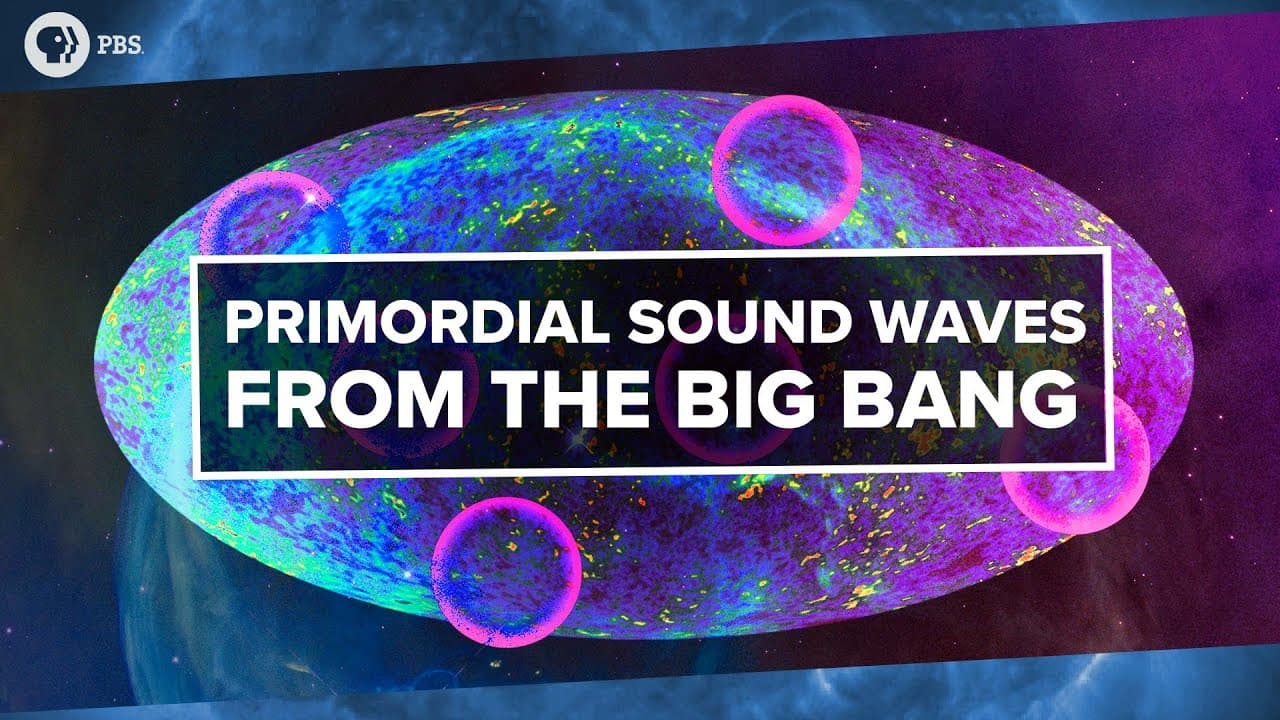
Baryon Acoustic Oscillations reveal universe's expansion and dark energy.
Transcript
We want to thank Google Science Journal app for supporting PBS Digital Studios. Invisible to the naked eye, Our night sky is scattered with the hundreds of billions of galaxies that fill the known universe. Like the stars, these galaxies form constellations, Hidden patterns that echo the reverberations of matter and light From an epoch long before ... Read More
Key Insights
- Baryon Acoustic Oscillations (BAO) are remnants of the universe's first sound waves, crucial for understanding cosmic expansion and dark energy.
- The early universe was filled with a plasma of baryons and photons, creating opaque conditions that later transitioned to transparency.
- Dark matter, unaffected by radiation pressure, played a dominant gravitational role, shaping the universe's structure alongside baryons.
- Density fluctuations from quantum origins led to competing gravitational and radiation forces, resulting in expanding sound waves.
- Recombination marked the universe's transition from plasma to gas, allowing light to travel freely and forming the cosmic microwave background.
- Modern galaxy surveys reveal BAO patterns, providing a 'standard ruler' to measure cosmic expansion and confirm dark energy's existence.
- BAO measurements align with supernovae data, confirming an accelerating universe expansion and supporting Einstein's cosmological constant.
- The study of BAO highlights the shift to precision cosmology, where detailed measurements offer insights into the universe's evolution.
Install to Summarize YouTube Videos and Get Transcripts
Explore YouTube Video Summarizer or Get YouTube Transcript Extractor
Questions & Answers
Q: What are Baryon Acoustic Oscillations (BAO)?
Baryon Acoustic Oscillations (BAO) are the imprints of the first sound waves that traveled through the early universe. These oscillations are crucial for understanding the universe's expansion history and the nature of dark energy. They are observed as patterns in the distribution of galaxies, providing a 'standard ruler' for measuring cosmic distances.
Q: How did the early universe transition from opaque to transparent?
The early universe was filled with a plasma of baryons and photons, creating opaque conditions. As the universe expanded and cooled, electrons combined with nuclei to form neutral atoms, marking the recombination phase. This transition allowed light to travel freely, turning the universe transparent and forming the cosmic microwave background radiation.
Q: What role did dark matter play in the early universe?
Dark matter was the dominant gravitational force in the early universe, outweighing baryons by a factor of five. Unlike baryons, dark matter did not interact with light, allowing it to influence the formation of cosmic structures. Its gravitational pull helped shape the density fluctuations that led to the formation of galaxies.
Q: How do BAO patterns help measure the universe's expansion?
BAO patterns provide a 'standard ruler' for measuring cosmic distances. By observing the distribution of galaxies and their redshifts, scientists can determine the size of the BAO rings at different points in time. This information helps track the expansion rate of the universe, confirming the accelerating expansion due to dark energy.
Q: What evidence supports the existence of dark energy?
The existence of dark energy is supported by observations of distant supernovae and BAO patterns. Both methods indicate that the universe's expansion is accelerating. BAO provides an independent confirmation of this acceleration, aligning with the predictions of Einstein's cosmological constant and suggesting that dark energy behaves as the energy of the vacuum.
Q: How do galaxy surveys reveal BAO patterns?
Galaxy surveys use redshift measurements to create a three-dimensional map of the universe. By analyzing the distances between galaxy pairs, scientists detect a slight overabundance of galaxy pairs at separations corresponding to the BAO rings. This statistical pattern confirms the presence of BAO and provides insights into cosmic expansion.
Q: What is the significance of the cosmic microwave background radiation?
The cosmic microwave background radiation is the remnant light from the early universe's recombination phase. It provides a snapshot of the universe at that time, revealing temperature fluctuations and density variations. These patterns offer insights into the universe's initial conditions and the processes that led to the formation of cosmic structures.
Q: How does the study of BAO reflect the era of precision cosmology?
The study of BAO highlights the shift to precision cosmology, where advanced telescopes and techniques allow for detailed measurements of cosmic phenomena. This precision enables scientists to test theoretical models, confirm the existence of dark energy, and gain a deeper understanding of the universe's evolution, from its origins to its current state.
Summary & Key Takeaways
-
Baryon Acoustic Oscillations (BAO) are the imprints of the universe's first sound waves, providing a key to understanding cosmic expansion and dark energy. The early universe's plasma conditions eventually transitioned to a transparent state, allowing light to travel freely and forming the cosmic microwave background.
-
Dark matter's gravitational influence shaped the universe's structure alongside baryons, with density fluctuations leading to expanding sound waves. BAO patterns, observed through galaxy surveys, offer a 'standard ruler' to measure the universe's expansion and confirm the existence of dark energy.
-
The study of BAO represents the shift to precision cosmology, where detailed measurements reveal insights into the universe's evolution. These findings align with supernovae data, supporting the concept of an accelerating universe and Einstein's cosmological constant.
Read in Other Languages (beta)
Share This Summary 📚
Summarize YouTube Videos and Get Video Transcripts with 1-Click
Try YouTube Summary with ChatGPT & Claude or YouTube Transcript Generator
Explore More Summaries from PBS Space Time 📚
Summarize YouTube Videos and Get Video Transcripts with 1-Click
Try YouTube Summary with ChatGPT & Claude or YouTube Transcript Generator