How to Acquire and Organize Data for Machine Learning in Python
TL;DR
To acquire and organize data for machine learning in Python, download data from reliable sources like Yahoo and compare it against benchmarks like the S&P 500. Structure your data with features that categorize companies as 'buy' or 'sell' based on financial metrics, such as the debt-to-equity ratio, to facilitate investment decisions.
Transcript
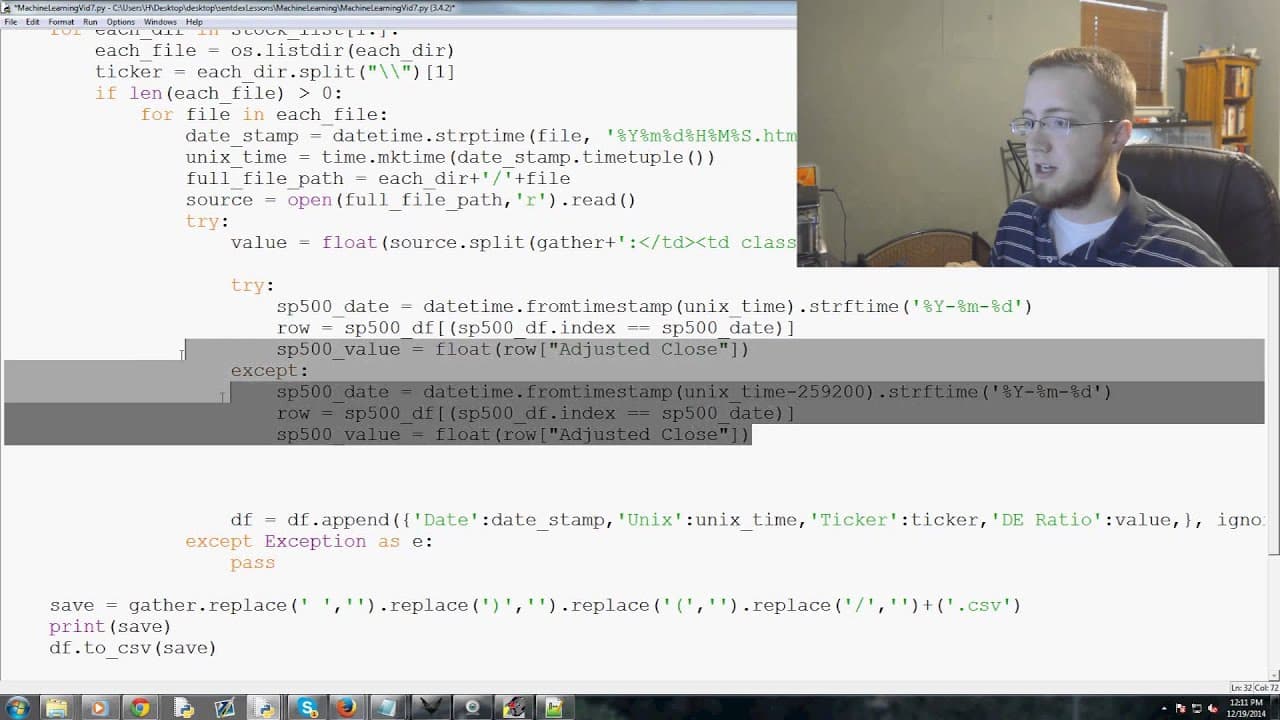
what's going on everybody welcome to these seventh Python machine learning with scikit-learn for investing or whatever you want tutorial video in this video we're gonna be building on the last video and basically acquiring our data so like I was saying this is the hardest part getting the data and kind of organizing the data so later you can basica... Read More
Key Insights
- 🏛️ Acquiring and organizing data is the most challenging step in building a machine learning model for investing.
- 🉑 The S&P 500 is a widely accepted benchmark for comparing a company's performance.
- 🚨 Data from different sources can be merged to create a comprehensive dataset.
- 🥳 The debt-to-equity ratio is one of the initial features used for categorizing companies, but it is not the sole determinant of a company's value.
- 🪜 Additional features will be added to the model to enhance prediction accuracy.
- ⚾ The model aims to categorize companies as either a buy or sell based on their performance compared to the S&P 500.
- 🥅 The goal is to have a dataset with multiple features to make more informed investment decisions.
Install to Summarize YouTube Videos and Get Transcripts
Explore YouTube Video Summarizer or Get YouTube Transcript Extractor
Questions & Answers
Q: Why is acquiring and organizing data considered the hardest part of building a machine learning model for investing?
Acquiring and organizing data is challenging because it requires finding reliable sources, cleaning and formatting the data, and ensuring it is aligned with the model's goals and variables. This step is essential for accurate predictions.
Q: How is the S&P 500 benchmark used in this model?
The S&P 500 is used as a benchmark to compare each company's performance. The goal is to determine if a company is meeting or exceeding market standards. By comparing a company's performance to the S&P 500, investment decisions can be made more effectively.
Q: How is the data from Yahoo and the S&P 500 merged in the model?
Data is acquired from Yahoo and an outside source for the S&P 500. The S&P 500 data is downloaded as a CSV file and loaded into a data frame. The data frames for both sources are then compared and merged based on the dates to create a comprehensive dataset for analysis.
Q: Why is the debt-to-equity ratio used as a feature for categorizing companies?
The debt-to-equity ratio is used as a starting point feature because it provides insights into a company's financial health and risk. However, it is not the sole factor in assessing a company's value. Additional features will be added to the model for more accurate predictions.
Summary & Key Takeaways
-
Acquiring and organizing data is the most challenging part of building a machine learning model for investing.
-
The goal is to categorize data based on features and assign a value of 0 or 1 (sell or buy) for investment decisions.
-
The S&P 500 is used as a benchmark for comparison, and data from an outside source is downloaded to enhance the dataset.
Read in Other Languages (beta)
Share This Summary 📚
Summarize YouTube Videos and Get Video Transcripts with 1-Click
Try YouTube Summary with ChatGPT & Claude or YouTube Transcript Generator
Explore More Summaries from sentdex 📚


Summarize YouTube Videos and Get Video Transcripts with 1-Click
Try YouTube Summary with ChatGPT & Claude or YouTube Transcript Generator