Which AI Video Model Is Best at the End of 2025?
TL;DR
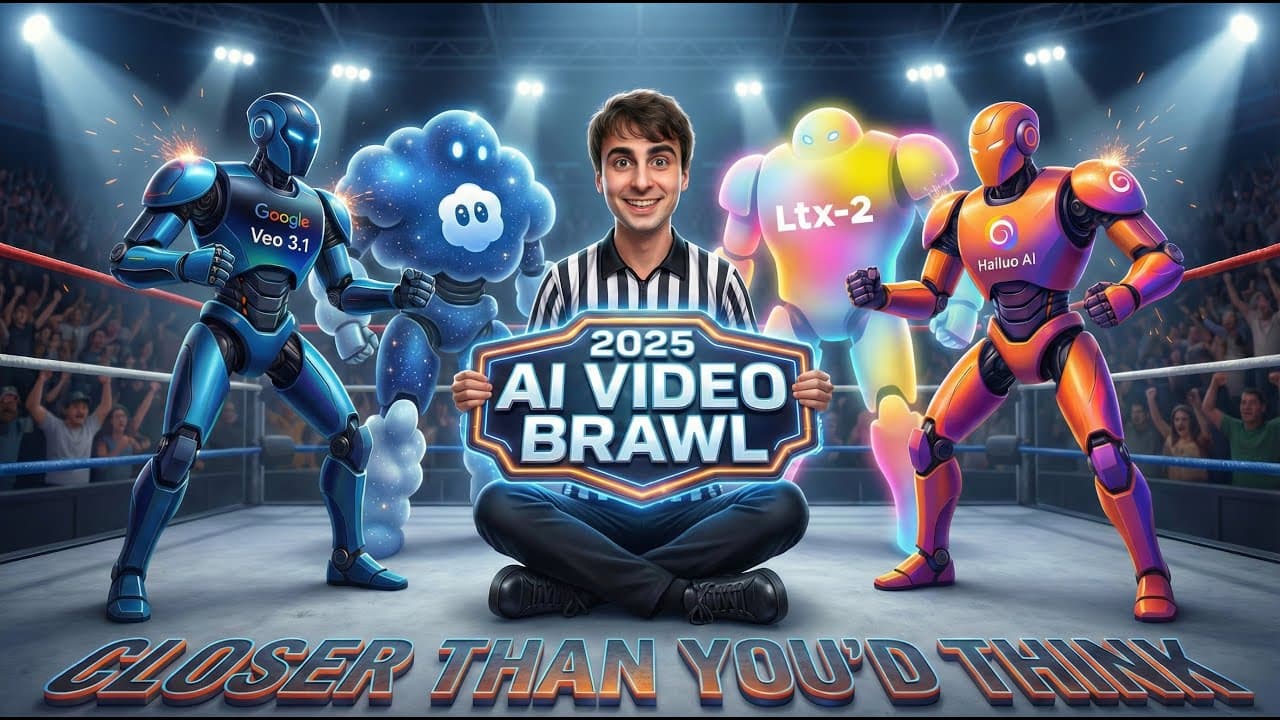
Google’s VEO 3.1 was the best overall AI video model in this end-of-2025 comparison, winning both scored tests for its balance of prompt adherence, animation quality, and watchability. Sora 2 came close, while Hailuo 2.3 showed strong detail but suffered anatomical morphing, and LTX-2 finished last. Read on for the test settings, model-specific strengths, audio capabilities, and notable failures.
Transcript
What's up everybody? Welcome back to the Matt Vidpro AI YouTube channel. Today we are having an AI video model showdown at the end of 2025. We've got four models in the lineup. Today, yes, we do have a sponsor for today's brawl. It is Miniax aka Haleo AI. Yes, their model is going to be competing today, but as you know, I don't exactly like to go e... Read More
Key Insights
- VEO 3.1 won both scored tests in this comparison, taking the interpretive K-pop squid dance round and the reference-image anime duel round, judged on the best overall combination of prompt adherence, animation quality, and watchability.
- Hailuo 2.3 has no support for audio at all. Pairing it with Minimax audio through the Hailuo video creation agent gives some level of audio generation, and Minimax told the reviewer that future plans include upgrading the video model to include built-in audio.
- VEO 3 was the first AI video model to natively generate audio alongside video, including characters talking to each other and generated music, but VEO output is limited to 8 seconds of video.
- LTX-2's distinguishing feature is not quality but openness: it does native 1080p and its weights are supposedly going to be released open source in early 2026, after an original release window that slipped, making it a preview of what open-source video generation may offer.
- Anatomical morphing is Hailuo 2.3's main failure mode. In the dance test the model handled a backward step and head swoop by turning the dancer's back into the front of her body, and a retry showed instant morphing at the start followed by roughly 90 percent coherent footage.
- Reference images materially change results. The same fruit anime duel prompt run without a reference image made VEO 3.1 drop the fruit theme and generate characters resembling copyrighted anime, while the reference-image version stayed on concept.
- Animation style differs by model on anime prompts: Hailuo 2.3 reads more like Flash animation that moves whole characters rather than animating every new frame, and Sora 2 exhibits a similar stretch style while taking creative liberty with character designs.
- LTX-2 placed last in every test covered here. Its audio quality is much lower than the other three, its fighting movements ran so fast that the characters' arms were hard to see, and its body movement showed poor anatomical performance.
Install to Summarize YouTube Videos and Get Transcripts
Explore YouTube Video Summarizer or Get YouTube Transcript Extractor
Questions & Answers
Q: Which AI video model was best at the end of 2025?
Google’s VEO 3.1 won both scored tests in this comparison: the interpretive K-pop squid dance and the reference-image anime fruit duel. The reviewer judged it to have the best overall combination of prompt adherence, animation quality, and watchability, although Sora 2 was close in the dance test.
Q: How did the four models perform in the K-pop squid dance test?
VEO 3.1 won after creating a squid-themed jacket with tentacles that moved realistically, although its dancing looked more like hip-hop or pop than interpretive dance. Hailuo 2.3 produced the most interpretive dancing and strong hair physics but morphed the dancer’s back into her front; Sora 2 avoided morphing with lower detail, while LTX-2 produced anatomically impossible bending.
Q: Does Hailuo 2.3 generate audio?
Hailuo 2.3 has no built-in audio support, so its test clips were silent. The Hailuo video creation agent can pair it with Minimax audio, and Minimax told the reviewer that future plans include adding built-in audio to the video model.
Q: What are Hailuo 2.3’s main strengths and weaknesses?
Hailuo 2.3 showed strong detail, real-world physics, hair movement, and interpretive motion. Its main weakness was anatomical morphing: during the dance test, a backward step and head swoop caused the dancer’s back to become the front of her body.
Q: How do VEO 3.1, Sora 2, Hailuo 2.3, and LTX-2 compare on audio?
VEO 3.1, Sora 2, and LTX-2 generate native audio, while Hailuo 2.3 does not. VEO can generate dialogue and music alongside video, whereas LTX-2’s audio quality was described as much lower than that of the other competitors.
Q: What settings and platforms were used for the comparison?
Hailuo 2.3 ran on the Hailuo AI website at 768p for 10 seconds, while Sora ran on its website in landscape for 10 seconds. LTX-2 used the LTX AI playground’s Pro setting at 1080p, 25 fps, and 8 seconds; most VEO 3.1 clips came from Gemini, with later clips generated through Hailuo AI after the reviewer exhausted his Gemini Ultra credits.
Q: Why was LTX-2 included despite finishing last?
LTX-2 was included because it supports native 1080p and native audio, and its model weights were said to be scheduled for an open-source release in early 2026 after an earlier window slipped. In the tests, however, it finished last and showed weak audio, poor anatomy, and fighting movements so fast that the characters’ arms were difficult to see.
Q: How did reference images affect the anime fruit duel results?
VEO 3.1 won the anime fruit duel when given a lemon-versus-banana reference image created with Nano Banana Pro. Without a reference image, it abandoned the fruit theme and generated characters resembling copyrighted anime, while Hailuo 2.3 stayed on prompt with simple lemon and blueberry characters.
Summary & Key Takeaways
-
Four AI video generators are put head to head at the end of 2025: Minimax's Hailuo 2.3, Google's VEO 3.1, Sora 2, and LTX-2. The same prompt goes to every model, sometimes with a shared reference image, and every raw output is shown. Hailuo sponsored the video but had no say over the clips or the verdicts.
-
Test settings differ per platform: Hailuo 2.3 ran on the Hailuo AI site at 768p for 10 seconds, Sora ran on the Sora website in landscape at 10 seconds, and LTX-2 ran in the LTX AI playground on Pro at 8 seconds, 1080p, 25 fps. Most VEO 3.1 clips came from the Gemini app, with a few made through Hailuo AI's site after the Gemini Ultra credits ran out.
-
In the K-pop squid dance test, VEO 3.1 took the win by inventing an unprompted squid-themed jacket with tentacles that flip realistically. Hailuo 2.3 produced the most genuinely interpretive dance and strong hair physics but morphed a dancer's back into her front. Sora 2 avoided morphing with slightly lower fidelity, and LTX-2 bent its subject in anatomically impossible ways.
-
The anime duel tests used a lemon versus banana reference image generated with Nano Banana Pro, then a no-reference rerun with lemon versus blueberry. VEO 3.1 won the reference version, while its no-reference attempt abandoned the fruit theme entirely and produced characters resembling copyrighted anime. Hailuo 2.3's no-reference attempt delivered simple but on-prompt lemon and blueberry characters.
Read in Other Languages (beta)
Share This Summary 📚
Summarize YouTube Videos and Get Video Transcripts with 1-Click
Try YouTube Summary with ChatGPT & Claude or YouTube Transcript Generator
Explore More Summaries from MattVidPro 📚



Summarize YouTube Videos and Get Video Transcripts with 1-Click
Try YouTube Summary with ChatGPT & Claude or YouTube Transcript Generator