How Could OpenAI and Anthropic IPOs Compare?
TL;DR
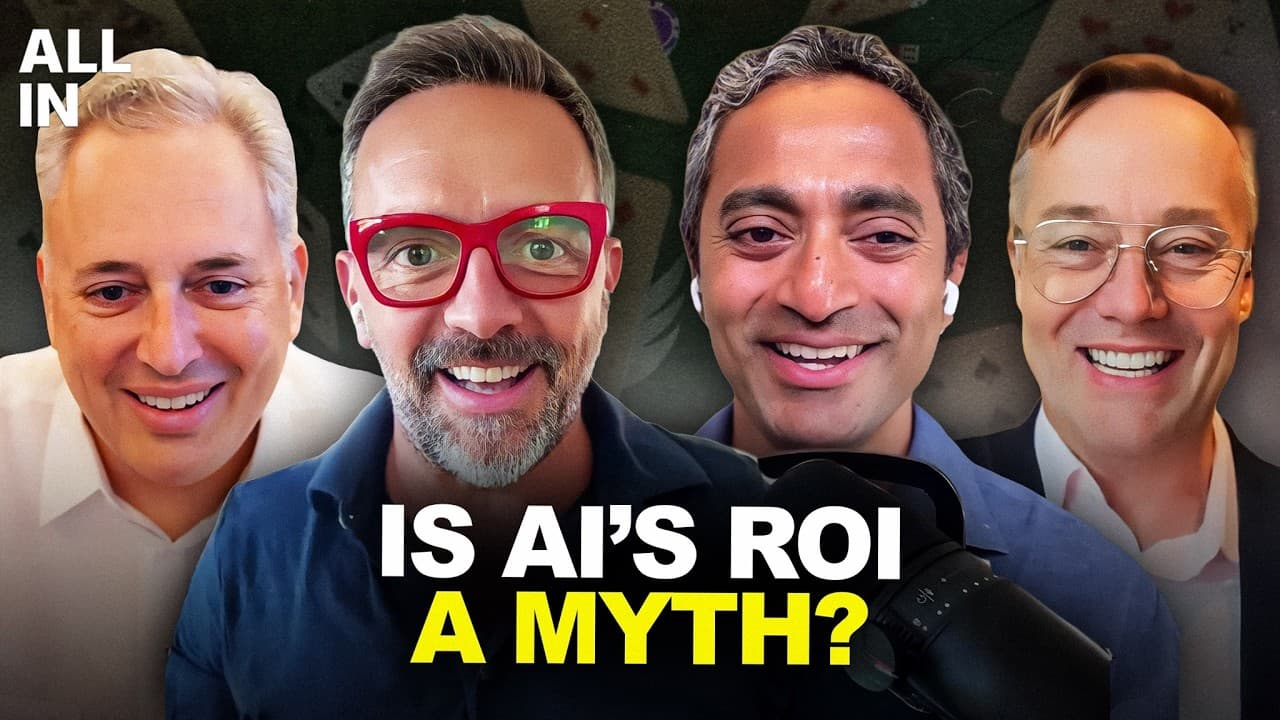
Anthropic may be better positioned for an early IPO because the discussion portrays it as closer to profitability, while OpenAI still carries high cash burn but has regained revenue momentum. SpaceX's large offering is presented as a blueprint for pricing, liquidity, lockups, fundraising, and index inclusion, although rising token costs could eventually make investors scrutinize the economics of AI adoption more closely.
Transcript
All right, everybody. Welcome back. Number one podcast in the world. It's July Allin episode 280. Freeberg is on a little vacay. We'll leave it at that. And uh yeah, bestie Brad is here. How you doing, Brad? >> I'm doing great. I'm do vacay in maybe Idaho or somewhere. Jal, >> I know. Who knows? Who knows? >> Who know? It could be anywhere. He coul... Read More
Key Insights
- SpaceX's IPO is presented as a blueprint for other large technology offerings because it raised $75 billion at a $1.75 trillion valuation and addressed pricing, liquidity, index inclusion, and staged lockup releases in ways Anthropic and OpenAI can study.
- Anthropic is portrayed as potentially closer to profitability than OpenAI, although the participants repeatedly frame the available financial figures as rumors or estimates. Its reported revenue trajectory is the main reason investors on the program expect strong demand for a possible offering.
- OpenAI is described as having higher cash burn because its operations are more diffuse and more reliant on consumers than Anthropic's enterprise-oriented business. The discussion nevertheless says OpenAI has regained momentum through anticipated model releases and an improving revenue trajectory.
- Public-market appetite is identified as a central constraint on AI IPO valuations. The companies may be strong businesses, but their market-clearing prices would still depend on how much new issuance investors can absorb and what valuation multiples they are willing to accept.
- Token spending can rise much faster than measurable productivity benefits. Chamath reports that his company's token costs were doubling every 45 days while his chief technology officer estimated downstream productivity improvement at no more than about 5%, leading the company to reconsider its approach.
- Early index inclusion creates a tradeoff between representing an exceptionally large company and protecting index investors from post-IPO volatility. The speakers note that newly public companies can experience major drawdowns, while a company as large and important as SpaceX may warrant quicker inclusion.
- Timing is presented as strategically important for AI companies seeking public capital. One argument favors going public before corporate customers broadly confront rising token costs and limited incremental productivity, because that reckoning could reduce enthusiasm or produce more demanding scrutiny of AI economics.
- Open-source AI is treated as a strategic issue involving Meta, potential price competition, an emerging AI duopoly, and possible Chinese export controls on models. The episode description frames these developments as questions about whether open-source availability could narrow in China and elsewhere.
Install to Summarize YouTube Videos and Get Transcripts
Explore YouTube Video Summarizer or Get YouTube Transcript Extractor
Questions & Answers
Q: Why might Anthropic go public before OpenAI?
Anthropic is portrayed as having a particularly strong revenue trajectory and possibly being closer to profitability, which could make its public-market story easier to present. The podcast also says the company confidentially filed on June 1 and reportedly wanted to go public during the year under discussion. These points are presented as reported or rumored information, not confirmed financial guidance.
Q: What did Anthropic and OpenAI learn from SpaceX's IPO?
SpaceX is presented as a practical blueprint for conducting an unusually large offering. The hosts highlight its total capital raise, pricing, liquidity structure, early index inclusion, and staged lockup release. They argue that Anthropic and OpenAI watched these choices closely because the offering demonstrated how a very large, mature private company could enter public markets and manage investor demand.
Q: How did SpaceX structure its public offering?
According to the discussion, SpaceX raised $75 billion at a $1.75 trillion valuation and later traded around a $2 trillion market capitalization. The hosts also describe staged lockup releases tied to time and other milestones, along with modified treatment by exchanges and indexes. They characterize the overall process as highly successful and useful for later large offerings.
Q: Why is early index inclusion controversial for a new IPO?
Early index inclusion can force index-linked investors to buy a newly public company before the market has fully tested its price. The hosts note concerns about volatility and say the peak-to-trough drawdown during the six months after an IPO can reach 50%. They also present the counterargument that an exceptionally large and important company should be represented in major indexes promptly.
Q: What is the main economic risk of rising AI token usage?
The main risk is that usage costs can grow much faster than the business value created. Chamath says his company's token costs were doubling every 45 days, while his chief technology officer estimated the downstream productivity improvement at about 5% at most. That mismatch led them to step back and reconsider how they were using AI and measuring its benefits.
Q: How do OpenAI and Anthropic differ as businesses?
The discussion characterizes OpenAI as having a more diffuse business with greater consumer reliance and substantial cash burn. Anthropic is portrayed as more enterprise-oriented and potentially closer to profitability. At the same time, the hosts say OpenAI has regained momentum, with new model releases expected and rumored revenue growth improving, so the comparison is not presented as settled.
Q: Why could IPO timing matter for major AI companies?
The argument is that AI companies may receive stronger valuations before customers broadly reassess the relationship between token spending and productivity. If more businesses discover rapidly increasing AI costs without comparable gains, investors may apply greater scrutiny to revenue durability and customer economics. Going public sooner could therefore provide access to substantial capital while market enthusiasm remains strong.
Q: What broader AI policy issues does the episode discuss?
The episode connects financial-market questions with open-source AI strategy, Meta's model plans, price competition, the possibility of an AI duopoly, and potential Chinese export controls on models. The description asks whether open source could be ending in China, while the opening conversation also presents open source as important for countries considering their long-term access to AI technology.
Summary & Key Takeaways
-
The hosts examine whether Anthropic and OpenAI could reach public markets within the next six to nine months. Their prospects are compared with SpaceX, whose offering raised $75 billion at a $1.75 trillion valuation and subsequently traded around a $2 trillion market capitalization, according to figures discussed on the podcast.
-
Anthropic is portrayed as having a strong revenue trajectory and potentially better profitability, while OpenAI is described as having higher cash burn because its business is more diffuse and more dependent on consumers. Even so, the discussion says OpenAI has regained momentum, with new models arriving and rumored revenue growth accelerating.
-
The broader conversation connects IPO valuations to unresolved questions about AI economics, open-source strategy, model competition, and Chinese export controls. A concrete warning comes from one company whose token spending was doubling every 45 days while estimated downstream productivity improvement remained near 5%, prompting a reassessment of its AI usage.
Read in Other Languages (beta)
Share This Summary 📚
Summarize YouTube Videos and Get Video Transcripts with 1-Click
Try YouTube Summary with ChatGPT & Claude or YouTube Transcript Generator
Explore More Summaries from All-In Podcast 📚

Summarize YouTube Videos and Get Video Transcripts with 1-Click
Try YouTube Summary with ChatGPT & Claude or YouTube Transcript Generator