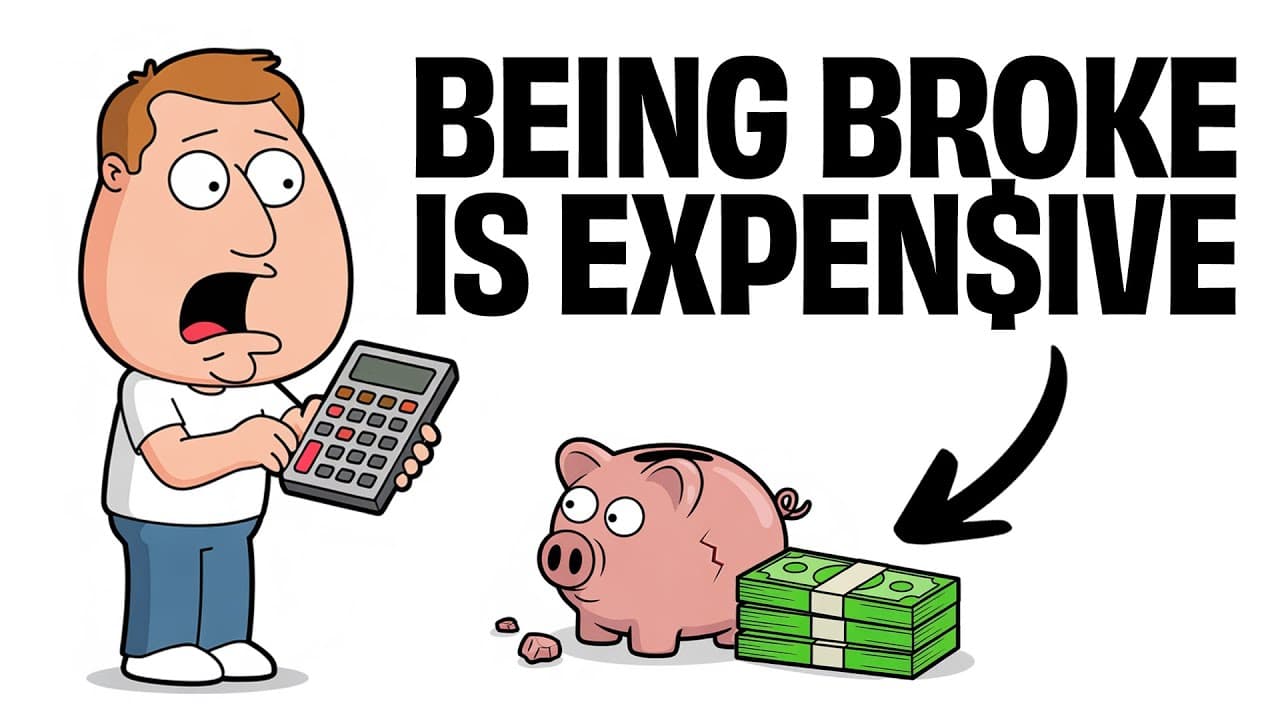
Why Does Being Broke Make Everything Cost More?
TL;DR
Being short on cash raises the effective price of daily life through overdraft charges, high-interest debt, costly financing, and exclusion from bulk discounts. The suggested escape sequence is to stop high-interest losses before investing, then build a $1,000 buffer that can absorb emergencies, support longer-lasting purchases, and reduce recurring expenses such as insurance premiums.
Transcript
You're running late for work. Your phone buzzes with a bank notification. And your heart drops faster than a lead balloon. Insufficient funds. $35 overdraft fee. All because that streaming service you forgot about decided to renew itself while you had $23 in your account instead of 25. Congratulations. You just paid a 700% interest rate on a $2 mis... Read More
Key Insights
- The poverty penalty is the extra cost imposed on people who lack enough cash, savings, or credit options to obtain favorable prices. It appears through smaller purchases, overdraft charges, late fees, expensive borrowing, unfavorable rental terms, deferred care, and repeated replacement of low-quality goods.
- Bulk purchasing lowers unit costs, but it requires money that can be committed before the products are used. The transcript compares detergent costing about 15 cents per load in an industrial-size container with a small bottle costing about 60 cents per load, even though both provide the same result.
- Bank overdraft fees can produce extraordinary effective borrowing costs. In the transcript's example, an account falls $6 below zero and receives a $35 penalty, meaning the customer effectively pays $35 to borrow $6 for perhaps 12 hours, an annual percentage rate described as exceeding 50,000%.
- Financial stress is linked in the transcript to a reduction of about 13 IQ points in cognitive capacity. When immediate concerns such as rent and groceries dominate attention, the remaining mental bandwidth for comparing options, preventing problems, and making long-term plans becomes severely constrained.
- Bad credit and insufficient savings can make essential transportation dramatically more expensive. The example describes financing a 10-year-old vehicle priced at $12,000, despite an estimated value of $6,000, at 24% interest and ultimately paying more than $20,000 over five years.
- High-interest debt should be addressed before seeking lower investment returns. Paying off a credit card charging 22% interest is presented as a guaranteed return equal to the avoided interest, while an index fund return of 8% cannot offset money that continues to leave through much costlier debt.
- A $1,000 financial buffer changes emergencies from borrowing events into manageable expenses. A flat tire can be paid directly instead of triggering a payday loan, a family request, or additional credit card debt, preventing one unexpected cost from starting another expensive cycle.
- Savings can reduce recurring costs as well as cover emergencies. The transcript suggests that a $1,000 buffer may allow an insurance deductible to rise from $200 to $1,000, potentially lowering the monthly premium by about $60 and turning available cash into ongoing savings.
Install to Summarize YouTube Videos and Get Transcripts
Explore YouTube Video Summarizer or Get YouTube Transcript Extractor
Questions & Answers
Q: What is the poverty penalty in personal finance?
The poverty penalty is the pattern in which people with limited cash pay more for the same necessities and services. They may be unable to buy in bulk, maintain required bank balances, qualify for affordable credit, pay security deposits, obtain preventive care, or purchase durable products. These constraints create higher unit prices, fees, interest charges, and repeated replacement costs.
Q: Why do people with less money pay more for household goods?
People living paycheck to paycheck often cannot commit a larger amount of cash to bulk purchases, even when those purchases cost less over time. The transcript compares detergent at about 15 cents per load when bought in an industrial-size container with about 60 cents per load from a small bottle. The same pattern can affect toilet paper, shampoo, diapers, and cooking oil.
Q: How do overdraft fees intensify financial hardship?
Overdraft fees impose a large fixed charge precisely when an account holder has very little money. In the transcript's example, a $25 subscription renews when the account contains $19, producing a $6 shortfall and a $35 fee. Paying $35 to cover $6 for perhaps 12 hours is described as an annual percentage rate above 50,000%.
Q: How does financial stress affect decision-making?
Financial stress consumes attention that would otherwise support planning and comparison. Studies cited in the transcript say it reduces cognitive capacity by about 13 IQ points, an effect compared with pulling an all-nighter or being legally drunk. With mental bandwidth focused on rent and immediate survival, people can struggle to evaluate long-term consequences or prevent future costs.
Q: Why can bad credit make car ownership more expensive?
Bad credit and the absence of a down payment can force a buyer toward unfavorable financing when a car is essential for work. The transcript describes a 10-year-old car with 150,000 miles, valued at perhaps $6,000, being sold for $12,000 at 24% interest. Over five years, the customer may pay more than $20,000, possibly beyond the vehicle's working life.
Q: Should high-interest debt be paid before investing?
The transcript argues that stopping high-interest losses should come before pursuing investment returns. An index fund return described as 8% does not compensate for credit card debt charging 22%. Paying off that debt provides a guaranteed benefit equal to the interest avoided, so the recommended hierarchy begins with stopping the financial bleeding before trying to build wealth through investments.
Q: How does a $1,000 emergency buffer help break the poverty cycle?
A $1,000 buffer allows an unexpected expense to be paid without immediately using a payday loan, asking family for money, or adding to a maxed-out credit card. The transcript uses a flat tire as the example. With no savings it can become a financial catastrophe, while with the buffer it remains a minor expense that can be handled directly.
Q: How can savings lower recurring living costs?
Savings can provide enough financial capacity to choose arrangements with lower continuing expenses. The transcript suggests that a $1,000 buffer may support raising an insurance deductible from $200 to $1,000, potentially reducing the monthly premium by about $60. Savings also enable durable purchases and early repairs, avoiding repeated replacements and larger damage caused by delaying maintenance.
Summary & Key Takeaways
-
The poverty penalty makes ordinary necessities more expensive for people living paycheck to paycheck. Limited cash prevents bulk purchases, while low balances invite banking fees. The resulting higher per-unit costs mean that a person with little money can face a higher personal inflation rate despite purchasing the same basic goods.
-
Financial stress compounds the problem by consuming mental bandwidth and reducing cognitive capacity by about 13 IQ points, according to studies cited in the transcript. Immediate survival demands can crowd out long-term planning, helping explain decisions involving payday loans, lottery tickets, fast food, and deferred maintenance that appear irrational to outsiders.
-
The proposed escape strategy prioritizes stopping losses over pursuing investment gains. Paying off high-interest debt offers a guaranteed return equal to the avoided interest. Building a first $1,000 buffer then reduces dependence on expensive emergency borrowing, enables preventive spending and durable purchases, and may support lower insurance premiums through a higher deductible.
Read in Other Languages (beta)
Share This Summary 📚
Summarize YouTube Videos and Get Video Transcripts with 1-Click
Try YouTube Summary with ChatGPT & Claude or YouTube Transcript Generator
Explore More Summaries from Nick Invests 📚
Summarize YouTube Videos and Get Video Transcripts with 1-Click
Try YouTube Summary with ChatGPT & Claude or YouTube Transcript Generator