Does High-Resolution Audio Actually Sound Better?
TL;DR
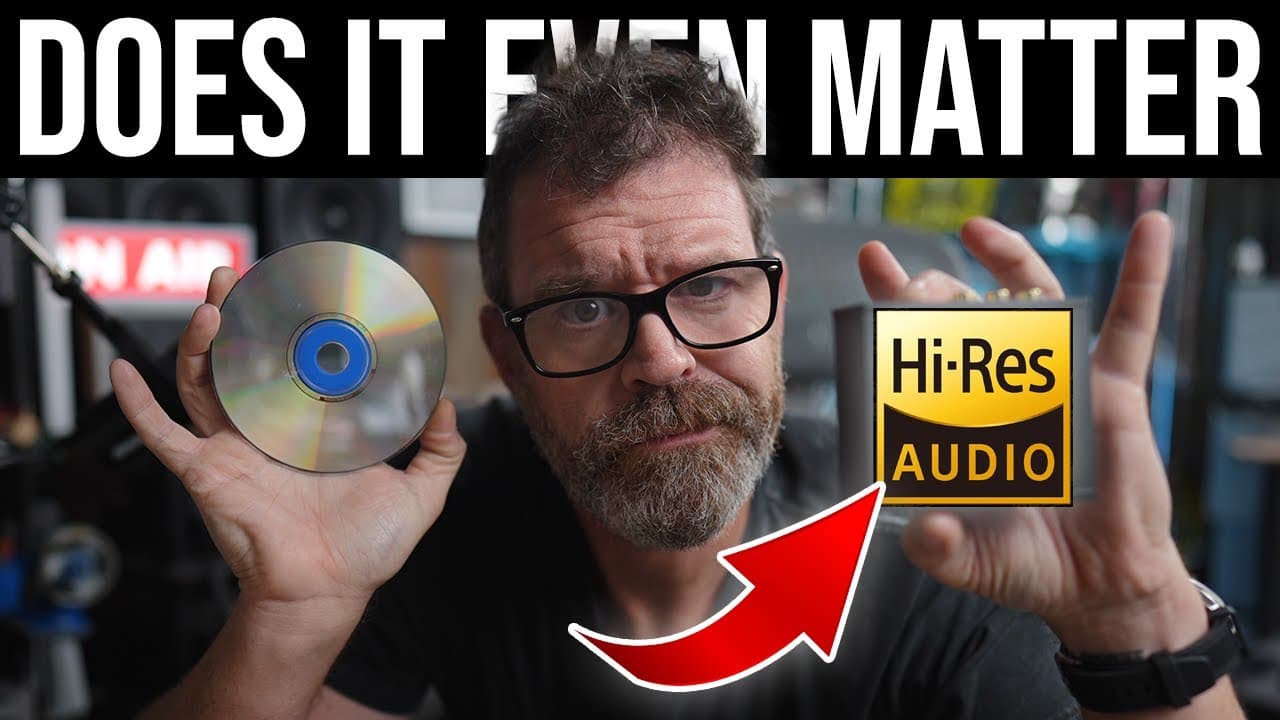
High-resolution audio does not automatically produce better sound, because mastering quality, playback equipment, system setup, speakers, and the room can matter more than bit depth or sample rate. Use the NPR blind listening test to compare high-resolution tracks with lower-resolution versions, trust what you actually hear, and avoid treating a high-resolution sticker as proof of superior performance.
Transcript
Do you even need high res music to get the best sound? Because let's face it, that's what we're all after, right? The best sound. Is high-res audio the door to audio nirvana? Or is it just a sticker being slapped on anything? A toy truck? Boom. It's a high resolution speaker. Even your sneaker, boom, it's a high resolution speaker. That's what we'r... Read More
Key Insights
- High-resolution audio is not an automatic guarantee of better sound. A recording's mastering, the playback system, the room, and the design of individual components can influence the listening experience more substantially than a high-resolution label or impressive numbers on a specification sheet.
- CD-quality digital audio uses 16-bit depth and a 44.1 kHz sample rate. High-resolution releases can increase those figures to 24-bit and sample rates of 96 kHz or 192 kHz, but larger numbers alone do not establish that listeners will hear an improvement.
- Bit depth represents the amount of information available for describing the signal, which the transcript compares to the number of color shades in a picture. Sample rate describes how frequently the signal is captured, including 44,100 times per second for a CD.
- The high-resolution audio sticker can indicate that equipment reproduces frequencies up to 40,000 hertz. That capability is not proof of overall quality, particularly because the transcript states that humans cannot really hear above 20,000 hertz and many different products can carry the label.
- Marketing language is not reliable evidence of sound quality. Terms such as high-res audio, studio quality, and digitally remastered may create confidence, but they do not reveal whether the underlying recording, mastering, circuits, analog output stages, amplifier, or speakers perform well.
- MQA was presented as a way to fold large high-resolution files for streaming and unfold them on compatible equipment. The transcript argues that the resulting output did not always match what entered the process and that the technology imposed licensing fees before Tidal replaced it with FLAC.
- The NPR blind listening test is a practical method for checking whether a listener can identify high-resolution audio. It compares a high-resolution track with versions at 320 kilobits per second and 160 kilobits per second, allowing listeners to judge with their ears instead of relying on labels.
- Mastering quality is described as the most important factor behind how a recording sounds. The recording process, CD player, streamer, digital-to-analog converter, amplifier, speakers, system setup, and room all play larger roles than the presence of a high-resolution sticker alone.
Install to Summarize YouTube Videos and Get Transcripts
Explore YouTube Video Summarizer or Get YouTube Transcript Extractor
Questions & Answers
Q: Does high-resolution audio actually sound better?
High-resolution audio does not necessarily sound better simply because it uses greater bit depth or a higher sample rate. The transcript identifies recording and mastering quality, component design, the digital-to-analog converter, amplifier, speakers, system setup, and room as more important influences. High resolution is neither the villain nor the hero, so listeners should compare formats directly and trust what they hear.
Q: What is the difference between CD audio and high-resolution audio?
CD audio follows the Red Book standard of 16-bit depth and a 44.1 kHz sample rate. High-resolution audio can use 24-bit depth with sample rates of 96 kHz or 192 kHz. The transcript compares bit depth to the number of available color shades and sample rate to how many snapshots are taken each second, while cautioning that larger figures do not automatically produce audible improvement.
Q: What does a high-resolution audio sticker mean?
A high-resolution audio sticker can mean that a device is capable of reproducing frequencies up to 40,000 hertz. It does not guarantee that the device has excellent circuits, analog output stages, amplification, or speakers. The transcript notes that humans cannot really hear above 20,000 hertz, so the sticker alone offers little evidence that a product will deliver better audible performance.
Q: How can I test whether I can hear high-resolution audio?
Use the NPR blind listening test linked in the description. It presents tracks in high resolution, at 320 kilobits per second, and at 160 kilobits per second, then asks the listener to identify the high-resolution version. The test requires no special equipment according to the transcript and can show whether high resolution creates a detectable difference for you on your existing setup.
Q: Why does audio mastering matter more than resolution?
Mastering determines how the recorded music is prepared and presented, making it central to the final sound. A file can carry a high-resolution label while preserving an unimpressive master, so its bit depth and sample rate cannot repair the underlying production choices. The transcript therefore describes the recording and mastering as the real magic and places them ahead of format labels when judging sound quality.
Q: Which parts of an audio system affect sound quality most?
The transcript identifies the CD player or streamer, digital-to-analog converter, amplifier, speakers, system setup, and listening room as major influences on sound. Circuit design and analog output stages also distinguish a good converter from a bad one, even if both carry the same high-resolution sticker. Overall component quality and system integration matter more than whether every device displays high-resolution branding.
Q: Why are larger audio specifications not always better?
Larger specifications appeal to listeners because they make products easier to compare and can reduce uncertainty about a purchase. However, figures such as more watts, more megapixels, higher sample rates, or broader frequency response may be presented without the context needed to assess actual performance. Legitimate numbers can still matter little if the equipment, mastering, setup, or listening conditions do not support an audible benefit.
Q: What was MQA, and why did Tidal replace it?
MQA was promoted as a technology that folded large high-resolution music files for efficient streaming and then unfolded them on compatible playback equipment. The transcript argues that the output did not always match the original input and that licensing fees applied throughout the system. After MQA lost its appeal, Tidal removed it and adopted FLAC while continuing to offer high-resolution music.
Summary & Key Takeaways
-
Consumer digital music began with CDs using 16-bit, 44.1 kHz audio, followed by ripping, MP3s, Napster, iTunes, and streaming services. High-resolution formats increased the stated bit depth and sample rate to figures such as 24-bit, 96 kHz, or 192 kHz, creating an apparently simple numerical measure of quality.
-
High-resolution branding does not guarantee superior sound. A sticker may only indicate that a device can reproduce frequencies up to 40,000 hertz, even though humans cannot really hear above 20,000 hertz. Marketing terms such as studio quality and digitally remastered can likewise sound meaningful without proving better performance.
-
A blind comparison is the practical way to determine whether high-resolution playback matters to an individual listener. The NPR test presents tracks at 160 kilobits per second, 320 kilobits per second, and high resolution. More consequential factors include mastering, recording quality, circuit design, playback equipment, speakers, system setup, and the room.
Read in Other Languages (beta)
Share This Summary 📚
Summarize YouTube Videos and Get Video Transcripts with 1-Click
Try YouTube Summary with ChatGPT & Claude or YouTube Transcript Generator
Explore More Summaries from cheapaudioman 📚
Summarize YouTube Videos and Get Video Transcripts with 1-Click
Try YouTube Summary with ChatGPT & Claude or YouTube Transcript Generator