Christine Lagarde on Tariffs and Europe's Economy
TL;DR
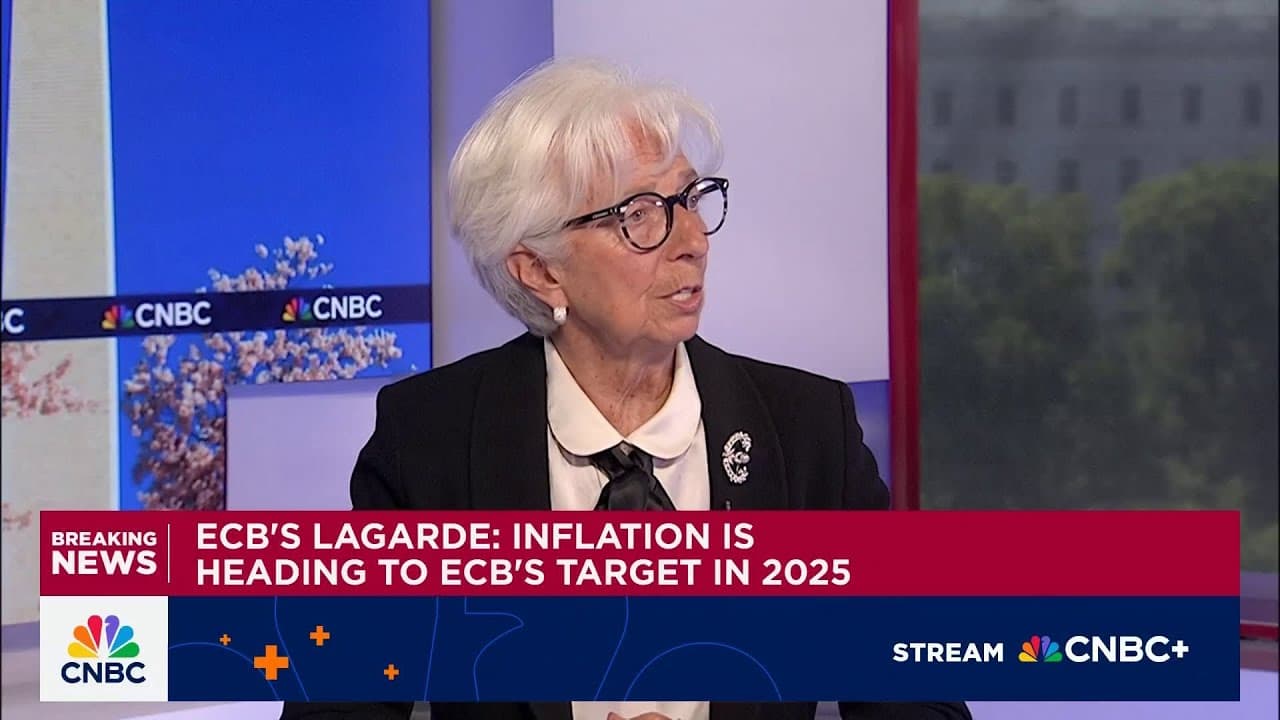
U.S. tariffs create a clear downside risk for European growth, while their net effect on inflation remains uncertain and dependent on European countermeasures and shifting trade flows. Christine Lagarde says Europe should reduce its internal trade barriers, pursue structural reforms, invest in defense and infrastructure, and keep monetary policy highly data dependent as inflation approaches the ECB's 2% target.
Transcript
stay close. >> Good to have you back. Mike Santoli here at post nine. Let's get back to Sarah in DC. >> Hi Carl again. And yes joining me here in Washington at our bureau is the ECB president Christine Lagarde. Great to have you here. >> Welcome. >> Lovely to be with you Sarah. >> It's nice to see you again. Nothing to talk about here at the IMF me... Read More
Key Insights
- U.S. tariffs are a downside risk to European growth because trade restrictions produce losses rather than gains across the economies involved. Lagarde says the inflation effect is less certain because it will depend on European countermeasures, fiscal developments, and changes in international trade flows.
- Europe's internal market accounts for 65% of its trade, making Europe its own most important trading partner. Lagarde argues that lowering internal barriers, particularly those affecting services, could improve the movement of goods and services among the European Union's 27 member states.
- The United States represents 17% of Europe's trade outside the euro area, according to Lagarde. Europe has a goods surplus with the United States, while the United States has a services surplus with Europe, so the overall commercial relationship is more balanced than goods figures alone suggest.
- U.S. tariffs on European trade rose substantially from a goods tariff level of slightly below 3%, while steel, aluminum, and automobiles faced higher sector-specific rates. Lagarde stresses that the effective tariff picture cannot be captured by referring only to a general 10% rate.
- Trade negotiations are likely because policymakers can present their priorities, redlines, and vulnerabilities through dialogue. Lagarde expects negotiations to be a process rather than a single event, reflecting the complexity of more than 8,000 customs-duty product lines and the interests on both sides.
- European structural reform is gaining urgency because tariff pressure has encouraged policymakers to act on changes that had already been described in multiple reports. Lagarde characterizes the moment as Europe's opportunity to implement reforms while strengthening trade, investment, infrastructure, and economic resilience.
- Germany's defense and infrastructure commitments helped create a positive market reaction by directing Europe's substantial savings toward investment. The planned approach includes greater defense spending, a large infrastructure fund, and setting aside the debt brake for defense-related investment, according to Lagarde's discussion.
- Euro area inflation was 2.2% at the latest reading cited in the interview, and Lagarde expects it to approach the 2% target during 2025. The ECB will still monitor incoming data closely because tariffs and policy responses can affect demand, prices, and growth differently.
Install to Summarize YouTube Videos and Get Transcripts
Explore YouTube Video Summarizer or Get YouTube Transcript Extractor
Questions & Answers
Q: How are U.S. tariffs affecting Europe's economic outlook?
U.S. tariffs are creating downside risk for European growth at a time when earlier shocks from the pandemic, energy crisis, and high inflation had been fading. Lagarde describes tariffs as part of a lose-lose outcome, but she says their net inflation effect is uncertain. That effect will depend on European countermeasures, fiscal spending, structural reforms, and possible increases in Chinese goods entering Europe.
Q: Why is trade within Europe especially important?
Trade within Europe is especially important because 65% of Europe's trade occurs inside Europe, making the region its own largest trading partner. Lagarde says this creates a strong reason to lower internal barriers so goods and services can move more freely among the European Union's 27 member states. She emphasizes services because they represent an important part of economic activity and cross-border trade.
Q: How exposed is Europe to trade with the United States?
Lagarde says the United States accounts for 17% of Europe's trade outside the euro area, while 65% of European trade takes place within Europe. She also argues that the relationship should be assessed through both goods and services. Europe has a goods surplus with the United States, but the United States has a services surplus with Europe, reducing the imbalance suggested by goods figures alone.
Q: Can Europe and the United States negotiate a trade deal?
Lagarde believes there is scope for negotiations because policymakers generally want to explain their priorities, redlines, and vulnerabilities. She expects dialogue to occur, but warns that reaching an agreement will be a process. Trade negotiations require detailed work across more than 8,000 customs-duty product lines, with both sides seeking to protect sensitive sectors while identifying terms they can accept.
Q: What should Europe do in response to tariff pressure?
Europe should reduce barriers inside its own market, strengthen trade in goods and services, and advance structural reforms that policymakers had already discussed. Lagarde also highlights defense and infrastructure investment, particularly Germany's commitments in those areas. Europe must monitor changing U.S. measures, remain agile, and be prepared to adjust monetary policy by either cutting rates or pausing as incoming data warrants.
Q: Why did German markets respond positively despite tariff risks?
Lagarde links the positive reaction in German markets to the planned government's commitments on defense and infrastructure. The program includes increased defense spending, a large infrastructure fund, and setting aside the debt brake for defense-related investment. She says this approach would direct Europe's substantial savings toward better infrastructure and improved defense capabilities, addressing areas she describes as needing investment and greater resilience.
Q: Is euro area inflation returning to the ECB's target?
Lagarde says the latest inflation reading cited in the interview was 2.2% and expects inflation to move toward the ECB's 2% target during 2025. She describes the disinflationary process as nearing completion. However, the ECB still must evaluate tariffs, European countermeasures, defense spending, infrastructure investment, structural reforms, and changing trade flows before determining the complete effect on prices.
Q: How will the ECB set monetary policy amid trade uncertainty?
The ECB will remain highly data dependent and prepared either to cut rates or pause, depending on economic developments. Lagarde views downside risk to growth as relatively clear, while the effect on inflation requires further observation. The ECB will examine short-term conditions, potential European countermeasures, fiscal investment, structural reforms, exchange-rate developments, and whether more Chinese goods enter European markets.
Summary & Key Takeaways
-
Lagarde says tariffs arrived as earlier shocks from the pandemic, energy crisis, and high inflation were fading and disinflation was progressing. The new trade shock creates downside risk for growth, but it also strengthens the case for European structural reforms, defense investment, infrastructure spending, and the removal of barriers within the European market.
-
Europe conducts 65% of its trade internally, while the United States represents 17% of its trade outside the euro area. Lagarde therefore emphasizes improving European trade in goods and services while closely monitoring negotiations with the United States, where tariff announcements, pauses, exceptions, and sector-specific duties create a complicated and changing environment.
-
Euro area inflation was most recently 2.2%, and Lagarde expects it to move toward the ECB's 2% target during 2025. However, tariffs, possible European countermeasures, Chinese goods entering Europe, defense spending, infrastructure investment, and structural reforms make the inflation outlook uncertain, requiring the ECB to remain highly attentive and data dependent.
Read in Other Languages (beta)
Share This Summary 📚
Summarize YouTube Videos and Get Video Transcripts with 1-Click
Try YouTube Summary with ChatGPT & Claude or YouTube Transcript Generator
Explore More Summaries from CNBC Television 📚



Summarize YouTube Videos and Get Video Transcripts with 1-Click
Try YouTube Summary with ChatGPT & Claude or YouTube Transcript Generator