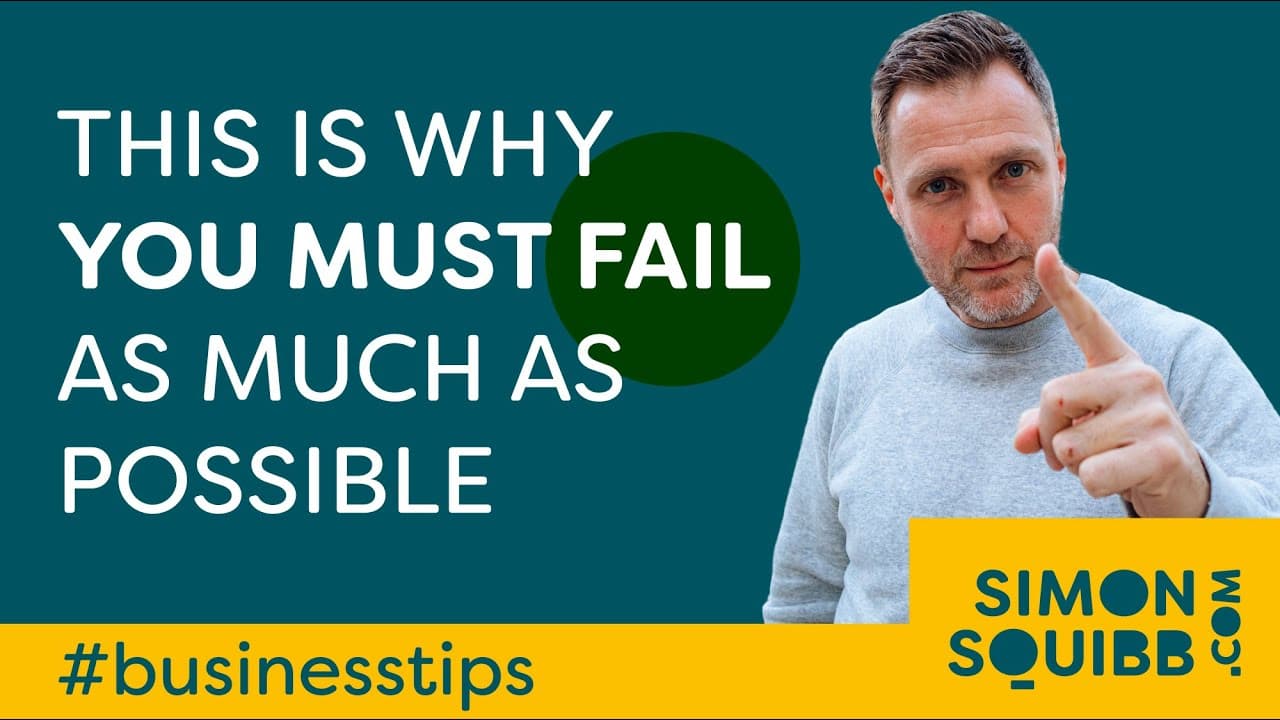
Why Is Failure in Life and Business Never the End, and How Can It Be the Best Teacher?
TL;DR
Failure in business is not the end when you examine what went wrong, learn from it, and try again. The speaker says only 3 of his 17 companies became financial successes, while the others provided lessons that helped enable later success. He also explains why “fail fast” should be balanced with persistence, consistency, and purpose. Read on to understand when to pivot and when to keep going.
Transcript
okay so I've got a question from Martha and she is asking I have been thinking to start a business I read that as a startup it's good to fail but I don't understand why could you explain to me why this what this saying means okay Martha yeah did you know to be honest I see a lot of startup sayings out there that I find strange and so the the saying... Read More
Key Insights
- 🥺 Failure in startups is an essential part of the learning process, leading to eventual success.
- 🖐️ Luck plays a significant role in entrepreneurial success, although other factors are also important.
- 🥺 Failures in startups provide valuable lessons and insights that can lead to improvement.
- 💨 The "fail fast" philosophy highlights the importance of agility and adaptation in startups.
- 💨 Persistence, consistency, and following a purpose can counterbalance the "fail fast" mentality.
- 🧂 It is crucial to take startup sayings with a grain of salt and adapt them to individual situations.
- 💨 Sharing experiences and helping others can be a meaningful way to foster innovation and growth.
Install to Summarize YouTube Videos and Get Transcripts
Explore YouTube Video Summarizer or Get YouTube Transcript Extractor
Questions & Answers
Q: Why is it considered good to fail in a startup?
A startup failure can reveal exactly where the business went wrong and provide lessons for making better decisions. The speaker says failure only becomes final if you give up instead of learning and getting back up.
Q: How can failure contribute to later business success?
Failure teaches how to operate better in a business environment, become stronger and faster, and think differently. The speaker says his failures allowed him to have his successes because he learned more from failure than from success.
Q: What does “fail fast” mean for startups?
“Fail fast” means recognizing when an idea is unlikely to work and then stopping, starting something else, or pivoting. The reasoning is that time is too valuable to keep pursuing an approach that is slowly failing.
Q: Should an entrepreneur always follow the “fail fast” philosophy?
No, the speaker says the philosophy needs a counterbalance. Persistence, consistency, and following a purpose rather than revenue can sometimes justify continuing with the business.
Q: How much did the speaker learn from his 17 companies?
Of the 17 companies he started, 3 became financial successes. He describes the remaining companies as incredible learning experiences that helped make those successes possible.
Q: What role does luck play in business success?
The speaker attributes a huge part of his major business successes to luck, while also acknowledging ingredients such as hard work. He finds it difficult to pinpoint precisely why successes happened but can identify where failures went wrong.
Q: Why does the speaker compare business failure to learning to walk?
A baby falls, experiences bumps, becomes more careful, and eventually learns to walk. Likewise, a new business must endure mistakes and learn from them rather than treating the first setback as a reason never to try again.
Q: How did starting a business at age 15 affect the speaker’s career?
The speaker says he started his first business at 15 and that those early lessons allowed him to retire at 40. In his view, starting later would have meant fewer early failures and a longer path toward knowing what he was doing.
Summary & Key Takeaways
-
Failing in startups allows for valuable learning experiences and insights.
-
Success in startups can be attributed to a combination of luck and hard work.
-
Having a purpose and being persistent can counterbalance the "fail fast" philosophy in startups.
Read in Other Languages (beta)
Share This Summary 📚
Summarize YouTube Videos and Get Video Transcripts with 1-Click
Try YouTube Summary with ChatGPT & Claude or YouTube Transcript Generator
Explore More Summaries from Simon Squibb 📚


Summarize YouTube Videos and Get Video Transcripts with 1-Click
Try YouTube Summary with ChatGPT & Claude or YouTube Transcript Generator