How Do Tariffs and Growth Affect the US Deficit?
TL;DR
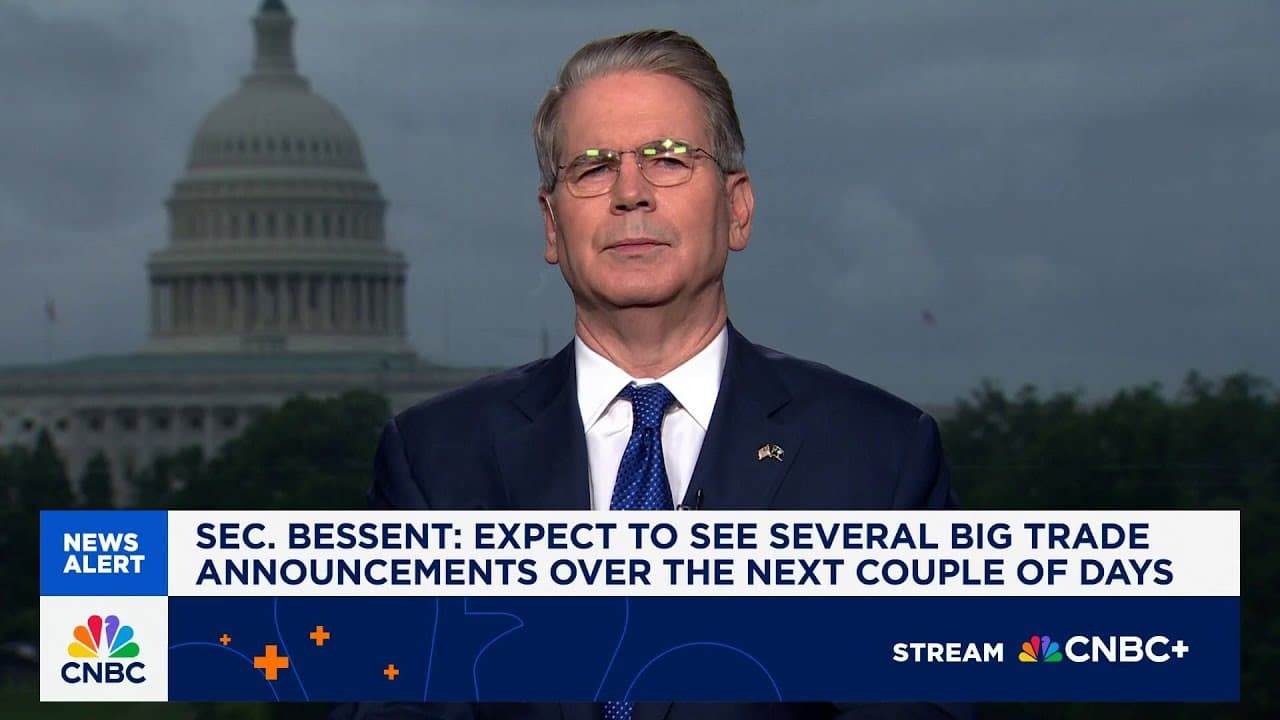
Faster non-inflationary growth, spending restraint, tariff revenue, and deregulation are central to Scott Bessent’s plan for lowering debt relative to GDP. He says new trade announcements are imminent, Vietnam’s generalized tariff is 20% overall, markets may be anticipating lower interest rates, and the dollar’s decline is not historically extraordinary despite its speed.
Transcript
up slightly. The S&P futures are down by 15. The Nasdaq off by 86. >> And joining us now for the latest on tariffs and the recently passed budget bill. And more. Treasury Secretary Scott Bessent the Secretary thanks for joining us. I don't know how much you could necessarily hear of our last conversation. We're definitely want to talk trade tariffs... Read More
Key Insights
- The reported deficit was 6.7% of GDP last year, which Bessent describes as unusually high for a period without recession or war. He argues that controlling government spending and improving the economy’s growth trajectory are both necessary to address the fiscal imbalance.
- Debt relative to GDP is Bessent’s preferred measure of fiscal sustainability. He argues that the central question is whether government policies generate enough growth for GDP to expand faster than the deficit, rather than treating every form of deficit spending as economically equivalent.
- The administration’s economic agenda is a three-part combination of trade, tax policy, and deregulation. Bessent says deregulation should accelerate economic activity and that the intended result is stronger growth without the inflationary pattern he associates with the previous four years.
- Several trade announcements were expected within 48 hours of the interview. Bessent says negotiators submitted many new offers after President Trump warned that countries could return to their April 2 reciprocal tariff levels, although any return to those rates would wait until August 1.
- Vietnam’s generalized tariff is 20% overall, according to Bessent. He says this rate supersedes other generalized tariffs rather than being added on top of them, although separate Section 232 tariffs may continue to apply to particular industries.
- Tariff revenue was estimated by the CBO at $2.8 trillion over a ten-year window based on the trade deals then in effect. Bessent says upcoming agreements could produce a slightly higher figure and argues that this revenue would substantially reduce deficit pressure.
- Interest-rate markets may be reflecting expectations for lower policy rates and different future Federal Reserve leadership. Bessent says markets were pricing in two additional cuts for the year, but he stresses that monetary policy is determined by a committee rather than solely by its chair.
- Currency movements are not inherently unusual because exchange rates naturally rise and fall. Bessent acknowledges the speed of the dollar’s decline but points to euro strength amid European fiscal spending and notes that the Chinese RMB had depreciated about 11 to 11.5% against the euro during the year.
Install to Summarize YouTube Videos and Get Transcripts
Explore YouTube Video Summarizer or Get YouTube Transcript Extractor
Questions & Answers
Q: How does Scott Bessent propose reducing the US deficit?
Scott Bessent proposes addressing the deficit through spending restraint and faster economic growth. He says the administration reduced spending associated with the IRA and considers some of those projects uneconomical stranded assets. He also expects trade policy, tax policy, and deregulation to improve growth. His preferred objective is to reduce debt relative to GDP by making GDP grow faster than the deficit.
Q: Why does Bessent focus on debt relative to GDP?
Bessent treats debt relative to GDP as the important fiscal measure because it compares government debt with the economy’s capacity to support it. He says deficit spending should be evaluated partly by whether it creates growth and whether GDP expands faster than the deficit. Under this framework, stronger growth can improve the fiscal position even while policymakers also work to control spending.
Q: What is the administration’s three-part economic agenda?
The administration’s economic agenda consists of trade, tax policy, and deregulation, which Bessent describes as a three-legged stool. He argues that tax policy can support growth, trade policy can generate agreements and tariff revenue, and deregulation can accelerate economic activity. He says the intended combination should raise the growth trajectory in a non-inflationary manner while helping reduce debt relative to GDP.
Q: What did Bessent say about upcoming tariff agreements?
Bessent says several trade announcements are expected within 48 hours of the interview. He emphasizes that President Trump values the quality of agreements more than their quantity. According to Bessent, negotiators produced many new offers after countries were warned that they could return to their April 2 reciprocal tariff levels, although those rates would not return before August 1.
Q: Is Vietnam’s 20% tariff added to existing duties?
Bessent says Vietnam’s 20% generalized tariff is an overall rate, not an additional charge placed on top of other generalized tariffs. He states that it supersedes those other tariffs. However, he adds an important qualification: separate Section 232 tariffs may still apply to specific industries, so the 20% clarification concerns the generalized tariff treatment rather than every possible industry-specific duty.
Q: How much tariff revenue could the United States collect?
Bessent cites a CBO estimate of $2.8 trillion in tariff revenue over a ten-year window based on the trade deals in effect at the time. He says deals expected to be announced would make the amount slightly higher. Although he expresses dissatisfaction with CBO scoring generally, he argues that revenue on this scale would substantially ease pressure on the federal deficit.
Q: Why might markets expect lower interest rates?
Bessent says markets live in the future and may be pricing in the president’s view that interest rates should be lower. He reports that markets appeared to expect two additional rate cuts during the year and notes an inversion between the overnight rate and the two-year rate. He also says expectations about a future Federal Reserve chair could provide guidance, while stressing that decisions come from a committee.
Q: How does Bessent interpret the dollar’s decline?
Bessent says currencies naturally move up and down and characterizes the dollar’s movement as not extraordinary, although he acknowledges that its speed may be notable. He points to euro appreciation amid increased European fiscal spending, particularly on defense and from Germany. He also notes that the Chinese RMB had fallen roughly 11 to 11.5% against the euro during the year.
Summary & Key Takeaways
-
Scott Bessent argues that the inherited deficit, reported as 6.7% of GDP last year, reflects a spending problem rather than insufficient tax collection. His proposed response combines spending reductions with stronger economic growth, emphasizing debt relative to GDP as the important measure and describing trade, tax policy, and deregulation as the administration’s three-part economic agenda.
-
On trade, Bessent says several announcements are expected within 48 hours and that negotiations intensified after countries faced the possibility of returning to their April 2 reciprocal tariff levels. He clarifies that Vietnam’s generalized tariff is 20% overall, while noting that separate Section 232 tariffs may remain for specific industries.
-
Bessent says tariff income could ease the deficit, citing a CBO estimate of $2.8 trillion over ten years under current deals and saying forthcoming agreements may raise that figure. He also discusses market expectations for two rate cuts, respectful meetings with Federal Reserve Chair Jay Powell, and currency movements involving the dollar, euro, and Chinese RMB.
Read in Other Languages (beta)
Share This Summary 📚
Summarize YouTube Videos and Get Video Transcripts with 1-Click
Try YouTube Summary with ChatGPT & Claude or YouTube Transcript Generator
Explore More Summaries from CNBC Television 📚



Summarize YouTube Videos and Get Video Transcripts with 1-Click
Try YouTube Summary with ChatGPT & Claude or YouTube Transcript Generator