Which Pop Filter Is Best for Recording Audio?
TL;DR
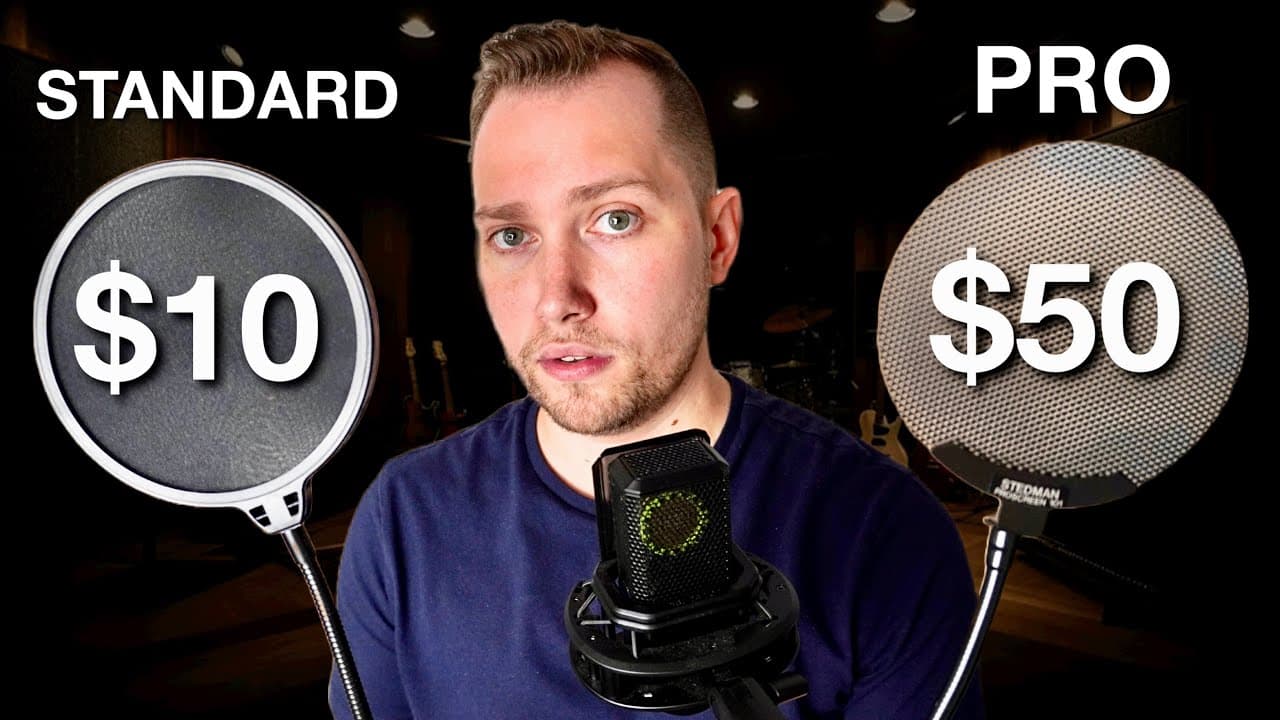
The best pop filter for recording audio varies by budget and purpose. A $50 professional-grade pop filter significantly reduces plosives and enhances audio quality better than a $10 budget option, primarily due to its metal mesh design. For serious voice work, investing in the more effective filter is advisable.
Transcript
have you noticed that when you say words with the letter P or the letter B that puff of air hits your microphone in a very unpleasant way well my friend that is called a plosive and this is exactly why we use pop filters this accessory is used for plosive rejection and it's ultimately going to make your recording sound more professional and easier ... Read More
Key Insights
- 😒 Plosives interfere with audio recordings, necessitating the use of pop filters for improved sound quality.
- 👷 Budget and professional pop filters vary significantly in construction materials and effectiveness.
- 🤘 Metal mesh designs, like that of the $50 filter, are more effective at dispersing air pressure, reducing plosives.
- 🎨 The design features make the professional filter transparent, beneficial for script reading.
- 🧍 The usability of pop filters can vary significantly depending on microphone stand orientation.
- 🧑🏭 For voice actors and singers, investing in a quality pop filter can result in better performance and recording outcomes.
- 🪡 There is a clear distinction between casual and professional recording needs when selecting equipment.
Install to Summarize YouTube Videos and Get Transcripts
Explore YouTube Video Summarizer or Get YouTube Transcript Extractor
Questions & Answers
Q: What is a plosive, and why do they matter in audio recordings?
A plosive occurs when a burst of air from pronouncing certain consonants, like P or B, hits the microphone, causing an unpleasant sound. This distortion can detract from overall audio quality, making recordings sound less professional. Understanding and addressing plosives is crucial for achieving clear, polished sound in any recording.
Q: How do the designs of the $10 and $50 pop filters differ?
The $10 pop filter features a longer design with a wider screen made of two layers of nylon. In contrast, the $50 filter is shorter and has a smaller screen constructed from metal mesh. These design choices contribute to their varying effectiveness in plosive rejection and usability during recordings.
Q: What were the audio test results between the two pop filters?
The audio tests revealed noticeable differences. The $10 pop filter provided some plosive reduction but did not eliminate them entirely. In contrast, the $50 pop filter significantly minimized plosive sounds, leading to clearer audio, which is particularly beneficial for professional-grade recordings.
Q: Why might someone choose the $50 pop filter despite its higher cost?
Choosing the $50 pop filter can be justified for those engaging in professional voice work. Its superior design for plosive rejection, which minimizes unwanted noise, can dramatically enhance audio quality, making it a worthwhile investment for achieving a more refined and clear sound in recordings.
Summary & Key Takeaways
-
Pop filters are essential accessories to minimize plosives, which are bursts of air that disrupt audio quality during recording, especially with words starting with P or B.
-
A comparison between a $10 budget pop filter and a $50 professional-grade filter reveals important differences in design and effectiveness in plosive rejection.
-
The professional-grade pop filter performs better in eliminating plosives due to its metal mesh design, while the budget option, though functional, does not completely eliminate the problem.
Read in Other Languages (beta)
Share This Summary 📚
Summarize YouTube Videos and Get Video Transcripts with 1-Click
Try YouTube Summary with ChatGPT & Claude or YouTube Transcript Generator
Explore More Summaries from Home Studio Academy 📚
Summarize YouTube Videos and Get Video Transcripts with 1-Click
Try YouTube Summary with ChatGPT & Claude or YouTube Transcript Generator