How Will Google Compete in the Next Era of AI?
TL;DR
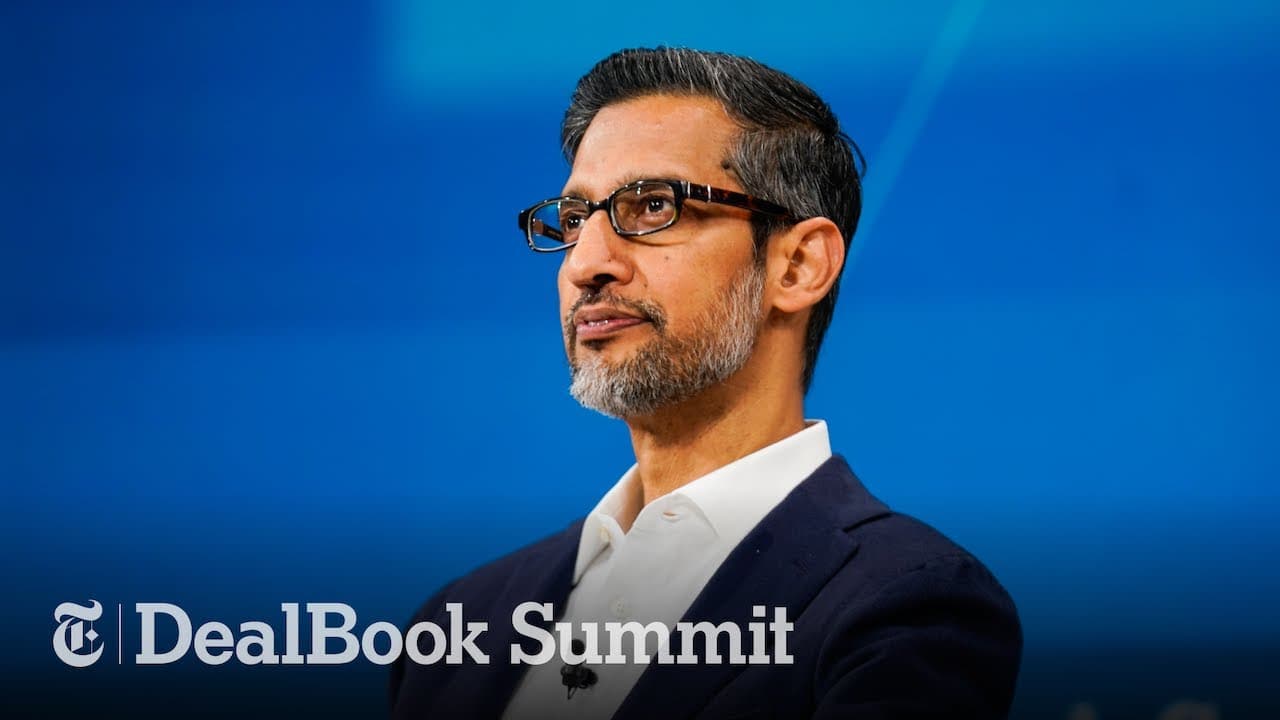
Google plans to compete in AI through a full-stack strategy spanning research, infrastructure, models, developer access, and widely used products. Sundar Pichai expects substantial progress in 2025, especially in reasoning and agentic systems, but says future gains will require deeper algorithmic breakthroughs rather than simply adding more computing power.
Transcript
oh please welcome Andrew Ross sorin and his guest CEO of Google Sundar pacai SAR Pai is here everybody the CEO of course of alphabet and Google the leading uh one of I at least should say but probably the leading company one of the most influential uh and most scrutinized I should also mention in the World under his leadership Google has now shaped... Read More
Key Insights
- Google's AI strategy is a full-stack approach that includes foundational research, specialized infrastructure, models, developer access, and consumer products. Pichai presents these connected capabilities as Google's basis for competing at the technological frontier rather than relying on a single model or product.
- Google is operating its sixth generation of tensor processing units and distributes its foundational models internally and to over 3 million developers. Pichai also points to 15 products with at least half a billion users as a major channel for deploying AI capabilities.
- AI development in 2025 is expected to become more difficult because the easiest gains are gone. Pichai predicts that leading teams will distinguish themselves through deeper technical advances as the improvement curve becomes steeper and simple scaling produces fewer straightforward benefits.
- AI models are expected to improve at reasoning, planning, and reliably completing sequences of actions. Pichai describes these capabilities as more agentic behavior and says they will contribute to substantial progress, even though future improvements may require overcoming increasingly difficult technical barriers.
- Computing power is not expected to be the primary long-term differentiator because companies with sufficient capital can obtain more compute. Pichai argues that meaningful competitive separation will instead come from algorithmic breakthroughs that improve reasoning, planning, and overall system performance.
- Google has already applied AI aggressively within search through transformer-based systems used to improve language understanding and search quality. Pichai cites internally named systems such as BERT and MUM, along with multimodal search, as evidence that AI has long shaped the product.
- Google Search is expected to change profoundly in 2025 by handling more complex questions and introducing new capabilities. Pichai rejects the idea that protecting the existing search business should justify hesitation, arguing that companies must lean into disruptive technological moments to survive.
- Search may become more valuable as AI increases the amount of available content. Pichai argues that users inundated with information will need reliable ways to identify trustworthy, relevant material, making effective filtering and interpretation increasingly important rather than less necessary.
Install to Summarize YouTube Videos and Get Transcripts
Explore YouTube Video Summarizer or Get YouTube Transcript Extractor
Questions & Answers
Q: How is Google planning to compete in artificial intelligence?
Google plans to compete through a full-stack AI strategy that combines foundational research, specialized computing infrastructure, foundational models, internal deployment, developer access, and consumer distribution. Pichai says Google is committed to remaining at the state of the art and highlights its sixth generation of tensor processing units, more than 3 million developers, and 15 products serving at least half a billion users.
Q: Why does Sundar Pichai think AI progress will become harder?
Pichai says the easiest opportunities for rapid model improvement are disappearing and the development curve is becoming steeper. Adding compute can still produce progress, but future gains will increasingly require deeper technical and algorithmic breakthroughs. He expects leading AI teams to stand out in 2025 through better reasoning, planning, and reliable execution rather than through computing scale alone.
Q: Does Sundar Pichai believe artificial intelligence has reached a wall?
Pichai does not fully accept the idea that AI development has reached a wall. He expects substantial progress in 2025, including stronger reasoning and more reliable completion of action sequences. However, he distinguishes future development from earlier scaling, saying that simply adding compute will not be enough and that researchers will need deeper breakthroughs to overcome smaller technical barriers.
Q: What AI capabilities does Google expect to improve in 2025?
Google expects models to improve in reasoning, planning, and completing sequences of actions more reliably. Pichai characterizes this direction as becoming more agentic, meaning systems can carry out connected steps rather than only generate isolated responses. He also says Google Search will tackle more complex questions and gain capabilities that could become visible early in 2025.
Q: Why are algorithmic breakthroughs important for future AI systems?
Algorithmic breakthroughs are important because Pichai expects computing resources to become broadly available to companies with enough capital. As competitors obtain more compute, hardware scale alone will provide less differentiation. Progress will depend more heavily on technical methods that make systems reason, plan, and operate more effectively, especially as the easiest improvements from straightforward scaling become harder to reproduce.
Q: How has Google already used AI to improve search?
Google has used AI to strengthen search quality, language understanding, and multimodal capabilities. Pichai says transformer-based systems known internally as BERT and MUM helped close search-quality gaps. He also says Gemini powers AI Overviews used by over a billion search users, presenting these developments as evidence that Google has applied AI aggressively within its core search product.
Q: Will Google protect traditional search from AI disruption?
Pichai argues that Google must lean into technological disruption rather than preserve the existing form of search. He describes some version of the innovator's dilemma as unavoidable for technology companies and says the only viable response is to embrace the new moment. Google therefore expects search to change profoundly and handle more complex questions through AI capabilities.
Q: Why could search become more valuable as AI content grows?
Search could become more valuable because users may face an overwhelming volume of content, including AI-generated material. Pichai argues that people will still need tools that sift through information and identify trustworthy, relevant content that makes sense for their needs. In his view, information sources are not purely zero-sum because people consume information through many different products and formats.
Summary & Key Takeaways
-
Sundar Pichai presents Google as a full-stack AI company with investments in foundational research, sixth-generation tensor processing units, models, developer tools, and large-scale product distribution. He argues that this combination positions Google to remain at the state of the art as AI development becomes technically harder and more competitive.
-
Pichai expects significant AI progress in 2025, particularly in reasoning, planning, reliable completion of action sequences, and more agentic behavior. Although he does not accept the idea of an absolute technological wall, he says easy gains are disappearing and future improvements will increasingly depend on technical and algorithmic breakthroughs.
-
Google intends to transform search rather than protect its traditional form from disruption. Pichai says AI already supports language understanding, multimodal capabilities, and AI Overviews used by over a billion users. He argues that search may become more valuable as people face growing volumes of content and need trustworthy, relevant information.
Read in Other Languages (beta)
Share This Summary 📚
Summarize YouTube Videos and Get Video Transcripts with 1-Click
Try YouTube Summary with ChatGPT & Claude or YouTube Transcript Generator
Explore More Summaries from New York Times Events 📚


Summarize YouTube Videos and Get Video Transcripts with 1-Click
Try YouTube Summary with ChatGPT & Claude or YouTube Transcript Generator