Which Smartphone Gimbal Is Best for Filming?
TL;DR
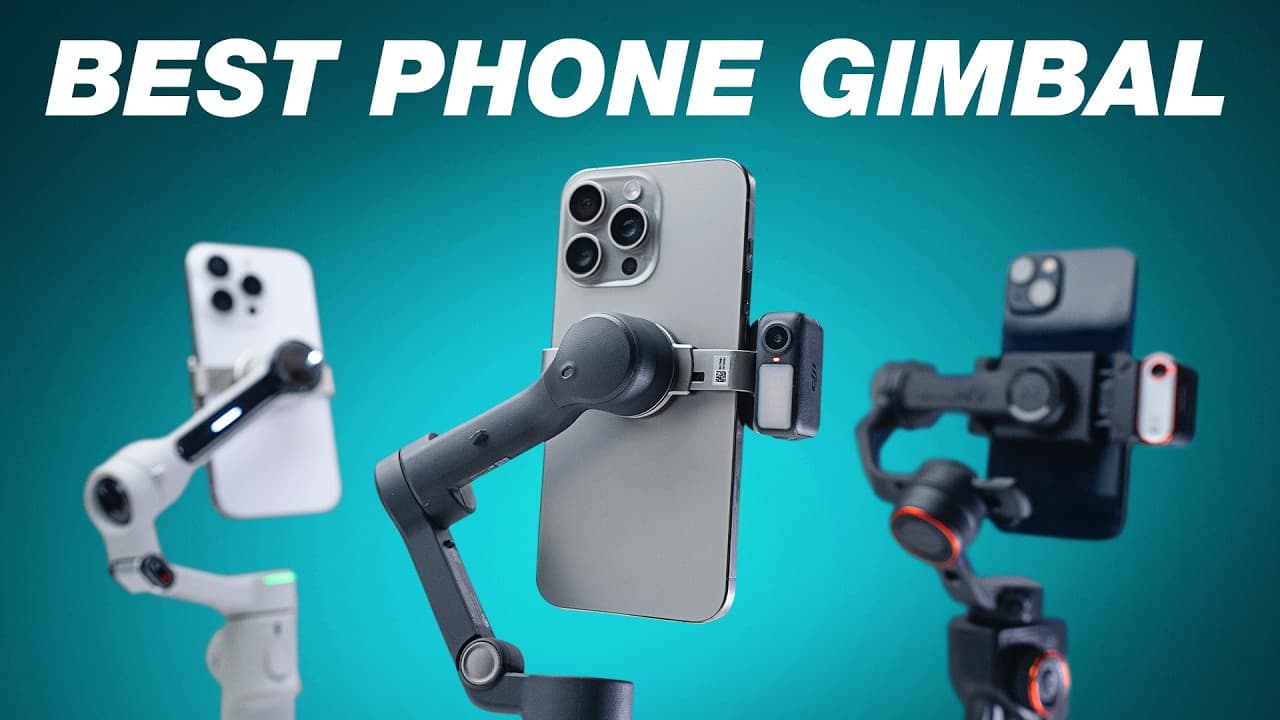
The DJI Osmo Mobile 7P is the strongest overall choice for most users because it combines reliable tracking, simple operation, useful audio integration, and competitive pricing. The Insta360 Flow 2 Pro is best for portability and full rotation, while the Hohem iSteady M7 provides the smoothest stabilization, longest stated battery life, and support for heavier setups.
Transcript
if you're looking for the best gimbal for your smartphone I'm going to be taking a look at the top three the DJI osmo mobile 7p the insta 360 flow 2 Pro and the Hem I stady M7 to figure out which one is right for you you got to just press record hey welcome back to think media Nate here now this video is sponsored by DJI and they sent us out each o... Read More
Key Insights
- The DJI Osmo Mobile 7P is a compact folding gimbal with an extension rod, built-in tripod, and multifunction tracking module. Its module also contains an LED light and DJI Mic Mini receiver, allowing a transmitter to connect to the phone through a simple USB-C cable.
- The Insta360 Flow 2 Pro is the lightest and most compact model in the comparison. It has a folding design, minimalist controls, full 360-degree rotation, and a small framing mirror, but its separately sold tracker adds $40 when native Apple DockKit tracking is unavailable.
- The Hohem iSteady M7 is the heaviest and most powerful option tested. Its stronger motor supports heavier phones and accessories, while axis locks improve transport security and a detachable remote provides image preview plus remote recording controls for creators filming without assistance.
- The Hohem iSteady M7 produces the smoothest stabilization in the demonstrated walking and running tests. The DJI and Insta360 results appear comparable and both improve upon handheld recording, but the Hohem footage looks smoothest because of the gimbal's more powerful motor.
- The DJI Osmo Mobile 7P provides the most reliable and intuitive tracking in the comparison. Its tracker works with any app on Android or iPhone, responds to gesture controls, and consistently keeps the subject centered, although it cannot perform a full 360-degree pan.
- The Hohem iSteady M7 has the longest stated battery life at 12 hours, compared with 10 hours for both competitors. All three gimbals charge through USB-C and can charge a connected phone, while their stated full charging times range from about two to three hours.
- The DJI Osmo Mobile 7P is the easiest model for an average consumer to operate. It powers on when unfolded and uses an intuitive interface, while the Hohem requires balancing, manual phone repositioning between portrait and landscape, and familiarity with more controls and settings.
- The DJI lineup offers the strongest price and feature combination presented. The Osmo Mobile 7P costs $149, while the simpler Mobile 7 costs $89. The Insta360 costs $159 before its optional $40 tracker, and the Hohem costs about $299 new or around $250 on sale.
Install to Summarize YouTube Videos and Get Transcripts
Explore YouTube Video Summarizer or Get YouTube Transcript Extractor
Questions & Answers
Q: Which smartphone gimbal is best for most users?
The DJI Osmo Mobile 7P is the best overall option in this comparison for most users. It wins the tracking, ease-of-use, and value categories while offering a folding body, built-in tripod, extension rod, LED light, and reliable tracking across apps and phones. Its integrated DJI Mic Mini receiver is especially useful for vloggers who need stabilized footage and clear audio.
Q: Which smartphone gimbal has the best stabilization?
The Hohem iSteady M7 delivers the smoothest stabilization in the demonstrated walking and running tests. Its more powerful motor produces steadier-looking footage than the other models, particularly during running. The DJI Osmo Mobile 7P and Insta360 Flow 2 Pro perform comparably and clearly improve upon handheld recording, but the Hohem receives the stabilization point based on the side-by-side footage.
Q: Which smartphone gimbal is easiest to carry?
The Insta360 Flow 2 Pro is the easiest gimbal to carry because it is the lightest and most compact model compared. Its folding design makes it convenient for packing into a sling bag, and it is slightly lighter and smaller than the DJI Osmo Mobile 7P. It also supports full 360-degree rotation, although a dedicated tracker is not included with the base package.
Q: Which gimbal has the most reliable subject tracking?
The DJI Osmo Mobile 7P provides the most reliable subject tracking in the comparison. Its multifunction module works on Android and iPhone and can track within any app. Gesture controls are intuitive, and the gimbal consistently keeps a moving subject centered. Its main tracking limitation is the inability to complete a full 360-degree pan around the subject.
Q: How does Insta360 Flow 2 Pro tracking work on iPhone?
The Insta360 Flow 2 Pro can use Apple DockKit on an iPhone, enabling tracking through the native camera app without requiring the separately sold tracker. Setup takes a moment, but the system recognizes people and selects a subject intuitively afterward. During more demanding movement, it can occasionally lose the subject and reacquire them with a jerky motion, though normal walking should be manageable.
Q: Which smartphone gimbal has the longest battery life?
The Hohem iSteady M7 has the longest stated battery life at 12 hours and requires approximately two and a half to three hours for a full charge. The DJI Osmo Mobile 7P and Insta360 Flow 2 Pro each provide around 10 hours. DJI requires about two and a half hours to recharge, while Insta360 requires about two hours.
Q: How much do the compared smartphone gimbals cost?
The DJI Osmo Mobile 7P costs $149, while the simpler DJI Osmo Mobile 7 costs $89. The Insta360 Flow 2 Pro costs $159, and its optional tracking module adds $40, bringing a fully equipped setup to around $200. The Hohem iSteady M7 costs approximately $299 new and was reported as being on sale for around $250.
Q: Who should choose the Hohem iSteady M7?
The Hohem iSteady M7 is best suited to users who prioritize powerful stabilization, longer battery life, heavier phone setups, and accessory support over portability. It includes a detachable remote with a preview screen, remote recording controls, axis locks, integrated tracking, and an RGB-capable light. Beginners may find it more involved because it requires balancing and manual switching between portrait and landscape orientations.
Summary & Key Takeaways
-
The comparison evaluates the DJI Osmo Mobile 7P, Insta360 Flow 2 Pro, and Hohem iSteady M7 across design, stabilization, tracking, battery performance, ease of use, price, and value. Points are awarded by category, with each model demonstrating advantages suited to a different type of smartphone filmmaker.
-
The Insta360 Flow 2 Pro wins portability because it is particularly compact and lightweight. The Hohem iSteady M7 wins stabilization and battery life through its powerful motors and stated 12-hour runtime. Its heavier body, detachable preview remote, axis locks, accessory capacity, and RGB light make it the more robust option.
-
The DJI Osmo Mobile 7P wins tracking, ease of use, and overall value. Its tracking module works across apps and phones, includes a light and DJI Mic Mini receiver, and reliably maintains framing. The automatic startup, intuitive controls, built-in tripod, extension rod, and $149 price make it suitable for most users.
Read in Other Languages (beta)
Share This Summary 📚
Summarize YouTube Videos and Get Video Transcripts with 1-Click
Try YouTube Summary with ChatGPT & Claude or YouTube Transcript Generator
Explore More Summaries from Think Media 📚



Summarize YouTube Videos and Get Video Transcripts with 1-Click
Try YouTube Summary with ChatGPT & Claude or YouTube Transcript Generator