The 7 Laws of How Money Actually Works
TL;DR
Money follows laws, not rules, built on three parts: momentum, structure, and asymmetry. Money loves speed while wealth loves time, so making one good decision and holding it compounds far more than fast flipping. Whoever gives the money holds the power, and leverage multiplies every return, tax advantage, and outcome.
Transcript
You can follow all the right money rules and still feel like you're never getting ahead. You can save more and invest early and work hard and still that scoreboard never moves. I went from being a janitor to building two billion-dollar companies and managing billions of dollars at Goldman Sachs. And what I learned is that money doesn't follow rules... Read More
Key Insights
- Money follows laws rather than rules, and a system to make more money has three parts: momentum (how you compound money), structure (who controls the money and what outcomes you get), and asymmetry (maximizing upside while minimizing downside).
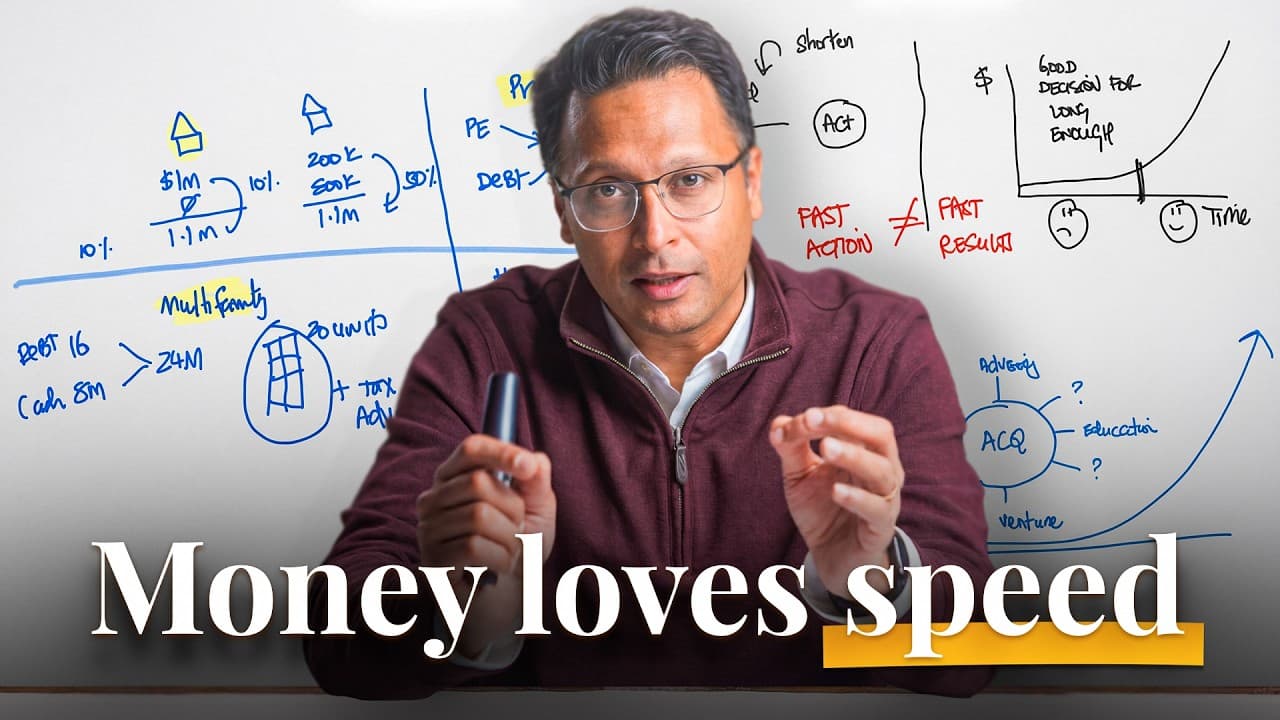
- Money loves speed but wealth loves time, where speed is the shortest distance between seeing an opportunity and acting on it, and time is making a good decision and holding it long enough to compound.
- Fast action does not equal fast results, a distinction most people confuse; a real estate flipper made cash flipping 100 homes in 5 years while a friend who held and recapped grew from 1 property to 20 units with five times the net worth.
- Berkshire Hathaway compounded at almost 20% annually from 1965 to 2024 by buying high-quality companies and holding them forever, beating the S&P 500 by double with a total return of 5 million percent.
- He who gives the money has the power, because buyers and builders have an unfair advantage; zero people made the Forbes 400 on earned income or salary alone, and the vast majority got there by continuously buying and building.
- Buying and building creates massive wealth, shown by Facebook buying Instagram for a billion dollars (now worth over $45 billion) and Google buying YouTube for $1.6 billion, now a core part of its business.
- Leverage multiplies everything: buying a $1 million home all-cash that rises 10% returns 10%, but putting $200,000 down with an $800,000 loan on the same 10% gain returns 50% on the cash invested.
- Billionaires use leverage to avoid taxes, as when Elon Musk borrowed against his Tesla stock as collateral to buy Twitter for $44 billion instead of selling equity, avoiding taxes while acquiring a bigger asset.
Install to Summarize YouTube Videos and Get Transcripts
Explore YouTube Video Summarizer or Get YouTube Transcript Extractor
Questions & Answers
Q: What are the three parts of the system to make more money?
The system to make more money has three parts: momentum, structure, and asymmetry. The job of momentum is to figure out how you can actually compound money more. The job of structure is to figure out who controls the money and what outcomes you get. The job of asymmetry is to maximize the upside and minimize the downside. Together these parts explain how money actually works, following laws rather than rules.
Q: What is the difference between money loving speed and wealth loving time?
Money loves speed but wealth loves time. Speed is the shortest distance between seeing an opportunity and acting on it, so the faster you shorten that distance, the faster money moves. Wealth loving time means you make a good decision and hold it for a long period so it compounds. At first a good decision looks only okay, but as time passes its value becomes clear. Most people confuse fast action with fast results.
Q: Why did the friend who held property end up with more wealth than the flipper?
Over the same 5-year period, the speaker flipped 100 homes by getting deals, rehabbing, and selling, making some cash. His friend instead started with one single family property, bought a fourplex a couple years later, then recapped money and bought a 20-unit complex without flipping. At the end, the friend owned 20 units and had a net worth five times greater, because the speaker worked on speed while his friend worked on time, letting the decision compound.
Q: What does it mean that he who gives the money has the power?
In the money game, the person who gives the money controls the outcome, because buyers and builders have an unfair advantage and control the terms. The speaker sold five companies in 20 years, and the buyers made 10 to 100 times more than he did. Analyzing the Forbes 400, zero people made it on earned income or salary alone. A few made it by selling a business, but the vast majority made it by continuously buying and building companies and opportunities.
Q: How does leverage multiply returns in real estate?
Leverage multiplies everything. If you buy a house all-cash for $1 million and it rises 10% to $1.1 million, you get a 10% return. But if you put $200,000 down and take an $800,000 loan on the same house with the same 10% gain, your return jumps to 50% compared to the cash you invested. That larger percentage return on invested cash was only possible because of leverage, which is why it is such an active strategy.
Q: How do billionaires use leverage to save on taxes?
Billionaires borrow against assets instead of selling them. Elon Musk bought Twitter for $44 billion, and rather than selling his Tesla equity, he borrowed against his Tesla stock, which became the collateral. The bank allowed it because if he defaulted they would take the stock. This let him access billions without selling and without triggering taxes, using his existing Tesla position to buy a significantly bigger asset over time, since taxes are described as the number one drag on wealth.
Q: What role does leverage play in the private equity industry?
Private equity lets investors invest in familiar companies like a laundromat, restaurant, or roofing company and unlock value. Investors bring cash to buy the business, similar to buying a house, then get the bank to finance the rest of the debt as leverage. This allows the company to grow while founders and owners take some money off the table. This entire trillion-dollar industry would not exist without leverage, because leverage multiplies everything.
Q: What four ways should you think about using leverage correctly?
First, know that leverage is the number one economic growth engine, because if leverage stopped in the world, everything would stop. Second, educate yourself on what kind of risk is available to you. Third, understand that leverage is a game of collateral, whether a house for a mortgage, a stock you borrow against, or a building you invest in, which makes leverage more manageable. Fourth, recognize that taxes are the number one drag on wealth, so leverage offers tax advantages.
Summary & Key Takeaways
-
A former janitor who built two billion-dollar companies and managed billions at Goldman Sachs argues money follows seven laws, not rules. His system has three parts: momentum to compound money, structure to control who gets outcomes, and asymmetry to maximize upside while minimizing downside.
-
Money loves speed but wealth loves time. Speed is acting fast on opportunity; time is holding a good decision to let it compound. A flipper made cash on 100 homes while a patient investor holding 20 units ended with five times the net worth, like Berkshire's 20% annual compounding.
-
He who gives the money has the power, since buyers and builders dominate the Forbes 400 while nobody makes it on salary. Leverage multiplies every return, unlocking private equity, commercial real estate tax advantages, and tactics like borrowing against stock to buy bigger assets tax-free.
Read in Other Languages (beta)
Share This Summary 📚
Summarize YouTube Videos and Get Video Transcripts with 1-Click
Try YouTube Summary with ChatGPT & Claude or YouTube Transcript Generator